
Robber Flies – Family Asilidae
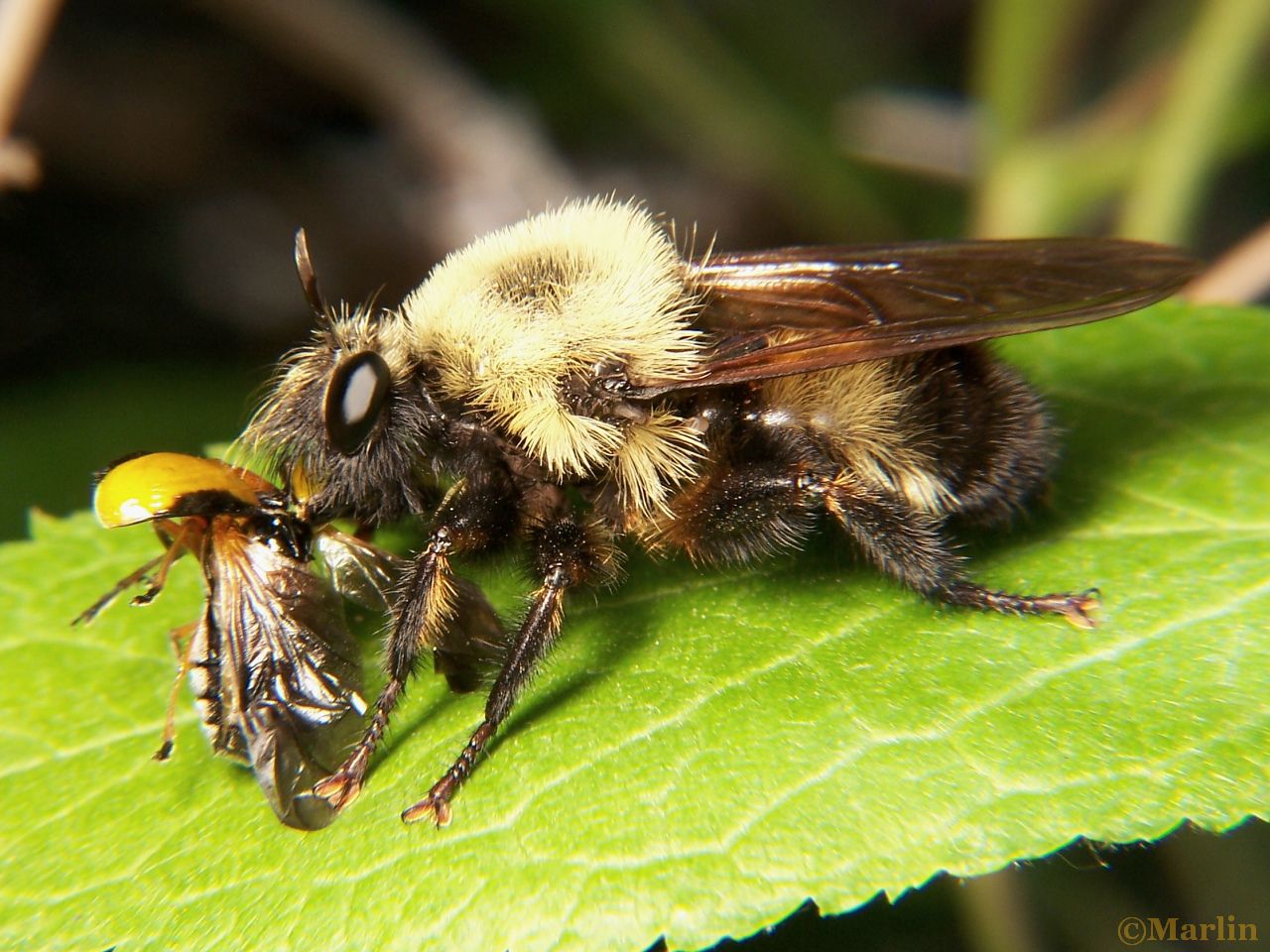
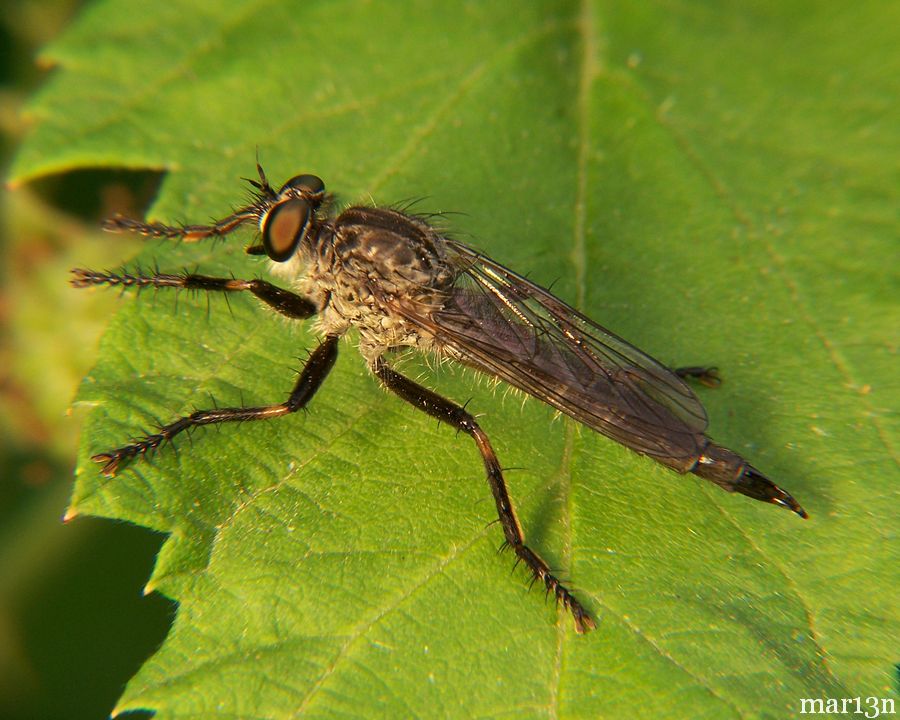
Female Robber Fly Laphria grossa
There are over 7,000 species of robber flies world wide; nearly 1,000 in North America. All robber flies have stout, spiny legs, a dense moustache of bristles on the face (mystax), and 3 simple eyes (ocelli) in a characteristic depression between their two large compound eyes. The mystax helps protect the head and face when the fly encounters prey bent on defense. The antennae are short, 3-segmented, sometimes with a bristle-like structure called an arista.
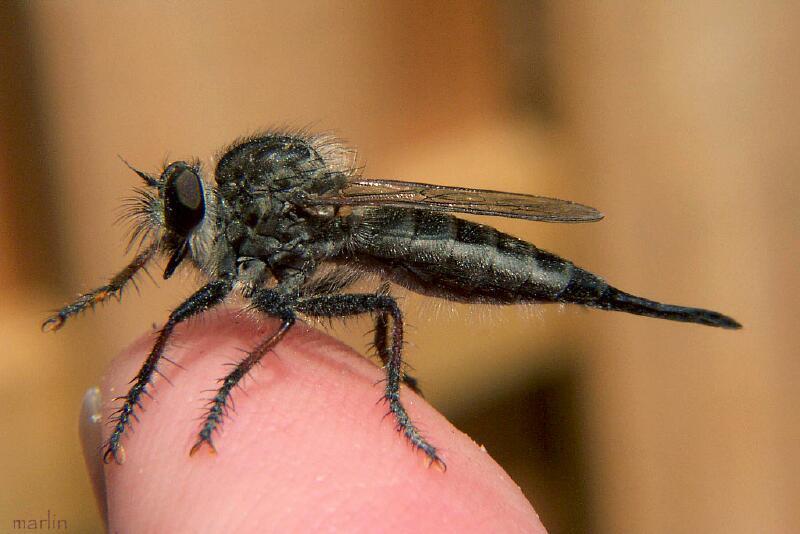
The short, strong proboscis is used to stab and inject victims with saliva containing neurotoxic and proteolytic enzymes which paralyze and digest the insides; the fly then sucks the liquefied meal much like we vacuum up an ice cream soda through a straw. Many species have long, tapering abdomens, sometimes with a sword-like ovipositor. Others are fat-bodied bumble bee mimics; the effect is quite convincing.
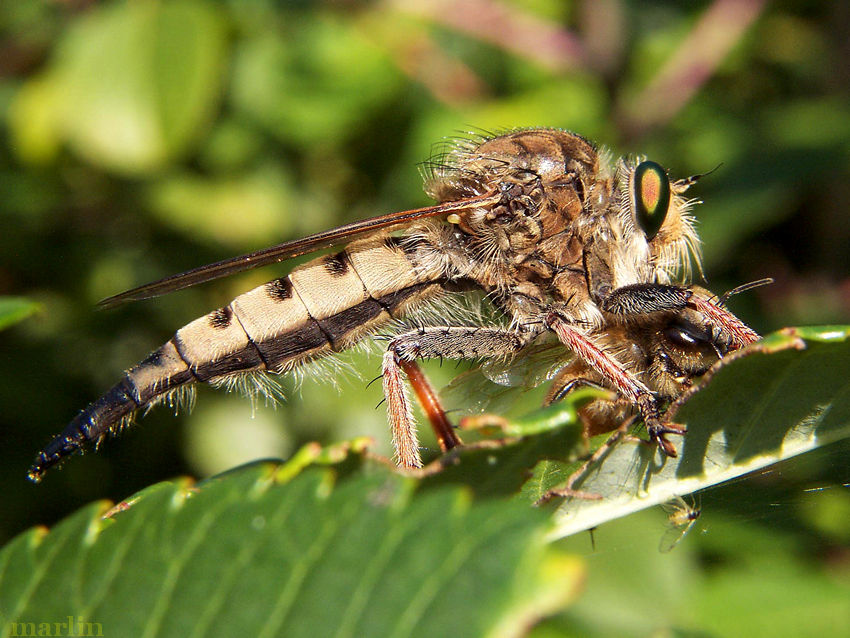
Giant Robber Fly – Promachus sp.
Much has been made of the speed and agility of these flies. Many books and sites cite them as fast and agile flyers, taking insects on the wing. Others attribute to them “still-hunting”, that is, perching and attacking in mid-air; My National Audubon Society Field Guide to Insects asserts they “pounce on resting insects from above.” Well, from my experience, I can say not all robber flies are fast, and not all robber flies are agile. The big robbers (Promachus) lumber and buzz in flight – it is very easy to follow them, and I’ve often seen them pounce on honeybees busy at flowers.
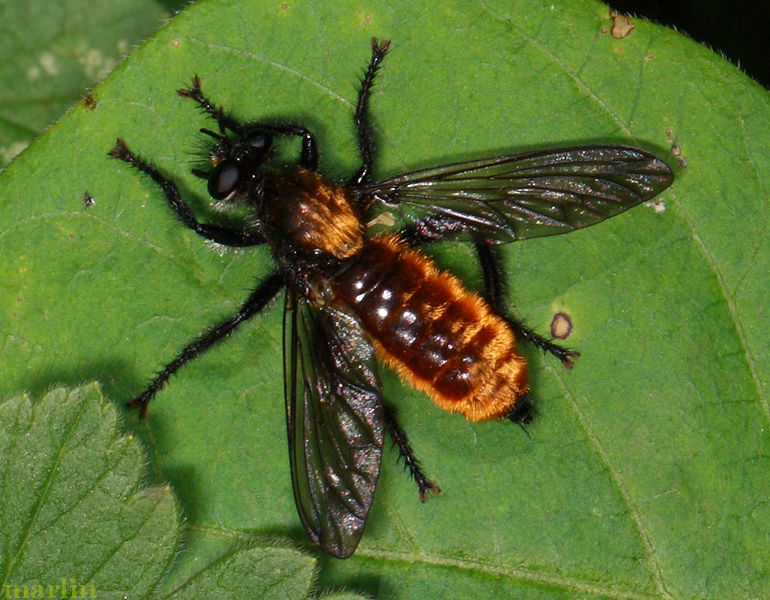
I’ve seen some smaller species (Tolmerus, Laphria canis) perch and attack – many times missing even slow-flying moths. So much for agility. Then there are the fast, agile ones – good luck seeing them do anything but disappear. Whatever the species, robbers are fun to watch. I consider myself lucky to see a capture: most often I find the fly enjoying a meal, or flying off with prey firmly impaled on that terrible beak.
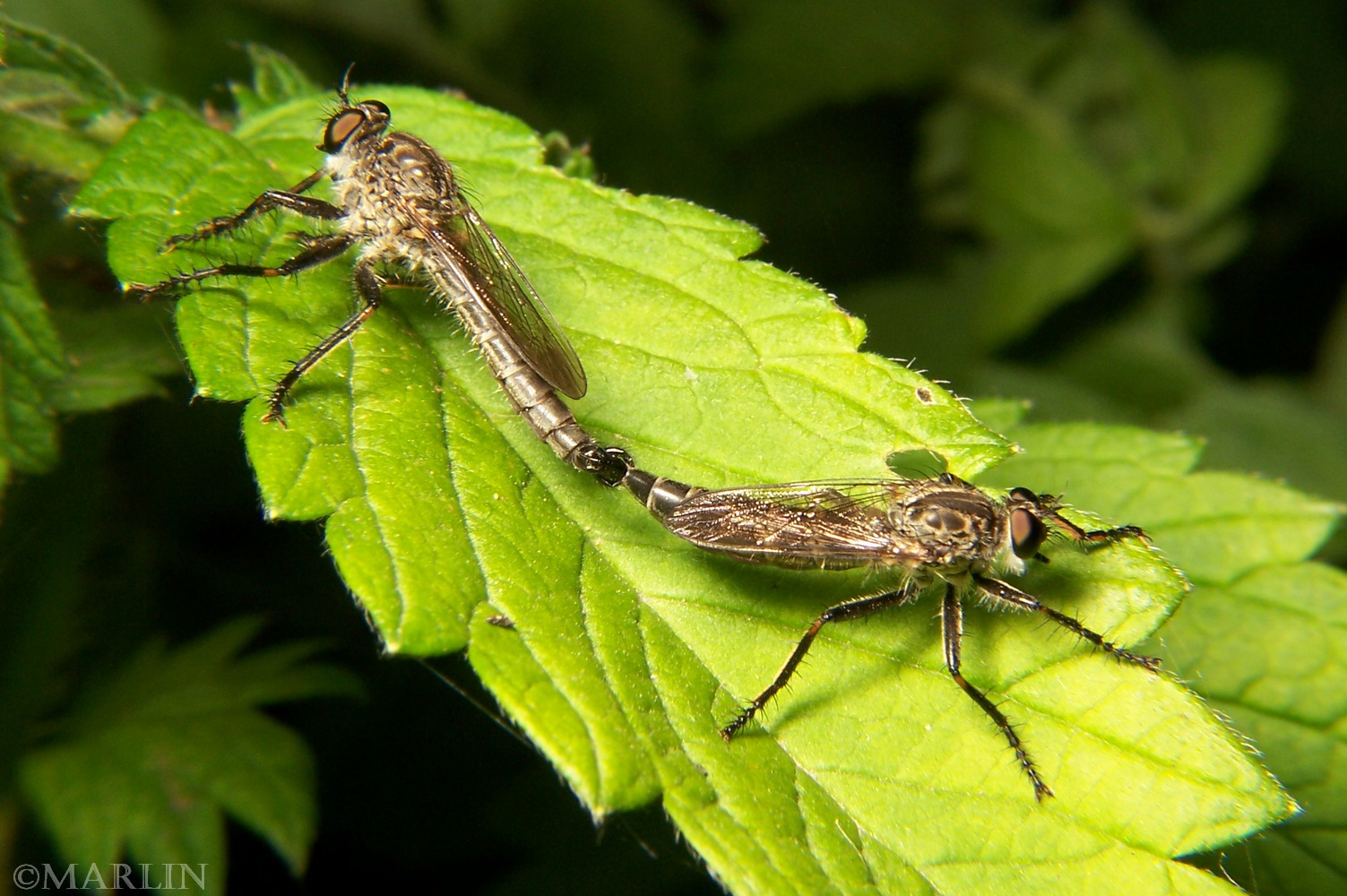
Robber flies mating – Machimus sp.
 Dioctria hyalipennis |
|
 Laphria canis |
|
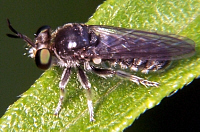 Cerotainia albipilosa |
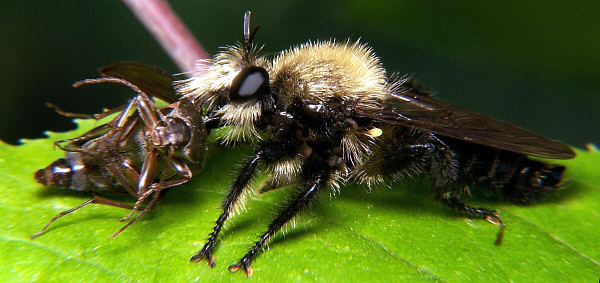 Laphria with beetle prey |
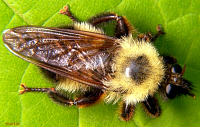 Laphria thoracica |
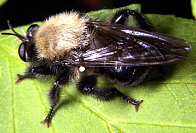 Laphria flavicollis |
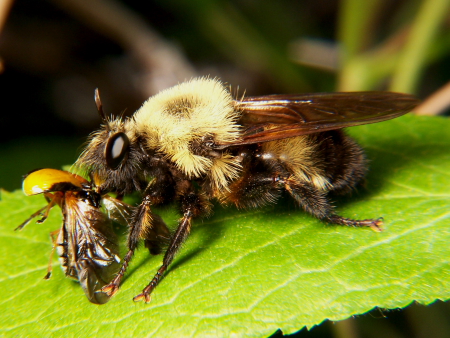 Female Robber Fly, Laphria grossa |
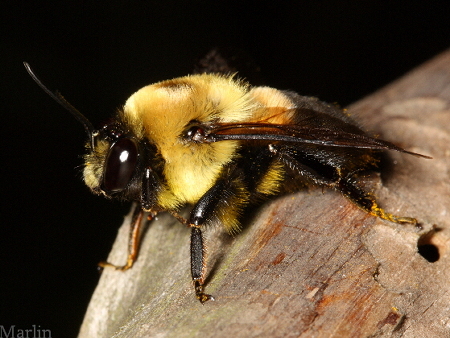 Male Bumble Bee |
Some robber flies are convincing bumble bee mimics. This evolutionary adaptation allows them to reap the benefits of aposematic (warning) coloration without the high metabolic cost of constructing and maintaining a venom-delivery system.
Adult robber flies attack other flies, beetles, butterflies and moths, various bees, dragon and damselflies, ichneumon wasps, grasshoppers, and some spiders. Courtship behavior consists of the male glomming onto the female as if she were prey. Copulation is accomplished tail-to-tail, with the genitalia interlocked. The duo has no trouble flying around in this condition; the male generally towing the female backwards.
 Holcocephala fusca |
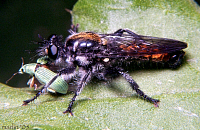 Laphria with weevil prey |
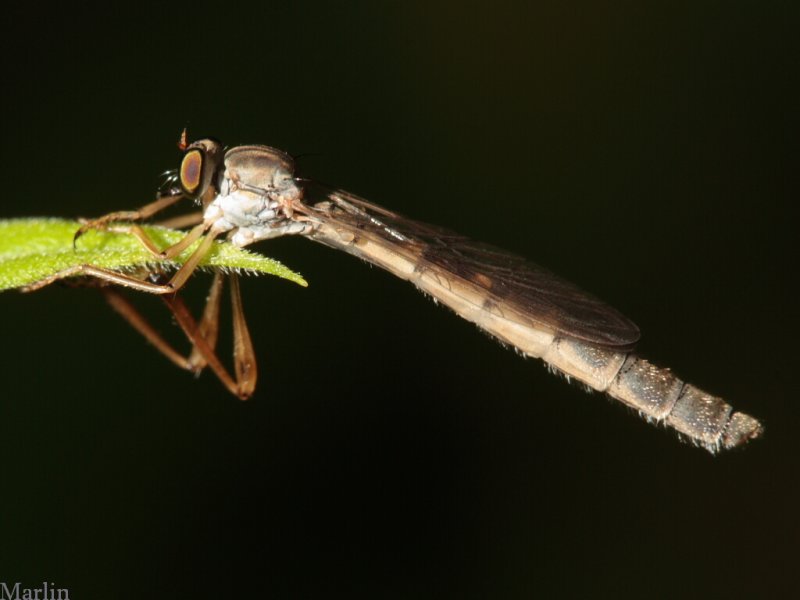
Robber Fly – Leptogaster sp. This is a very slender, small, secretive fly
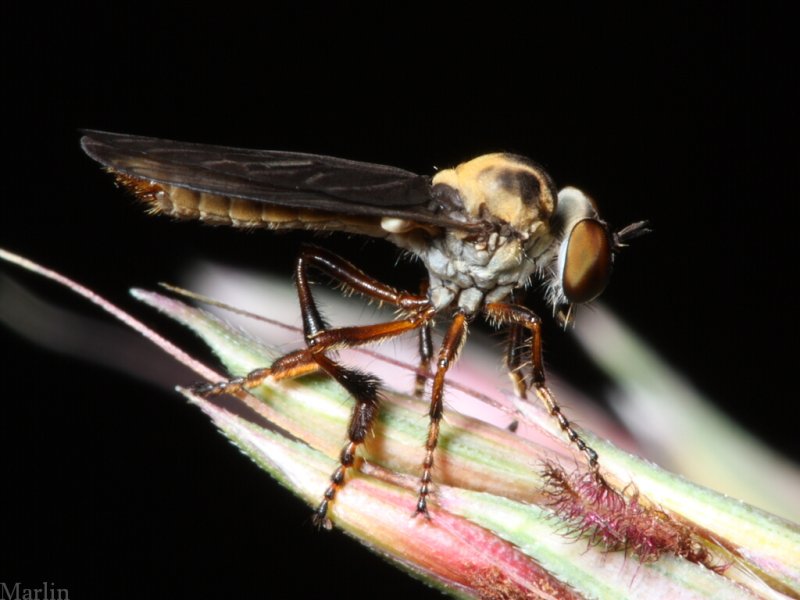
Holcocephala abdominalis — All flies in this genus are less than 10mm long
References
- Chen Young, Carnegie Museum of Natural History, “Crane Flies of Pennsylvania“
- P. Oosterbroek, “Catalogue of the Craneflies of the World“
- University of California, DANR, “Biological Control Agents for Aphids in Vegetable Crops“
- Bugguide.net, “Family Tachinidae“
Flies Index | Flies Main | Tachinidae | Syrphidae | Bombyliidae