
Asian Longhorned Beetle
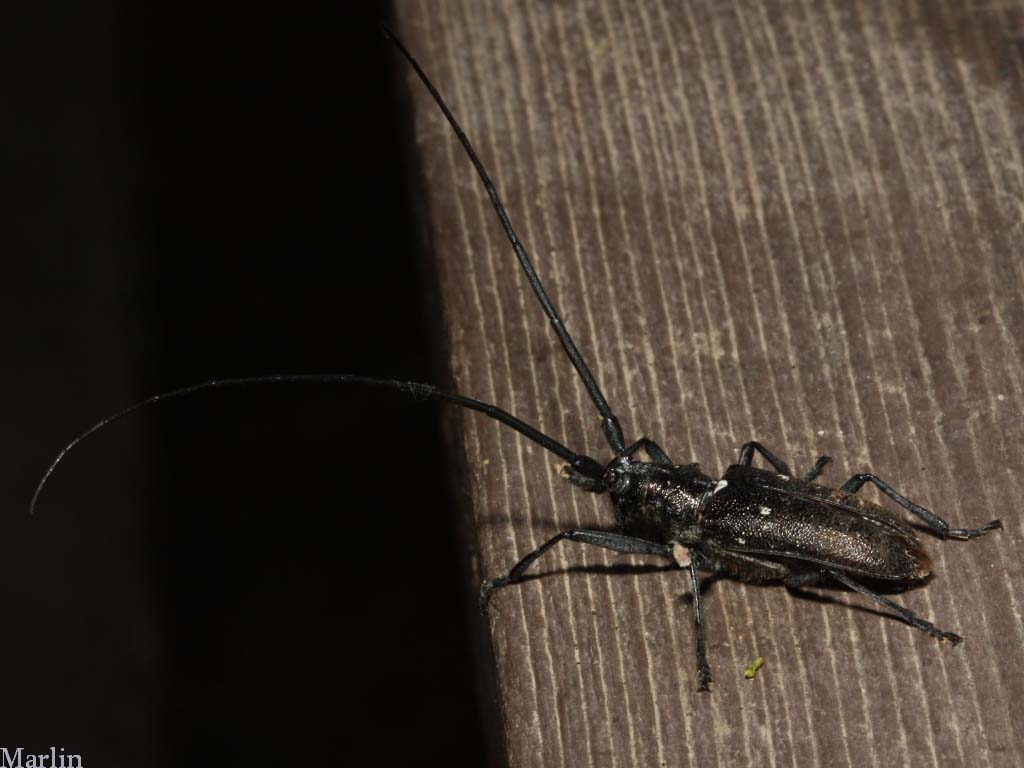
The white-spotted sawyer (Monochamus scutellatus) is frequently mistaken for the Asian longhorned beetle.
The Asian Longhorned beetle (ALB) is an exotic pest that has become established in New York City, Chicago, New Jersey, and recently in Ontario, Canada. Over 7,500 shade trees in New York and Chicago have thus far been cut down in an effort to eradicate the pest and prevent its permanent establishment in the United States. In addition, over 100 high-value shade trees discovered infested in New Jersey in 2002 were cut down in early 2003.
Infested cargo in warehouses has been discovered and eliminated in at least 17 states, including Alabama, California, Florida, Georgia, Indiana, Maine, Massachusetts, Michigan, New Jersey, North Carolina, Ohio, Oregon, Pennsylvania, South Carolina, Texas, Washington, and Wisconsin. If the ALB continues its advance, this invasive pest may potentially alter the makeup of North American hardwood forests. Losses to lumber, maple syrup and tourism industries dependent on healthy hardwood trees could reach $670 billion by recent estimates.
Countdown to Asian Longhorned Beetle Eradication: Chicago’s Final Push to Find Signs of the Beetle
CHICAGO, July 11, 2007–The U.S. Department of Agriculture’s Animal and Plant Health Inspection Service urges Chicagoans to mark the ninth anniversary of the discovery of the Asian Longhorned beetle (ALB) in Ravenswood by making a particular effort to search trees in their neighborhoods, communities and backyards for signs of the beetle and report the results to USDA. The invasive insect was first spotted by a Chicago citizen on July 9, 1998.
“While no beetles have been seen in Chicago since November 2003, Chicago’s fight against ALB is not considered over until the city is declared free of the insect through the formal USDA declaration of eradication, which is expected to occur by early 2008,” said Christine Markham, director of the National Asian Longhorned Beetle Cooperative Eradication Program. In order for previously infested areas to be declared eradicated, they must be free of any signs of ALB for four years, which for Chicago is in November 2007.
This spring the Illinois ALB cooperative eradication program performed the final year of formal surveys on hardwood trees in and around areas previously quarantined. Students in Chicago’s public school system joined in the search effort through USDA’s Beetle Busters service learning curriculum. After learning about the ALB in the classroom in May, students took the lessons to their communities searching neighborhoods and backyards and reporting the results to a special Web site.
“It’s critical that everyone who lives and works in Chicago remain vigilant and continue the search for one last summer. So, beginning July 9, we ask that you check hardwood trees where the beetle lives and feeds for signs of infestation, and keep looking through the rest of the summer months,” Markham said. “If any adult ALBs exist in Chicago, they will be most readily seen from June through September.”
Adult beetles can be found anywhere, including benches, car hoods, patio furniture, sides of houses, sidewalks etc. The ALB adults are about 1 to 1.5 inches long, and have a shiny jet black body with distinctive white spots and long antennae that are banded in black and white. The ALB infests hardwood trees such as all species of maple, birch, horse chestnut, poplar, willow, elm and ash. Signs of an infestation, in addition to the adult beetles include: the perfectly round, dime-sized holes left by adult beetles exiting a tree; sawdust-like material on the ground around the trunk or on tree limbs and oozing sap.
Upon hatching from eggs laid just under the bark, ALB larvae bore into healthy hardwood trees and feed on living tree tissue and heartwood over the winter. Throughout the summer, adult beetles emerge from exit holes and briefly feed on the leaves and small twigs of host trees. Any person who believes they have seen an ALB is urged to call the ALB cooperative eradication program at (847) 298-4540, Monday through Friday, or contact their local cooperative extension office or the state department of agriculture. The insect should be placed in a jar and put in a refrigerator or freezer. The ALB does not bite or sting.
In July 2006, USDA deregulated the final 9-square mile quarantine in the area surrounding Oz Park. As many as 35-square miles have been under quarantine since the beetle was first discovered in Chicago in 1998 in the city’s Ravenswood section. The beetle has been responsible for the loss of some 1,551 trees in Chicago. The ALB eradication program is a cooperative effort that includes USDA’s APHIS and Forest Service, the City of Chicago and the Illinois Department of Agriculture. [2]
This camping and hunting season, purchase your firewood from a vendor close to your destination. Don’t pack your own firewood for use at your campsite or cabin. Unfortunately, our native trees and forests are being threatened by invasive insects and diseases that live in dead and dying wood. In many cases, these pests are being accidentally spread to new locations by homeowners and recreationists moving firewood from one location to another.
Emerald ash borer, an invasive insect from Asia, is one example of a pest being moved in firewood. Emerald ash borer is responsible for over 20 million dead and dying ash trees in Michigan, Ohio, Indiana, and Illinois. This tiny insect has caused millions of dollars of damage to homeowners, the nursery industry, municipal governments as well as park and forest managers.
References:
1. Integrated Taxonomy Information Service (ITIS) standard report
2. USDA, Animal and Plant Health Inspection Service (APHIS) Release July 11, 2007, Asian Longhorned Beetle Eradication
 Beetles Index | Longhorns | Leaf Beetles | Soldier | Blister | Lady | Scarab
