
The Crown Fountain at Chicago’s Millennium Park
Millennium Park is located in the heart of downtown Chicago. Open daily from 6am – 11pm.
Admission is always free. Welcome Center located at 201 E. Randolph Street.
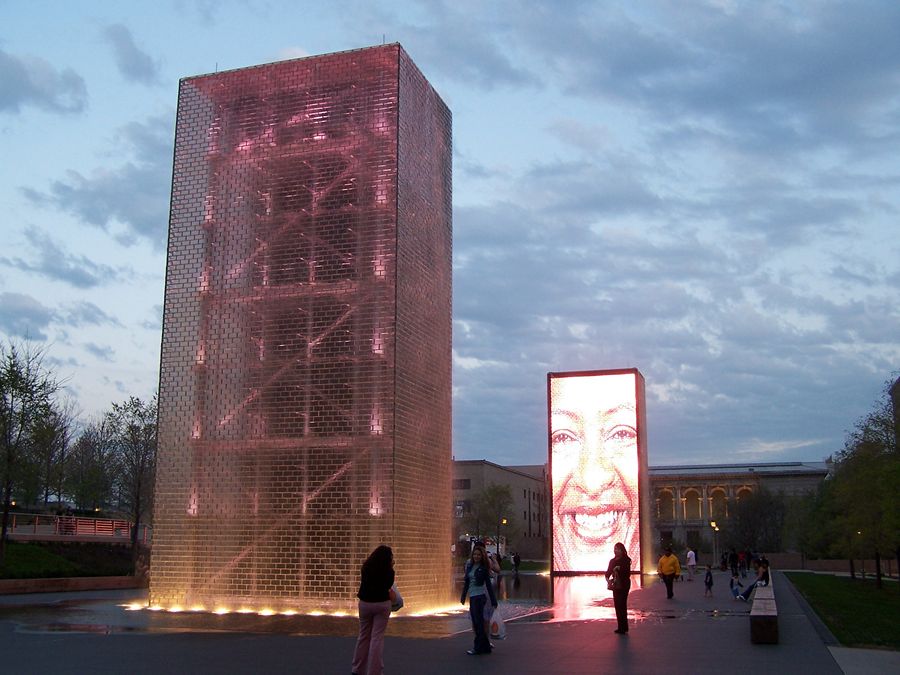
Designed by Spanish artist Jaume Plensa and inspired by the people of Chicago, The Crown Fountain is a major addition to the city’s world-renowned public art collection. The fountain consists of two 50-foot glass block towers at each end of a shallow reflecting pool. The towers project video images from a broad social spectrum of Chicago citizens, a reference to the traditional use of gargoyles in fountains, where faces of mythological beings were sculpted with open mouths to allow water, a symbol of life, to flow out. Plensa adapted this practice by having faces of Chicago citizens projected on LED screens and having water flow through a water outlet in the screen to give the illusion of water spouting from their mouths. The collection of faces, Plensa’s tribute to Chicagoans, was taken from a cross-section of 1,000 residents.
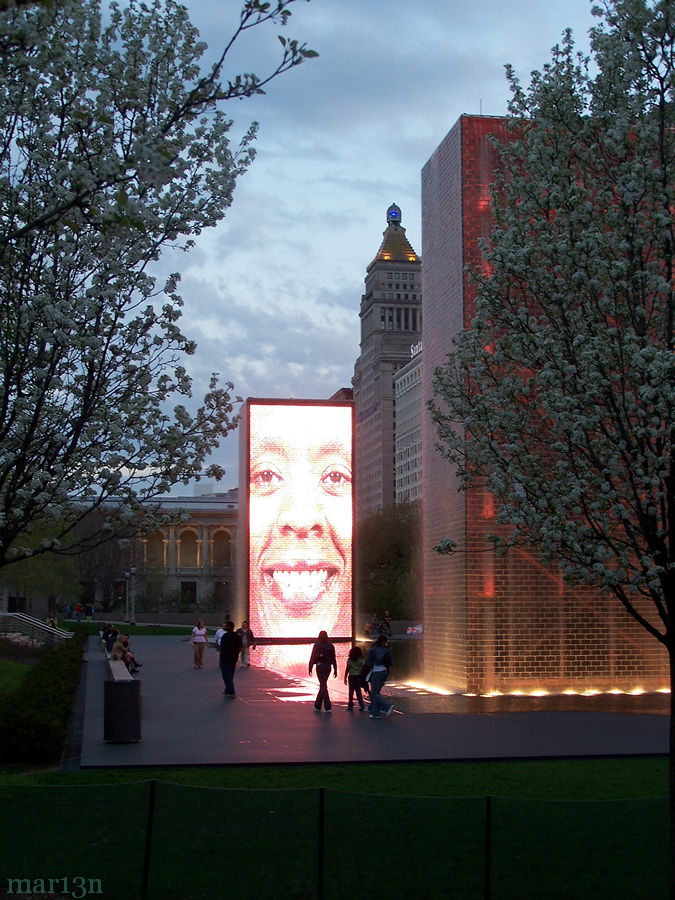
The fountain, which anchors the southwest corner of Millennium Park at Michigan Avenue and Monroe Streets, is a favorite of both children and families. The water is on from spring through fall each year, weather permitting. The images remain on year-round.
The 550 square foot control room is located underground, beneath one of the towers. Features include high-definition video servers and sensors that monitor equipment temperatures. Although the programs run automatically, features such as the synchronization of images, water flow, and lighting color and intensity can be controlled remotely. A pump room located under each tower draws water from a reservoir under the reflecting pool to supply the waterfalls and wash down the LED display when the face, nature scene, or shape disappears. Each pump circuit is designed to filter the sand out of the water (waders in the reflecting pool track hundreds of pounds of sand daily into the water) before sending it back to the fountain.
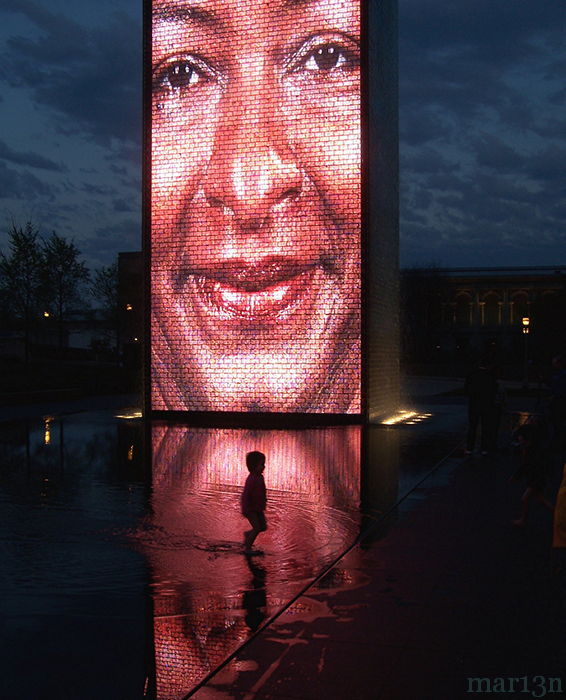
Reflecting pool is a favorite of children
Designers and engineers working on construction of the glass block towers had to figure out how to add a fountain to each of the structures without disrupting the visual effect. In what the project team calls the “gargoyle” feature, the faces on the two screens pucker up and spout water every 3 minutes. The team did not want pipes to protrude from the towers, and they didn’t want to remove LEDs in the mouth area because it would have looked like the face was missing a tooth. Instead, the team decided to recess one LED tile in each tower about 6 inches and install 1-inch clear tubing from which to issue the water deluge.
Wind gauges at the tops of the towers register wind speed and gusts, important because the gargoyle feature must be turned off when it’s too windy.
Staff members at the Art Institute of Chicago filmed more than 1,000 faces for the displays. Each of those face images are individual files stored on computer hard drives. The files have data that dictate when the face will pucker, if weather conditions permit, when to turn on and off the water.
Chicago, Illinois – The Windy City
A modest set of modern-day photographs of the great City of Chicago.
Subjects include selected shots from points of interest in the suburbs as well.
Picasso Sculpture | Chicago Water Tower | Adler Planetarium
