
Peter Tigerstedt Rhododendron
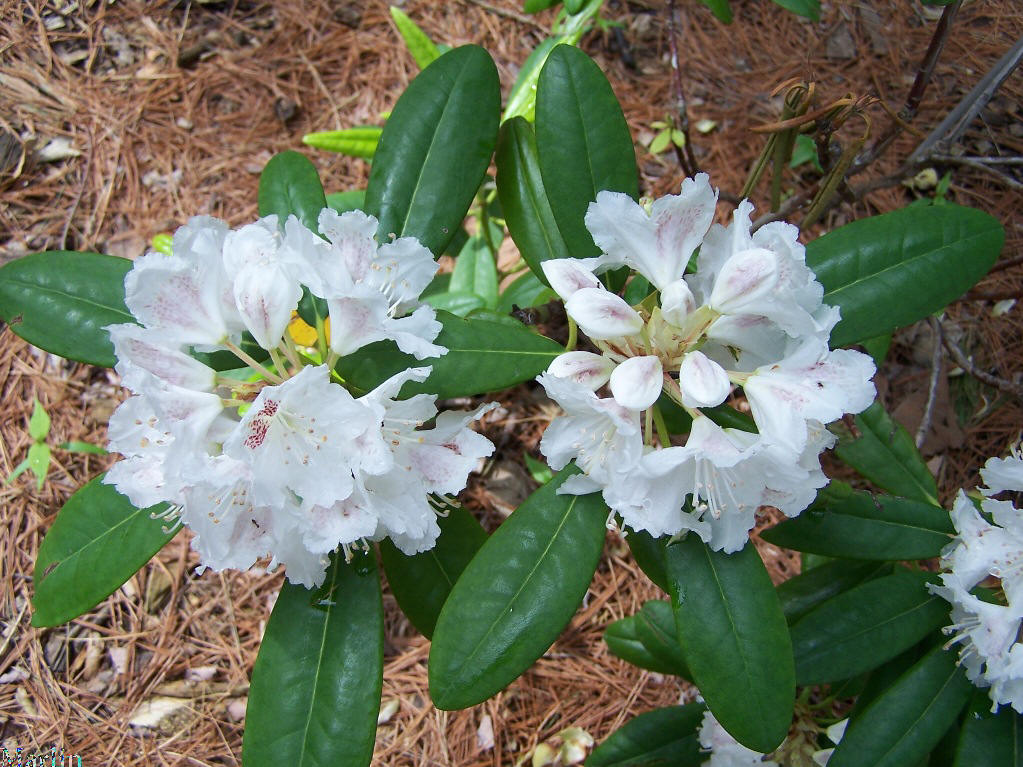
‘Peter Tigerstedt’ flowers are white with violet freckles. Hardy to -25 degrees F.
“‘Peter Tigerstedt’ is one of nine new extraordinarily hardy rhododendron cultivars, developed through a Finnish breeding program turning up in American and Canadian nurseries. Their development can be traced back to 1935, when a batch of rhododendron seeds arrived at Finland’s Mustila Arboretum, located east of Helsinki.
The seeds, originally collected in the mountain ranges of Korea and Japan, produced plants that for many years could not be classified. In 1970, they were identified as R. brachycarpum and given the subspecies name tigerstedtii to honor amateur plant breeder C.G. Tigerstedt, who introduced them.
Having withstood 49 degrees below zero Fahrenheit at the Mustila Arboretum, R. brachycarpum subsp. tigerstedtii is considered the most cold-hardy of all known rhododendrons.” — American Gardener, September 2003
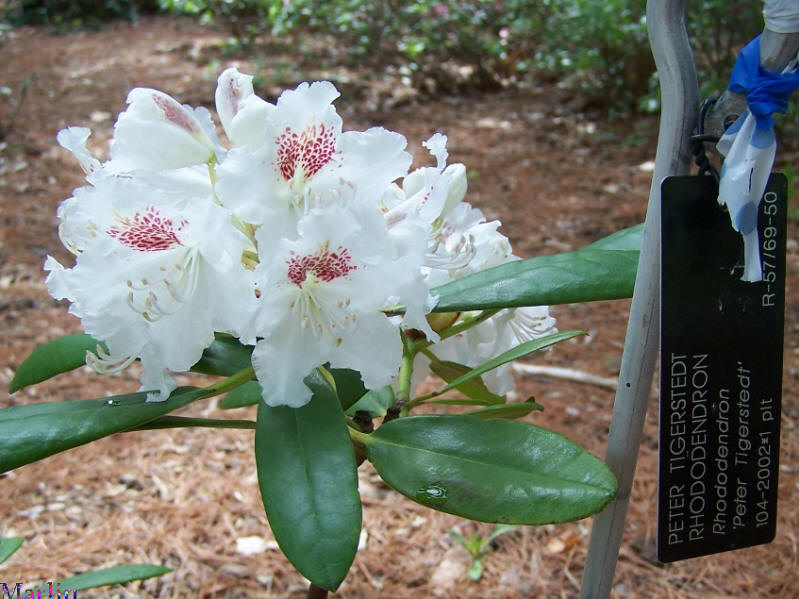
Rhododendron (from the Greek: rhodos, “rose”, and dendron, “tree”) is a genus of flowering plants in the Heath Family (Ericaceae). It is a large genus with over 1000 species. Most have very colorful, showy flowers. It includes the plants known to gardeners as azaleas.
Rhododendron grow as shrubs or small trees. The smallest species grows to 10-100 cm tall, and the largest, R. giganteum, has been reported at 90 feet. Leaves are spirally arranged; leaf size can range from 1-2 cm to over 50 cm, exceptionally 100 cm in R. sinogrande. They may be either evergreen or deciduous. In some species the underside of the leaves is covered with scales (lepidote) or hairs (indumentum. Some of the best known species are noted for their many clusters of large flowers. Both species and hybrid rhododendrons (including azaleas) are used extensively as ornamental plants in landscaping in many parts of the world, and many species and cultivars are grown commercially. Most large commercial growers in the United States are located on the west coast.
All parts of Rhododendrons are toxic to animals if ingested. Symptoms include vomiting, diarrhea, hypersalivation, weakness, coma, hypotension, CNS depression, cardiovascular collapse and death. [2]
References
- ASPCA, Animal poison control Toxic plant list
- Kenneth Cox, Rhododendrons & Azaleas: A Colour Guide (Crowood Press, 2005).
- Sonja Nelson, Rhododendrons in the Landscape (Timber Press, Incorporated, 2000).
Family Hamamelidaceae: Witch Hazel, Sweet gum, Ironwood
Trees Index | Pine Family | Beech, Oak | Nut Trees | Birch Family | Magnolias
Tree Encyclopedia / North American Insects & Spiders is dedicated to providing family-friendly educational
resources for our friends around the world through large images and macro photographs of flora and fauna.
Online since 2002