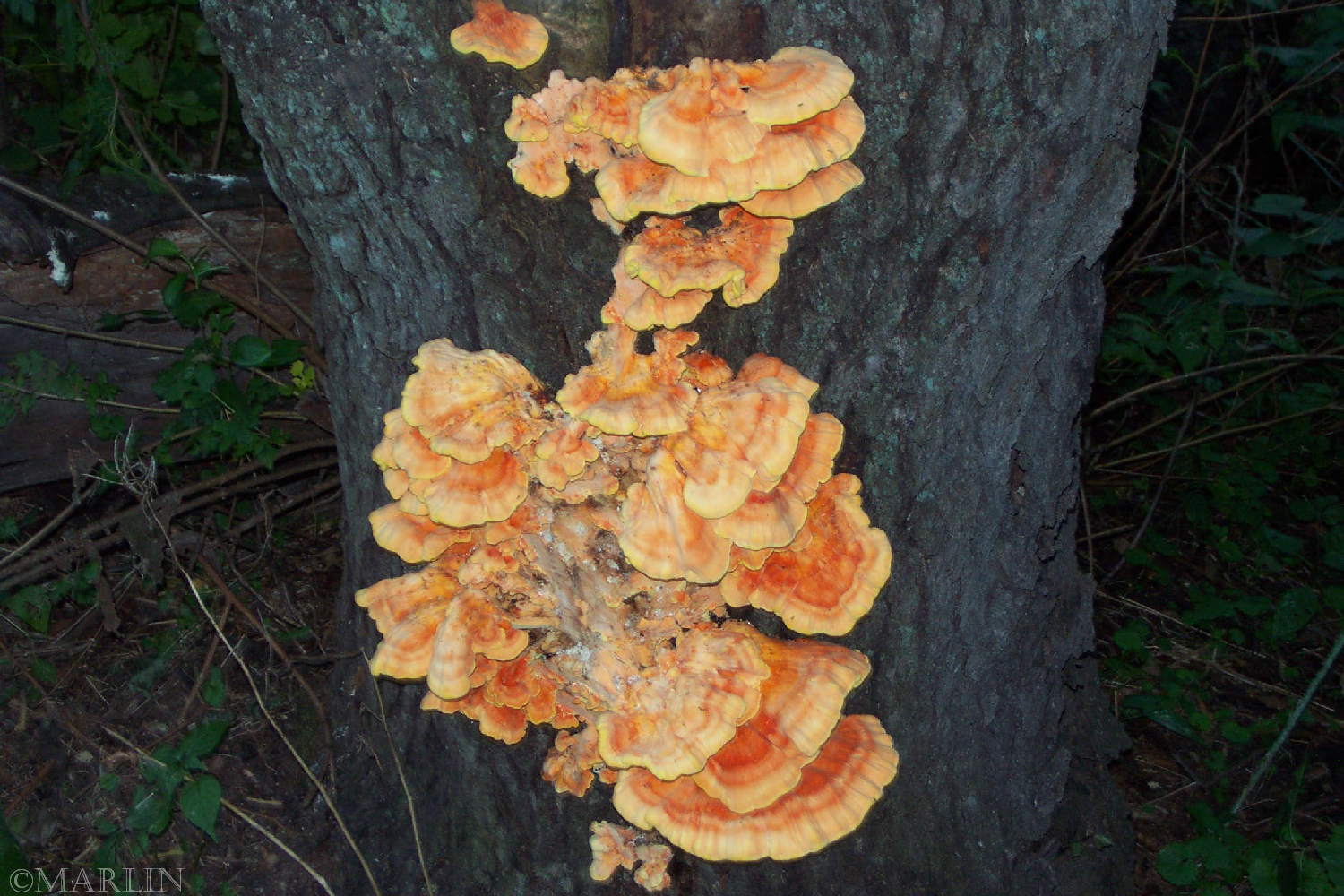
These edible mushrooms are conspicous
and not easily confused with other fungi, with their brilliant
orange-red caps
and pale sulphur-yellow pore surfaces. The sulphur shelf is a bracket fungus
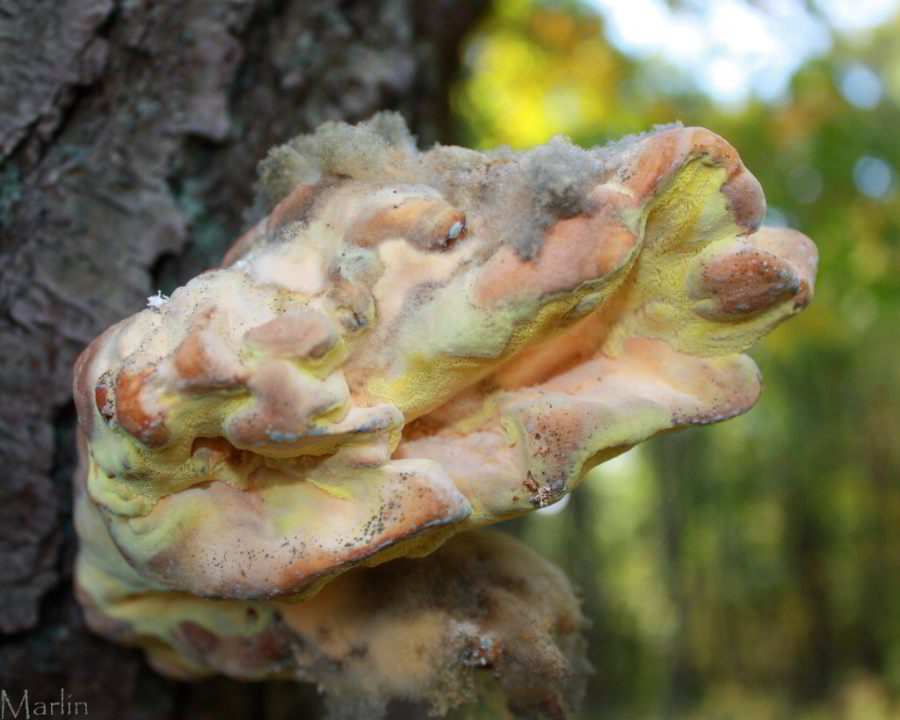
that grows on both living and dead tree
trunks and on stumps and logs. It is parasitic to live plants and
saprophytic (drawing nutrients from decaying material)
on dead plants. The sulfur shelf always grows on wood, usually in large
masses of overlapping caps. It has no
stem; the cap is attached directly to the wood. The pores are tiny. When
cooked, sulfur shelf mushrooms have
the texture and often the taste of chicken, hence the common names. |
|
Although Fungi were once considered to be part of the plant kingdom,
most experts now consider them to be a separate Kingdom or phylum.
There are estimated to be over 100,000 different fungi, most of which
form only tiny threads (Hypha) that can only be seen through a
microscope. Of these, about 20,000 are considered to be high fungi or
macro fungi, i.e. those that produce visible fruiting bodies. Only
these are of any interest to the fungi enthusiast and covered in any
detail, mostly of which belong to the subdivision Ascomycotina and
Basidiomycotina.
Species of fungi are divided into the following three categories
1 - Mycorrhizal fungi form a partnership with some plants,but mostly
with living trees.
2 - Parasitic fungi prefer the living host; this category is fairly
small.
3 - Saprophytic fungi prefer dead and decaying material.
Mycorrhizal
Mycorrhizal fungi form a partnership mainly with trees but also with
some plants, but rather then harming the tree, their presence
significantly increases the roots' effectiveness. Fungi send their
hyphae in and about the little rootlets of the tree until its
difficult to tell them apart. The tree supplies the mycelium with
moisture and carbohydrates, and the mycelium returns the favour with
minerals and other nutrients from the surrounding soil. Mycorrhiza
fungi are beneficial both in nature and agriculture; plants with them
tend to grow better than those without.
Parasitic
Parasitic fungi are the second largest group, of whose members do a
lot of serious damage. Rather than obtaining their food from dead
animals or plants, they prefer a living host, often attacking and
killing, it then living on as a saprophytic fungi.
Saprophytic
Saprophytic fungi are the largest group of fungi, they growing on
dead organic matter such as fallen trees, cow patties, dead leaves,
and even dead insects and animals. These fungi have enzymes that work
to "rot" or "digest" the cellulose and lignin found in the organic
matter, with the lignin being an important source of carbon for many
organisms. Without their digestive activities, organic material would
continue to accumulate until the forest became a huge rubbish dump of
dead leaves and trees. |