|
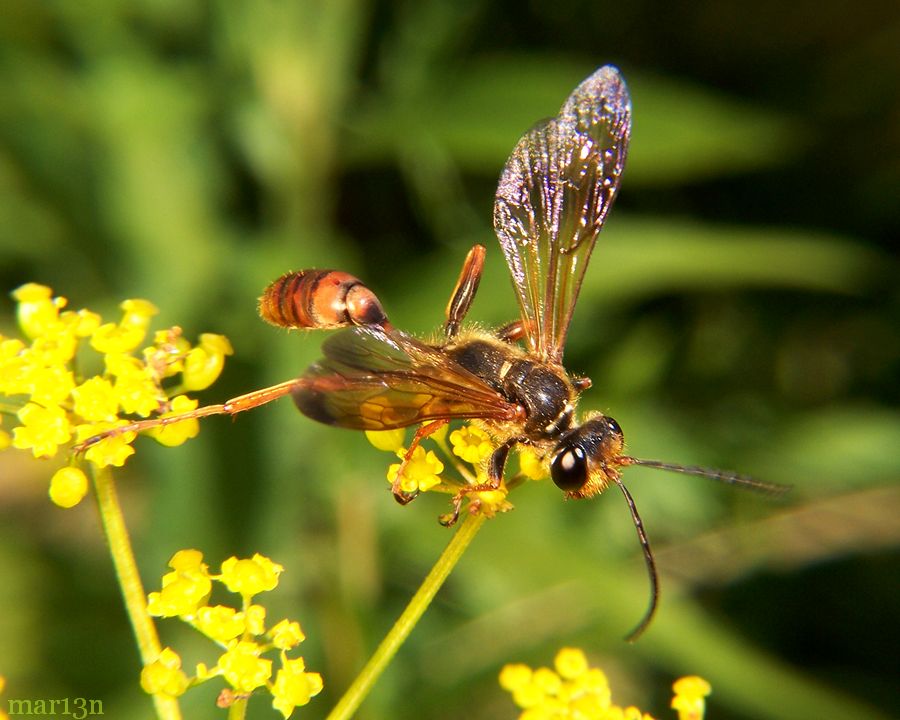
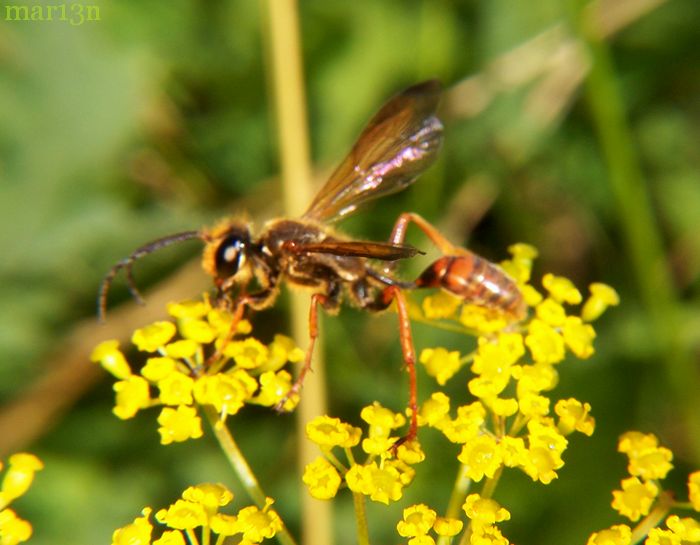
Wasps of this genus are sometimes called
"grass-carrying" wasps due to their habit of using grass to divide /
line their burrows. Nests are generally provisioned with orthoptera.
This wasp was actively nectaring at wild parsnip flowers.
Sphecidae (Latreille,
1802) is a
cosmopolitan family of wasps
that include digger
wasps,
mud
daubers and other familiar types that all fall under the category of
thread-waisted wasps. Both of the traditional definitions of the
Sphecidae (the conservative one, where all the sphecoid wasps other than
ampulicids and heterogynaids were in a single large family, and the more
refined one, where the 7 large sphecid subfamilies were each elevated to
family rank) have recently been shown to be
paraphyletic, and the most recent classification is closer to the
conservative scheme; the families
Heterogynaidae and
Ampulicidae are the sister taxa to what are now two families
(instead of one), the Sphecidae and
Crabronidae. Thus, the bulk of the sphecoid wasps are now placed in
Crabronidae, and Sphecidae per se is a much more restricted
concept, equivalent to what used to be the subfamily Sphecinae.
The biology of the Sphecidae, even under the
restricted definition, is still fairly diverse; some sceliphrines even
display rudimentary forms of sociality, and some sphecines rear multiple
larvae in a single large brood cell. Many nest in pre-existing cavities,
or dig simple burrows in the soil, but there are also species which
construct free-standing nests of mud and even (in one genus) resin. All
are predatory, but the type of prey ranges from
spiders to various
dictyopterans or orthopteroids to caterpillars (of either
Lepidoptera or
other Hymenoptera);
the vast majority practice
mass provisioning, providing all the prey items prior to laying the
egg. -- from Wikipedia
|