
Insect Order Strepsiptera
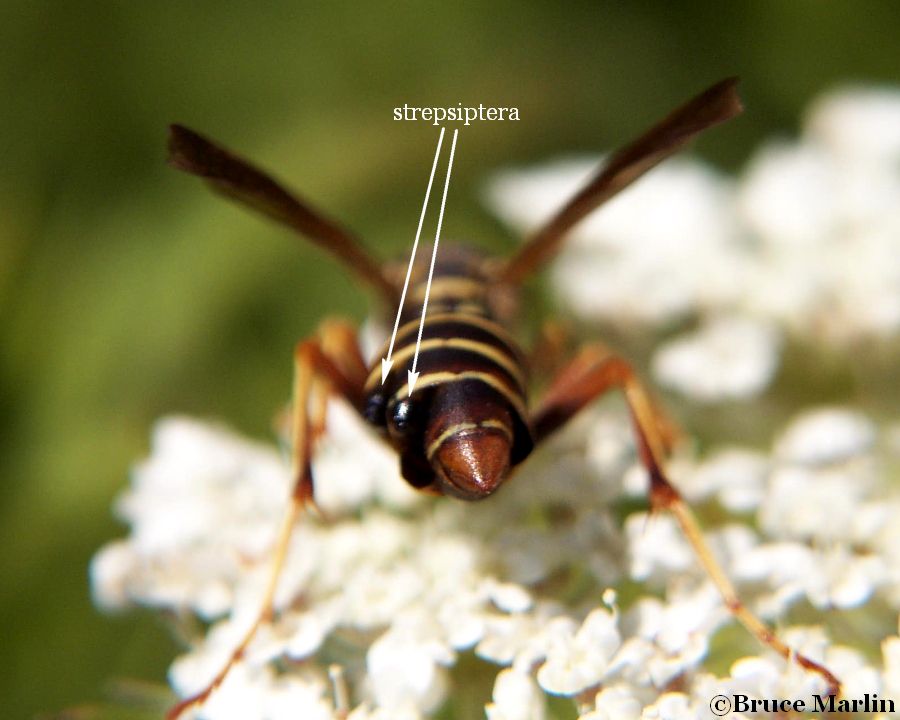
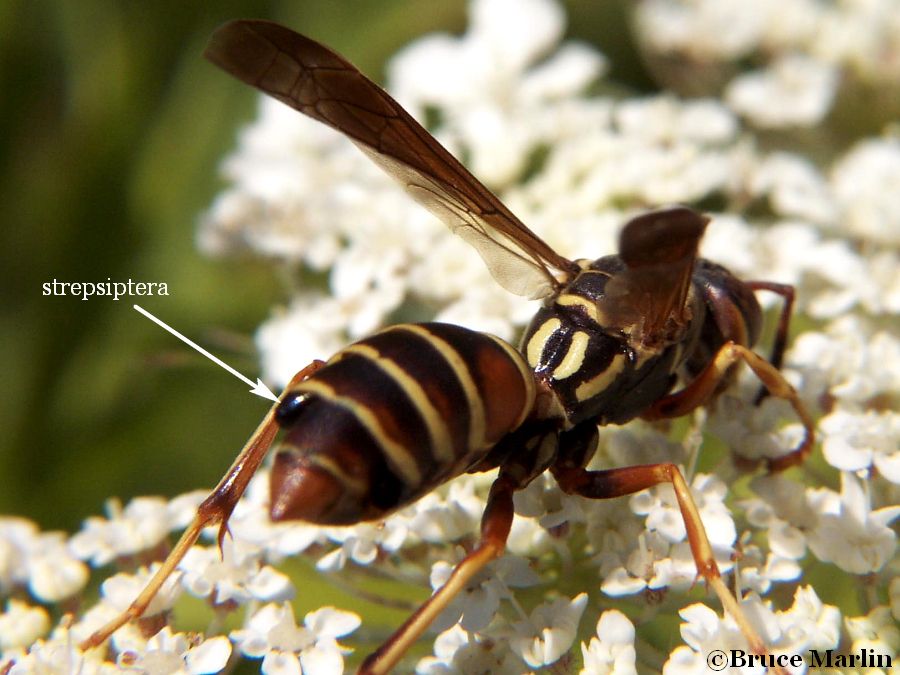 Polistes fuscatus with Strepsiptera lodged in its abdomen
The anterior abdomens of three female Strepsiptera in the family Stylopidae protrude from under the abdominal segments of a paper wasp in the genus Polistes (above). Female Strepsiptera thus provide access to adult males for purposes of reproduction, which is accomplished by a process known as hypodermic insemination. In this instance, the insects are acting as endoparasites, that is, living inside the host’s body. Strepsiptera are true zoological parasites, as they do not kill their hosts, which include hymenoptera, leafhoppers, and cockroaches [2].
Male Strepsiptera have wings, legs, eyes, and antennae, and look like flies, though they have no mouthparts. Females, lacking wings and legs, never leave their host. Males have a very short adult lifetime (usually less than five hours) and do not feed as adults. Virgin females release a pheromone to attract males.
In the Stylopidia, the female has its anterior region extruding out of the host body and the male mates by rupturing the female’s brood canal opening in a process called hypodermic insemination. Each female produces many thousands of triungulin larvae that escape from its body and out of the host into the soil and vegetation. These actively search out new hosts.
Strepsiptera find and enter their insect hosts as planidium larvae. The first instar larvae have stemmata (simple, single-lens eyes). They undergo hypermetamorphosis and become a less mobile legless larval form. In this stage they feed within the host’s body cavity. The colour and shape of the host’s abdomen may be changed and the host usually becomes sterile. The parasites then undergo holometabolous metamorphosis to become adults. Adult males emerge out of the host body while females stay inside. Females may occupy up to 90% of the abdominal volume of their hosts.
Male Strepsiptera have eyes unlike those of any other insect, resembling the schizochroal eyes found in the trilobite group known as Phacopida. Instead of a compound eye consisting of hundreds of ommatidia, each of which sees one pixel, the strepsipteran eyes consist of only a few dozen ommatidia separated by cuticle and/or setae.
Strepsiptera Identifying characteristics:
Size = 0.5 – 4.0 mm.
Front wings reduced to short, clublike structures.
Hind wings membranous, fan-shaped, with few veins.
Bulging eyes on side of head.
Antennae 4- to 7-segmented with 1 to 3 distinctive elongate projections.
Females: Minute, saclike insects, frequently lacking appendages.
References
- Midwest Institute for Biological Control, “Insect Pathogens”
- Wikipedia, “Strepsiptera“
Tree Encyclopedia / North American Insects & Spiders is dedicated to providing free, family-friendly
educational resources for our users through large images and macro photographs of flora and fauna.
Online since 2002