 |
Invasive Species -
Amur Honeysuckle - Lonicera maackii
(Rupr.) Herder
In forests the plant can
adversely affect populations of native members of the community. It can
spread rapidly due to the seeds being dispersed by birds and mammals. It
can form a dense understory thicket which can restrict native plant
growth and tree seedling establishment.
|
|
|

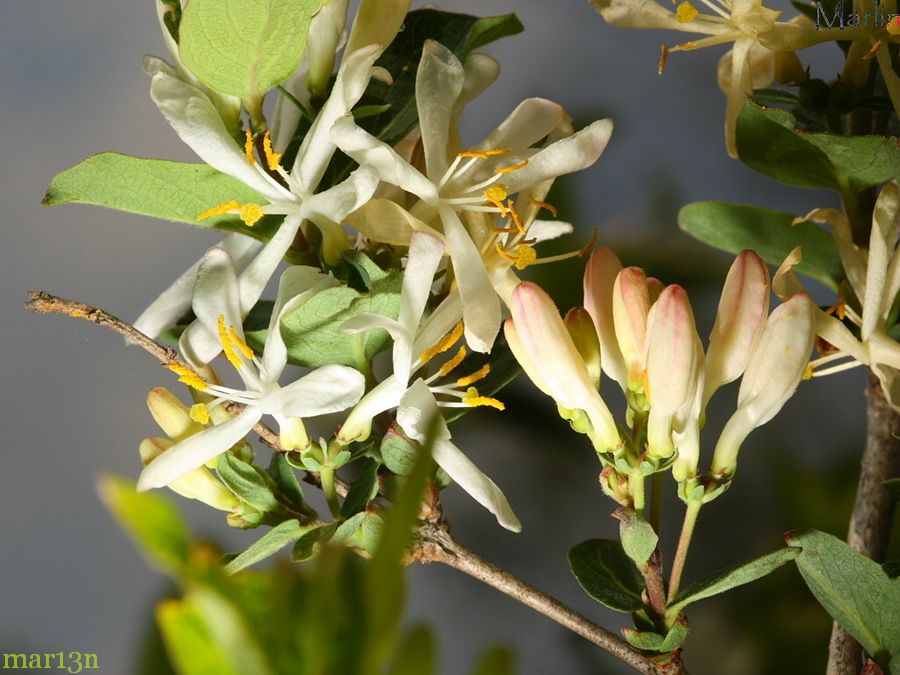
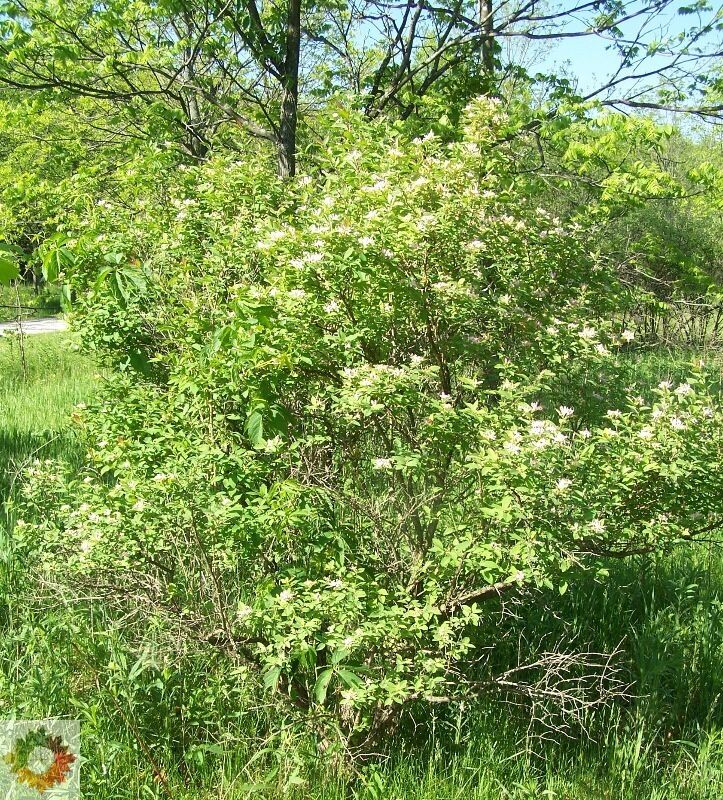
Amur Honeysuckle foliage and flowers
Leslie J. Mehrhoff, University of Connecticut, Bugwood.org |
|
Native Origin: Native to eastern
Asia; introduced into North America in 1896 for use as
ornamentals, for wildlife cover and for soil erosion
control.
Description: An erect multi-stemmed
erect deciduous shrub with arching branches that grows
up to 30 feet tall. The leaves are opposite, simple,
ovate, 2 to 3 inches long, green above, paler and
slightly fuzzy below. Fragrant flowers are tubular with
very thin petals and appear in late spring. They are
white changing to yellow and 3/4 to 1 inch in length.
Abundant red berries, 1/4 inch in diameter, appear in
late summer and often persist throughout winter. The
stems are hollow with stringy tan bark. It reproduces
both vegetatively and by seeds.
Habitat: Amur
Honeysuckle can grow
in a wide range of soil types. It tolerates wet soils
for brief periods of time, such as at the edge of
streams and creek banks that occasionally overflow. It
can grow in full sun or full shade and can be found in
fencerows, thickets, woodlands, roadsides, pastures, old
fields, neglected areas and lawns. It is tolerate of all
types of pollution, and thrives on neglect, tolerating
severe summer droughts and cold winter temperatures with
minimal dieback. It readily grows in zones 3 to 8.

Amur Honeysuckle Fruit
Chris Evans, River to River CWMA, Bugwood.org
Ecological Impacts: In forests the
plant can adversely affect populations of native members
of the community. It can spread rapidly due to the seeds
being dispersed by birds and mammals. It can form a
dense understory thicket which can restrict native plant
growth and tree seedling establishment.
Toxicity: Berries may be mildly
poisonous if eaten.
Control and Management:
Manual- Hand removal of seedlings or small plants
may be useful for light infestations. Repeated clipping
yearly to prevent dense stands from forming.
•
Chemical- Use a systemic herbicide. Thoroughly
wet all leaves with glyphosate (e.g., Roundup) as a 2-
percent solution in water with a surfactant from August
to October. Cut large stems and immediately treat stumps
with imazapyr as a 10 percent solution or a glyphosate
herbicide as a 20-percent solution. Check label
directions for details. Contact your state coop
extension for local recommendations.
•
Prescribed burning- Initiate prescribed burning
prior to the seed dispersal period (late summer to early
autumn) to minimize reinvasion of treated habitats.
References:
www.dnr.state.oh.us/forestry/Education/ohiotrees/honeysuckle.htm
http://enature.com/native_invasives_top.asp
www.nps.gov/plants/alien/fact/loni1.htm
http://www.cnr.vt.edu/dendro/dendrology/syllabus/factsheet.cfm?ID=268
www.duke.edu/~cwcook/trees/loma.html
www.invasive.org/browse/subject.cfm?sub=3040
http://plants.usda.gov
|
|
|

Amur Honeysuckle is a big problem at DuPage County, Illinois Forest
Preserves.
|
Trends and rising threats from invasive species
Humans intentionally and unintentionally spread
invasive
species. The foundations of agriculture and animal husbandry
are based on ancient habits of selectively favoring some
plant and animal species and their habitats over others for
food, fiber, and medicine (Flannery 1973). According to
Pimentel and others (1999), about 50,000 non-native species
have been introduced in the United States. Many nonnative
species have been deliberately introduced for erosion
control (kudzu), food animals and fish (brown trout),
agricultural crops (Johnson grass), and ornamental trees and
landscape plants (purple loosestrife). Some insects and
diseases have been introduced in ignorance, as was the Gypsy
Moth, or as the unintentional result of a global economy, as
with the West Nile virus and Zebra mussels (Pimental and
others 1999). Many invasive plants in the United States were
originally introduced for food, fiber or erosion control, or
as ornamentals. For example, purple loosestrife was
introduced as an ornamental in the early 19th century.
Loosestrife is present in riparian areas throughout the
continental United States and control costs are an estimated
$45 million per year. Riparian areas are extremely
valuable to native plants and animals, and the wholesale
invasion by Loosestrife poses a serious threat of eventual
extinction to numerous riparian-dependent species (Pimentel
and others 1999).
Other plant species, such as European
Cheatgrass, have almost entirely displaced
sagebrush-grassland plants and associated animals.
Cheatgrass has also seriously altered the fire regime from
an average return interval of 60-110 years to 0-3 years.
Cheatgrass is an example of the adverse impacts an
introduced species can have on the environment. Some
scientists estimate that Cheatgrass is present on 100
million acres of grassland-steppe in the western United
States. Cheatgrass forms a dense, uniform carpet that
out-competes native grasses and shrubs. It greens quickly,
dries quickly and produces a very flammable cover that often
burns completely, without allowing native plants to
reestablish. In pinyon-juniper woodlands, the combination of
Cheatgrass and fire may effectively prevent the
re-establishment of the original woodlands (Mitchell 2000). |
|
|
|
Invasive Species on National
Forests / Invasive Plants
The United States has about 2,000 non-native
invasive plant species, which are concentrated in
California, Florida, and Hawaii (Mitchell 2000). On
non-croplands in the midwestern states, one Forest
Service researcher estimates that 14 percent of the
plant species are non-native
invasive plants. Trend
data from the 19th century to the present indicates
a significant escalation in the percentages of
non-native invasive plants in the last half of the
20th century (Mitchell 2000). An estimated 3.5
million acres of National Forest System lands are
infested with invasive weeds, according to the 2000
RPA assessment, which summarized local estimates
from individual national forests(USDA Forest Service
2001). However, local estimates vary widely, and the
agency lacks a comprehensive inventory for either
terrestrial (land) or aquatic areas infested with
invasive species. The Framework for
Invasive Species
calls for expanding inventory and monitoring
activities to identify more invasive insects,
pathogens and plants (Forest Service 2003).
Some species of particular concern to Forest Service
managers are leafy spurge, knapweeds and
starthistles, saltcedar, non-indigenous thistles,
purple loosestrife, and cheatgrass in the West and
garlic mustard, kudzu, Japanese knotweed,
Tree-of-heaven, and purple loosestrife and hydrilla
in the East (Mitchell 2000).
Insect Damage and Disease
Insect damage and plant disease are natural
disturbances that are part of a healthy, functioning
ecosystem, along with fire and wind damage. However,
both native and non-native insects and diseases have
caused above normal mortality rates on forested
lands in the United States. Some 58 million acres or
8 percent of forested land are at risk for mortality
rates that exceed the norm by 25 percent or more
(USDA Forest Service 2001). High mortality rates can
accelerate the development of high fuel-loading in
fire-dependent forests, effectively remove important
ecosystem elements, and reduce private property
values. The highest profile exotic insects and
diseases include Asian Longhorn Beetle, Emerald ash
borer, Dutch elm disease, chestnut blight, white
pine blister rust, Port-Orford cedar root disease,
European gypsy moth, hemlock wooly adelgid, and
beech bark disease. Aside from the potential
economic loss from timber volume, many wildlife and
fish species are dependent on the ecosystems
affected by these invasive insects and diseases
(USDA Forest Service, 2001).
International context
Invasive species negatively affect natural
ecosystems throughout the world by out-competing
native flora and fauna for resources and growing
space. Because there are often no biological
controls on their growth, invasive species spread
quickly and negatively impact threatened and
endangered species. At least 4,500 nonnative plant,
animal, and microbe species were established in the
United States during the 19th century, and about 15
percent of these are considered harmful (Eav 1999).
Many invasive species arrive in the United States
through international trade. Therefore, the Forest
Service must work with international partners to (1)
stem the flow of invasive species into the country,
(2) discern and apply biological controls for
invasives that have already established and spread,
and (3) protect island ecosystems, which are
especially vulnerable due to their high percentage
of unique species and evolutionary isolation.
|
|
|
|