![]() |
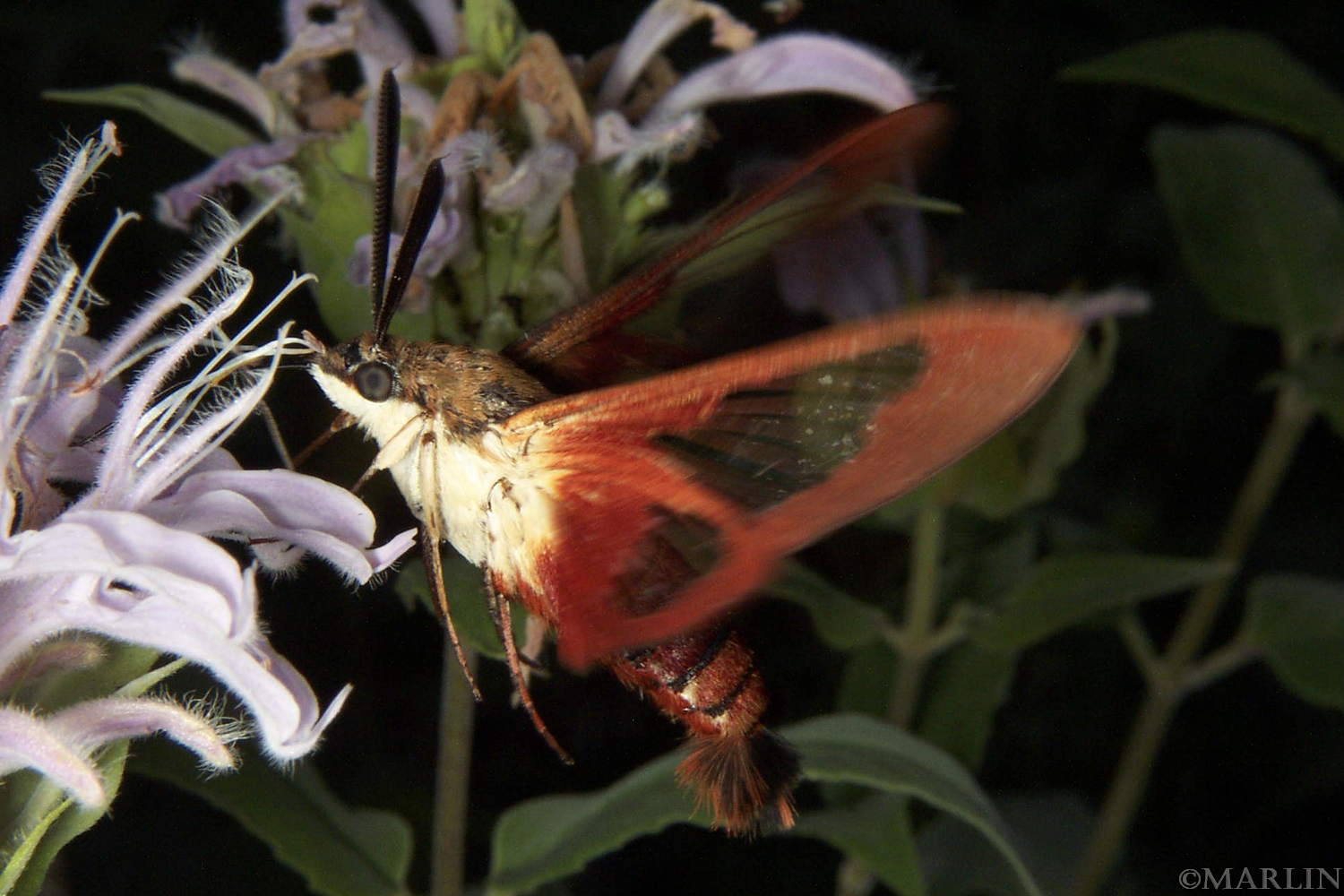
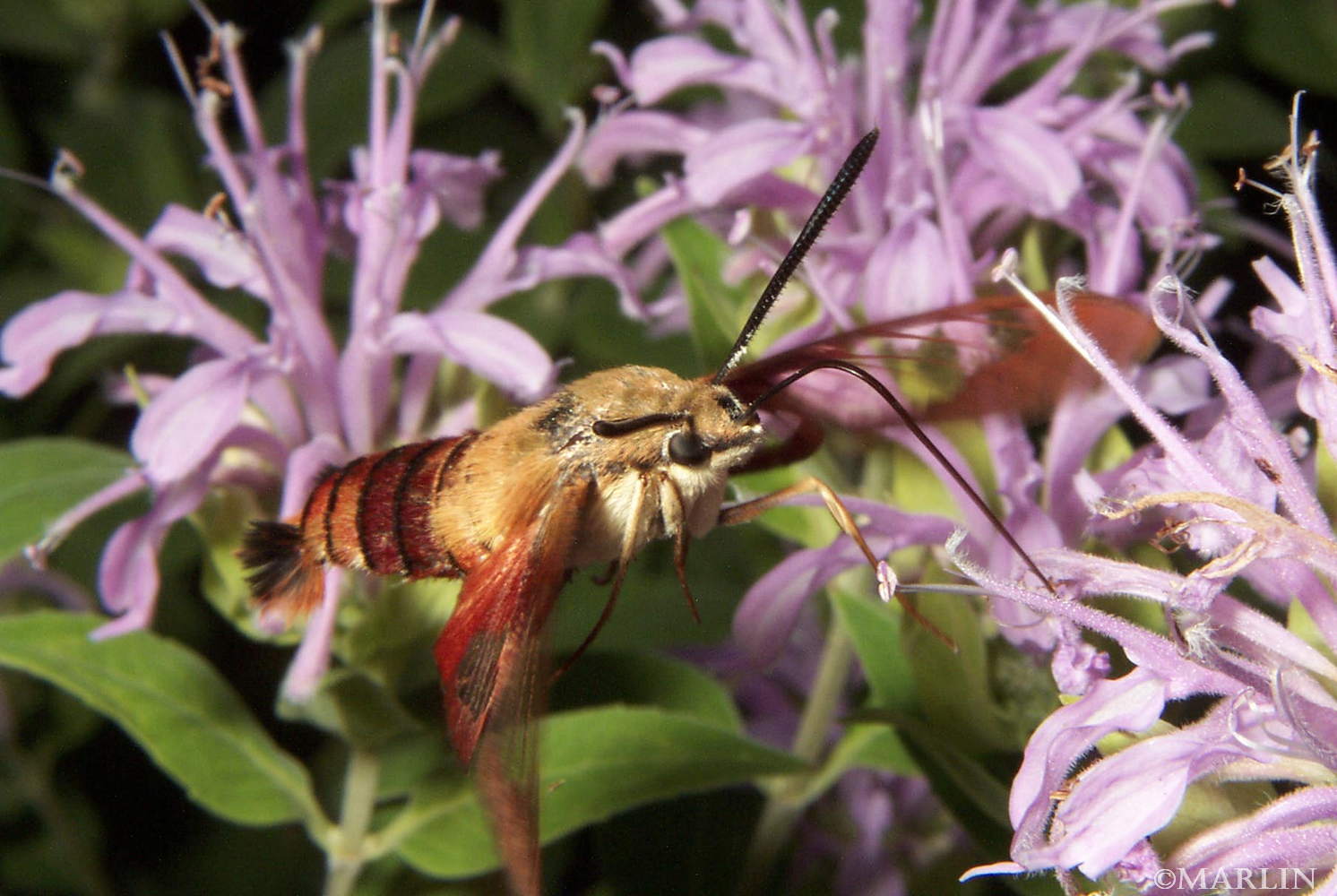
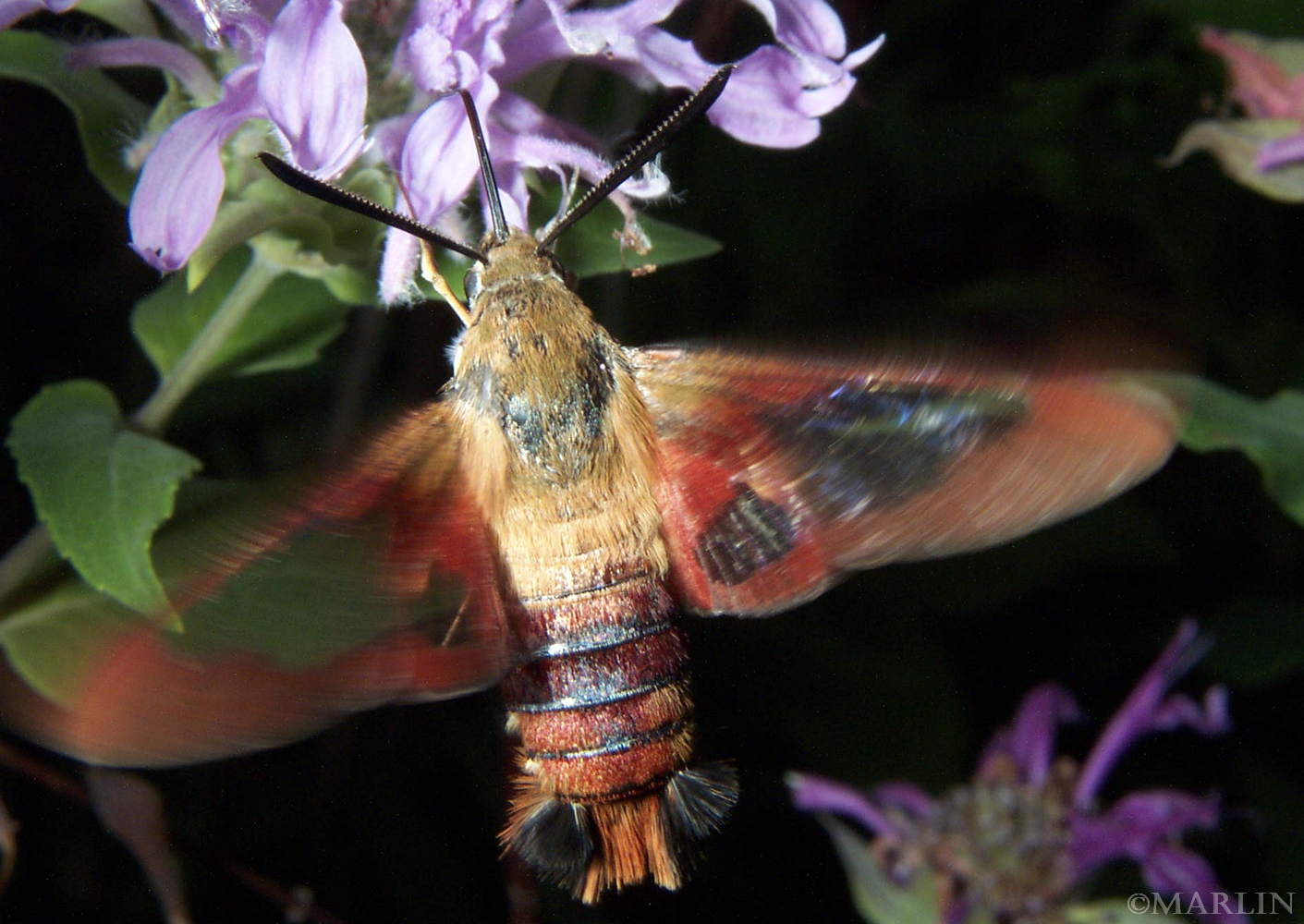
Hummingbird Clearwing Moth - Hemaris thysbe Commonly called common clear-wing, hummingbird moth, sphinx colibri. Live adult moths photographed in the wild at Winfield, Illinois, USA. Shown with Monarda fistulosa, commonly called wild bergamot. [Cirrus Home] [Moths Main Page Graphics] [Moths Table of Contents] |
|
Hummingbird Clearwing Moth, Hemaris thysbe |
|
Hemaris thysbe, the Hummingbird Clearwing Moth or Common Clearwing (wingspan 38-50 mm), readily visits flowers by day throughout the eastern half of the U.S. and Canada, where it ranges far to the north, even into the Yukon. It is not difficult to see why many gardeners would mistake an Hemaris thysbe moth for a small hummingbird as it hovers, sipping nectar from flowers through a long feeding tube. The moth hovers briefly, sipping for only a few seconds before darting off to a new flower. Green body "fur" and burgundy wing scales suggest a small ruby throated hummingbird. |
|
Adult sphinx moths are medium to large moths with wingspans ranging
from about 1.25 inches to 4.75 inches. The snowberry clearwing is
one of the smallest moths in this group, while the five-spotted hawk
moth is one of the largest. Its larva is the familiar tomato
hornworm. The Carolina sphinx, whose larva is known as the tobacco
hornworm, weighs only one to two grams, but it flaps its wings an
astonishing 25 to 30 beats per second. Some sphinx moths have been
clocked at speeds as high as 30 mph. |
Moth hovers, balancing on front legs just
touching flower petals. This is a defense against
lie-in-wait predators such as crab spiders and ambush bugs.
|
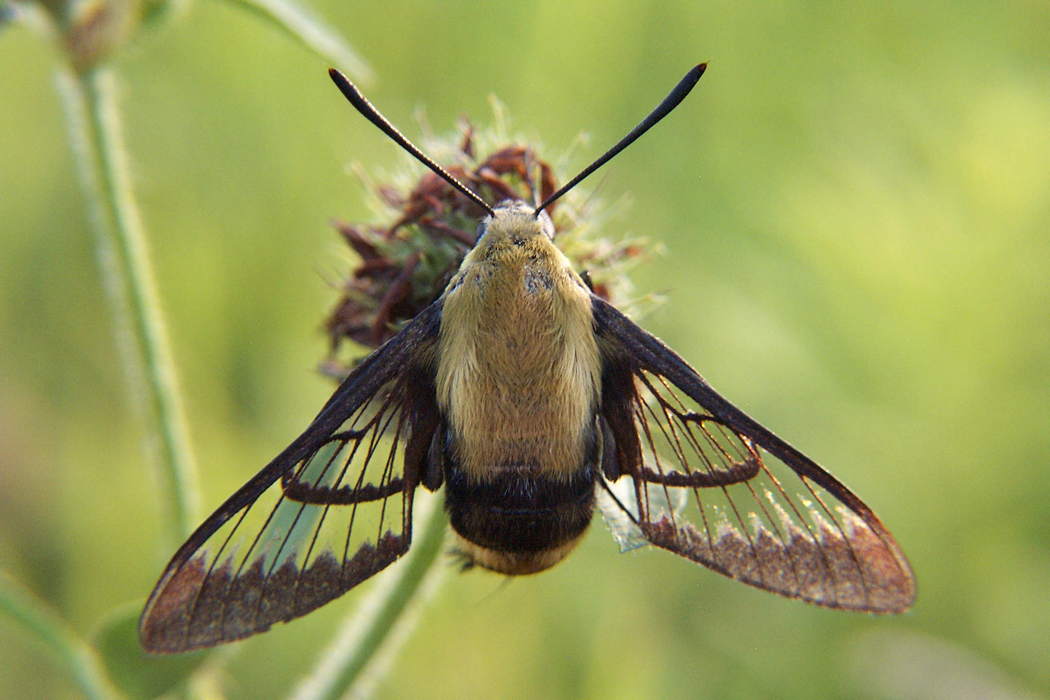
The hummingbird clearwing is common in North America. Its larvae feed on honeysuckle, buckbrush, wild cherry and plum. Adults hover to take nectar at many different flowers, including honeysuckle, beebalm, phlox, lilac and bergamot. All the specimens pictured here are feeding at bergamot. The snowberry clearwing, a close relative, is nearly as abundant. That bumblebee mimic is yellow with black wings and abdomen. At 1.25 to 2 inches, its wingspan is slightly smaller than that of the hummingbird clearwing. Its larvae feed on honeysuckle, dogbane and buckbrush. Adults eat from many flowers, including thistles, milkweed and lilac. See pictures of the snowberry clearwing moth, a mated pair, HERE. |
|
Moths, including sphinx moths, pollinate many species of plants. Moth-pollinated flowers tend to have a strong, sweet scent and are white or pale in color. Gardens planted with these flowers may attract several kinds of sphinx moths, including the hummingbird and bumblebee mimics. However, since these moths rarely come into contact with flowers except for the tip of a carefully-placed foot, and, of course, their proboscis, they are not important pollinators.
I find these engaging creatures extremely interesting and fun to
watch. They are wary and difficult to approach. A good digital
point-and-shoot camera with an external flash synch is invaluable in
photographing these fast-moving insects. I've taken many hundreds of
failed photos to get these few passable shots! I hope every insect photographer gets a chance to find an aggregation of flowers attracting these beautiful moths. |