 |
Snowberry Clearwing Moth - Hemaris diffinis Order Lepidoptera /
Suborder Macrolepidoptera / Superfamily Sphingoidea / Family Sphingidae
-- hawk moths, hornworms, sphinx moths / Genus Hemaris Live adult moths photographed
in the wild at Winfield, Illinois, USA.
Thanks to Michael W. Nelson, Invertebrate Zoologist, Massachusetts
Natural Heritage & Endangered Species Program, for identifying these
specimens. |
|
|

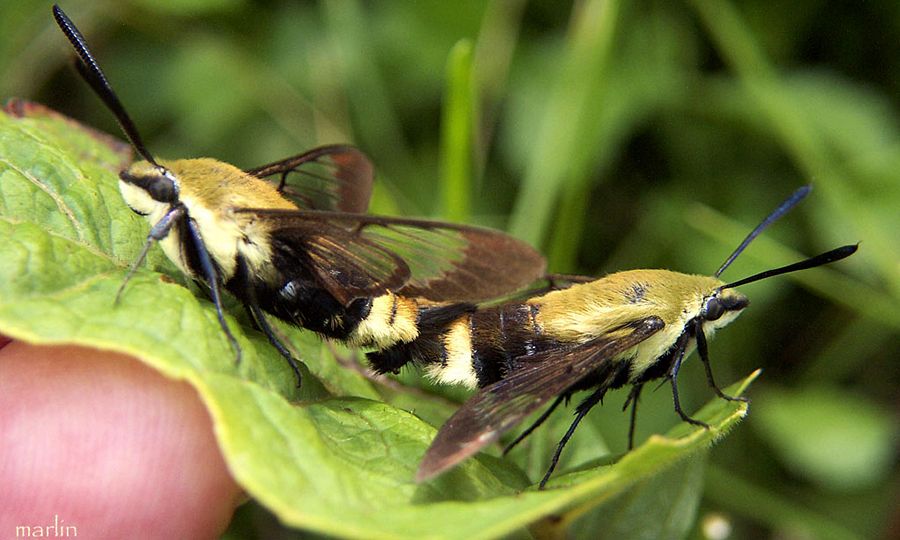
Snowberry Clearwing Moth, Hemaris diffinis
I was in great luck to find this mated pair, these moths do not normally
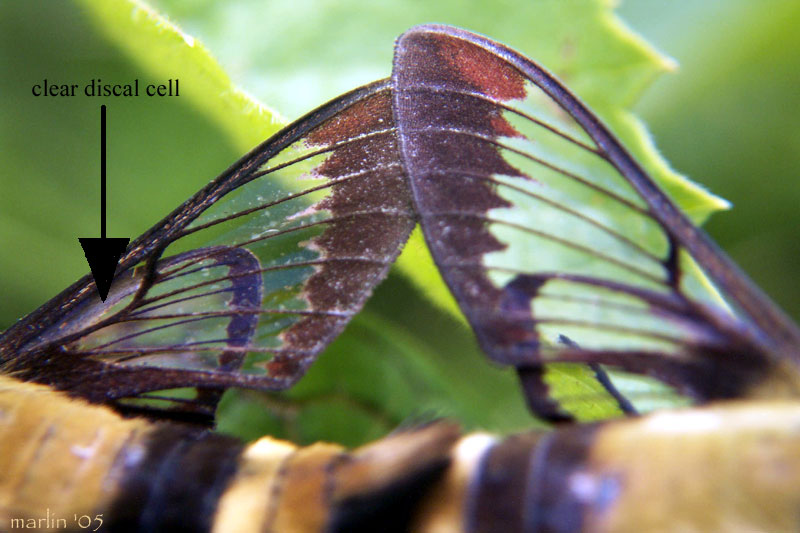
hold still for anything. Wing detail photo shows the completely clear
discal cell at the leading edge of the forewing - one indicator for this
species. These large hawk moths are diurnal, that is, active during the
day; they are most often seen nectaring at flowers. They hover and dart
about, flying both backward and forward just like hummingbirds, but I'm
convinced they are really mimicking bumblebees. Any time you see these
moths nectaring, they are invariably in company (and usually vastly
outnumbered by) of hoards of bumblebees. It's hard to tell them apart at
a distance and without looking carefully.
I love these moths -
they are as much fun to watch as hummingbirds, and more plentiful to
boot. They don't sting or bite or crawl around on poop or carrion -
thoroughly engaging! Live adult male and female hawk moths (also known
as sphinx moths) photographed at Winfield IL USA at various times during
June - August. |

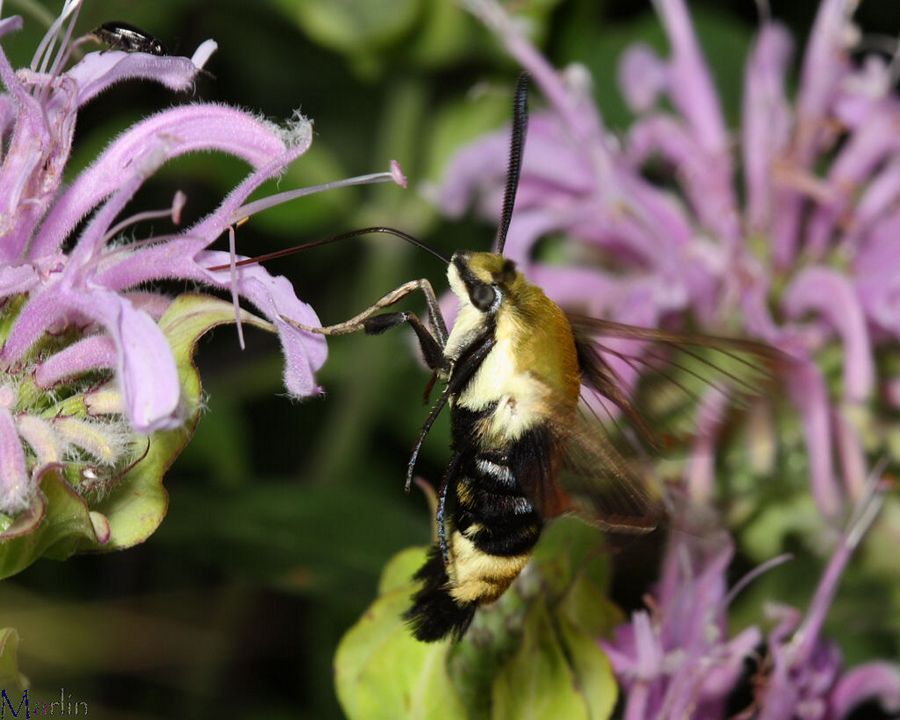
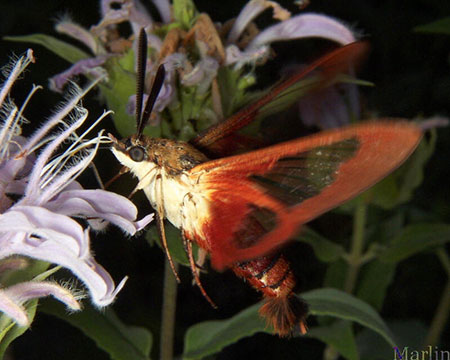
Snowberry Clearwing takes nectar at Wild Bergamot, Monarda fistulosa
It is said these moths hover at flowers; it should be noted they almost
always locate and stabilize their hover by resting their front legs on
the flower blossom. This is true of the hummingbird clearwing as well.

Reference: Visit our Hummingbird Clearwings
The
hummingbird clearwing is relatively common in North America.
Its larvae feed on honeysuckle, buckbrush, wild cherry and plum. Adults
hover and sip nectar at many different flowers, including honeysuckle,
beebalm, phlox, lilac and bergamot. All the specimens pictured here are
feeding at bergamot. The snowberry clearwing, a close
relative, is nearly as abundant. It is said this moth is a bumblebee
mimic, however, claims that the rapid wingbeats produce a buzz similar
to bumblebees are in error. This moth and its larger relative actually
produce a faint rustling sound when flying. At 1.25 to 2 inches, its wingspan is slightly
smaller than that of the hummingbird clearwing. Its larvae feed on
snowberry, honeysuckle, dogbane and buckbrush. |
|
|

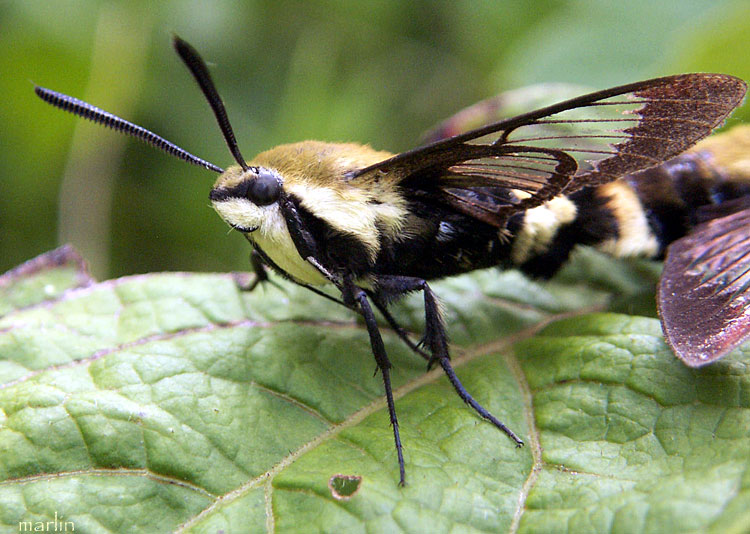
Male Snowberry Clearwing Moth
Adult sphinx moths are medium to large moths with wingspans ranging
from about 1.25 inches to 4.75 inches. The snowberry clearwing is
one of the smallest moths in this group, while the five-spotted hawk
moth is one of the largest. Its larva is the familiar tomato
hornworm. The Carolina sphinx, whose larva is known as the tobacco
hornworm, weighs only one to two grams, but it flaps its wings an
astonishing 25 to 30 beats per second. Some sphinx moths have been
clocked at speeds as high as 30 mph.
Sphinx moths are often mistaken for hummingbirds and bumblebees
because of their similarities in size, foraging behavior and feeding
structures. Many sphinx moths are nocturnal, but several species are
diurnal, meaning they are active during the daytime when
hummingbirds and bumblebees are also foraging. Adult sphinx moths
have a long, straw-like "tongue," called the proboscis, which they
keep curled under the head. They use it to suck nectar from the
flower. The nectar is rich in sugar, which fuels the energy required
for hovering. Hummingbirds also have a long tongue to lap up nectar. |
|

Clear discal cell of forewing is one diagnostic of Hemaris
diffinis.
Moths, including sphinx moths, pollinate many species of plants.
Moth-pollinated flowers tend to have a strong, sweet scent and are
white or pale in color. Gardens planted with these flowers may
attract several kinds of sphinx moths, including the hummingbird and
bumblebee mimics. While eating the nectar of a flower, moths receive
a dusting of pollen by brushing against anthers, which produce
pollen. Their fuzzy bodies are excellent pollen carriers. As a moth
sips nectar from another flower of the same species, it transfers
pollen from the previous plant. This cross-pollination is necessary
for many species of plants to produce seeds.
I find these engaging creatures extremely interesting and fun to
watch. They are wary and difficult to approach. A good digital
point-and-shoot camera with an external flash synch is invaluable in
photographing these fast-moving insects. I've taken many hundreds of
failed photos to get these few good shots!
Please select a thumbnail for larger 1024 X 768 image |
 |
 |
 |
 |
 |
 |
|