|
 |
Jumping Spiders -
Family Salticidae Live jumping spiders photographed at Dupage County Illinois, San Antonio,
TX, and Lake Crabtree Co. Park, Wake County, North Carolina, USA
|

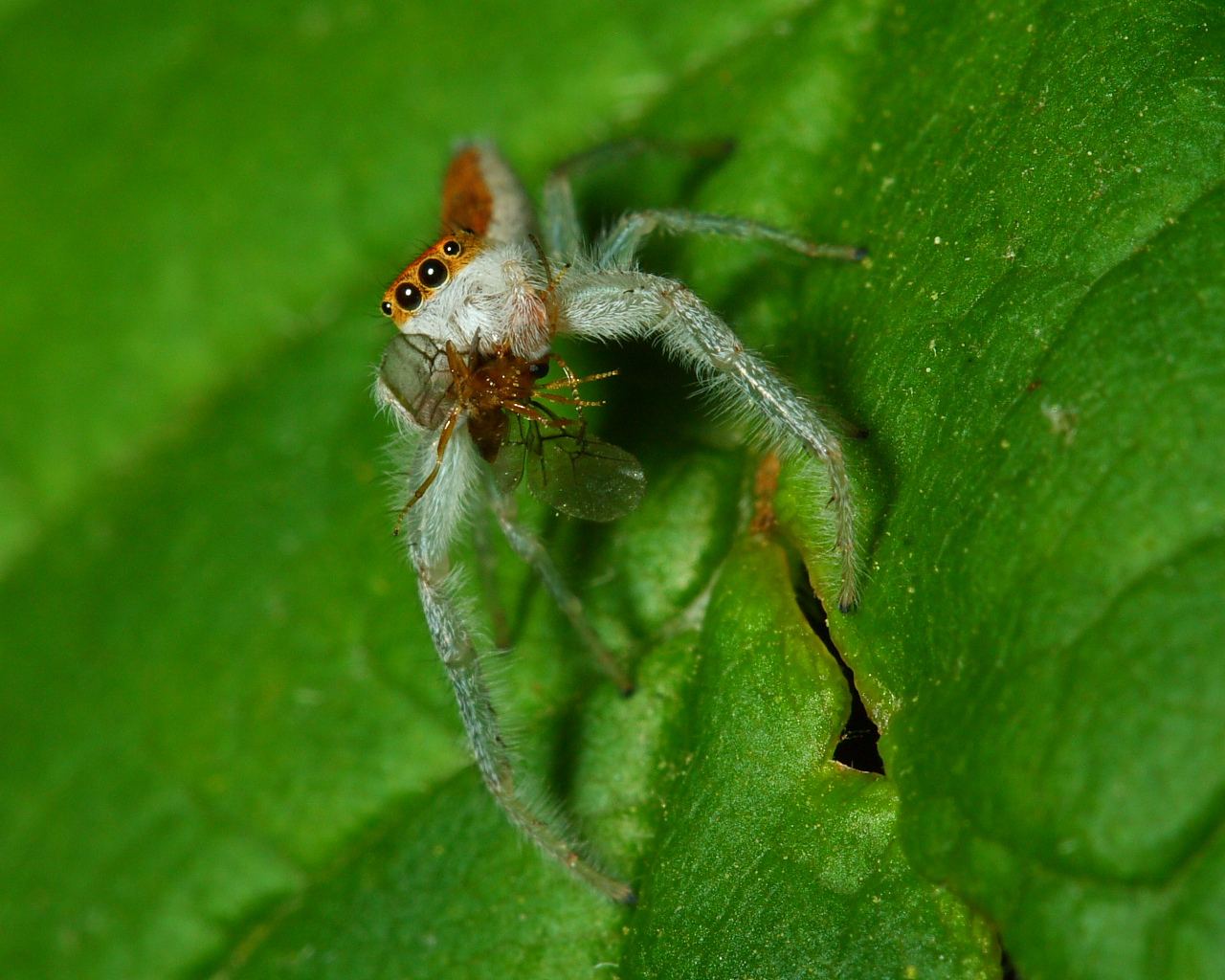
Female Phidippus clarus with ambush bug prey |
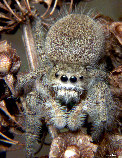
Jumping spiders are small to medium in size, stout-bodied
and short-legged, with a distinctive eye pattern. The body
is rather hairy (pubescent) and frequently brightly colored
or iridescent. Some species are antlike in appearance. The
jumping spiders forage for their prey in the daytime. They
approach prey slowly and, when a short distance away, make a
sudden leap onto the unfortunate animal. They are good
jumpers and can leap many times their own body length. |
|

Most colorful jumping spider? |
|
You've got to be quick and careful if you want to see a
jumping spider capture prey. I've often seen them hunting,
but they are so wary that once they catch sight of you, they
will usually suspend their activity to keep an eye on you;
if you make any sudden moves, they will drop to the ground
or hide under a leaf. |
|
|

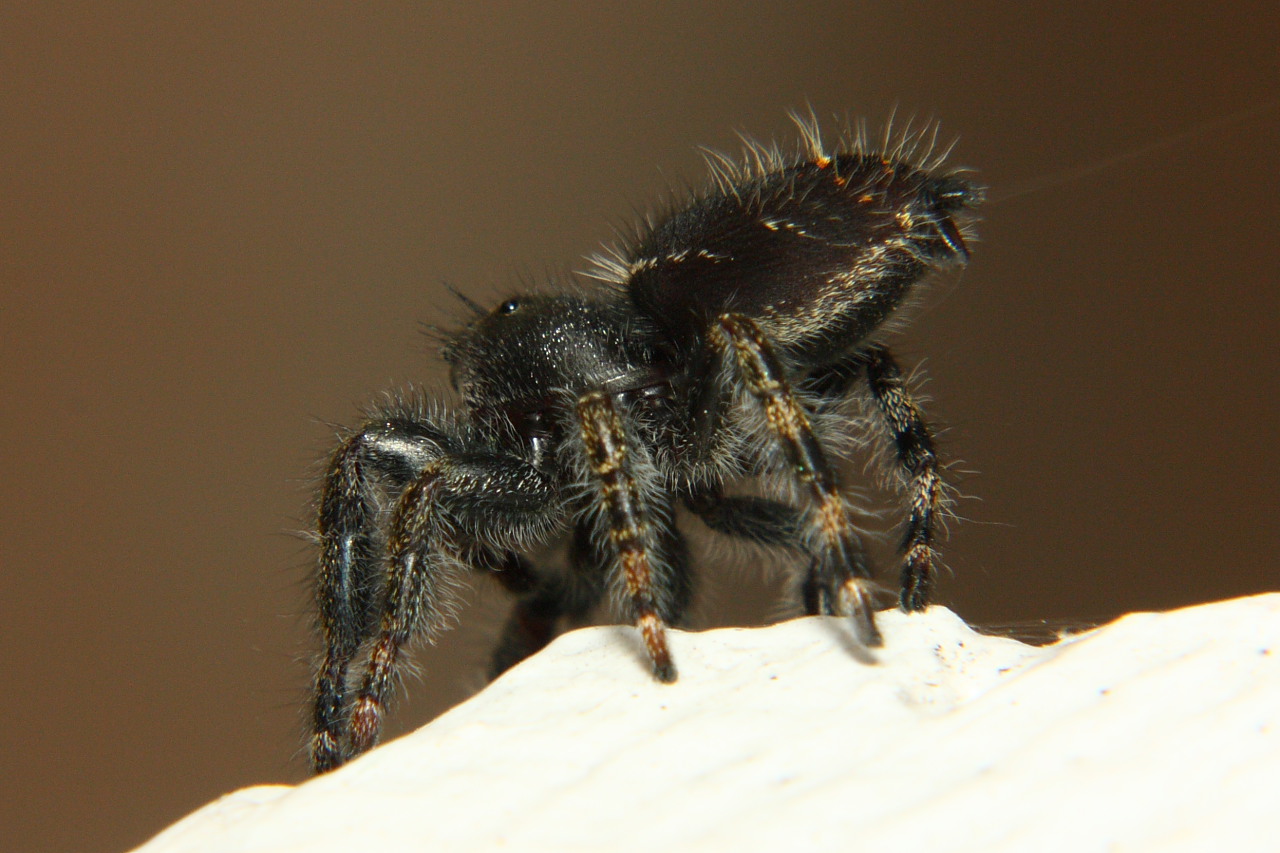
Daring Jumping Spider
Phidippus audax |
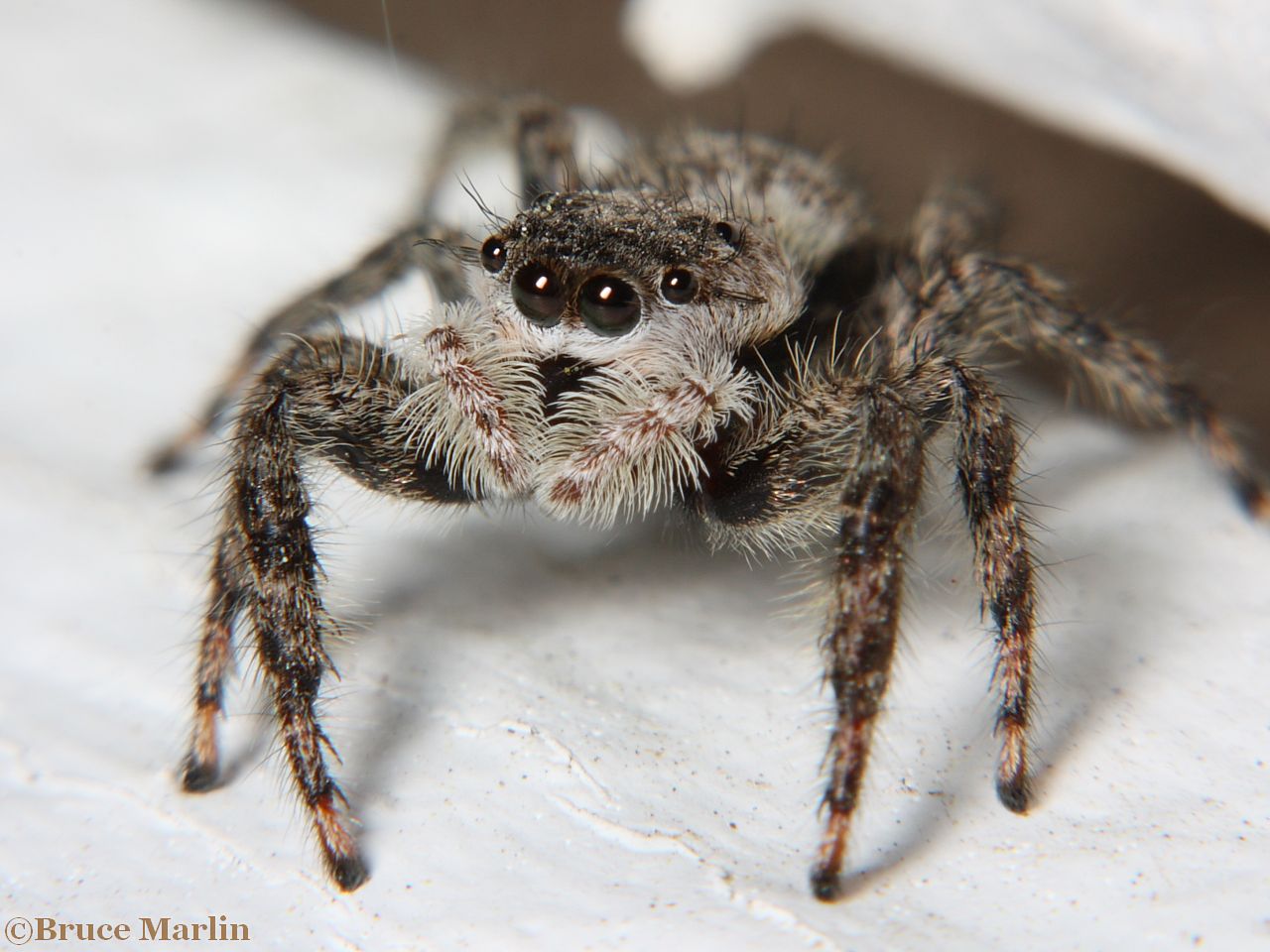
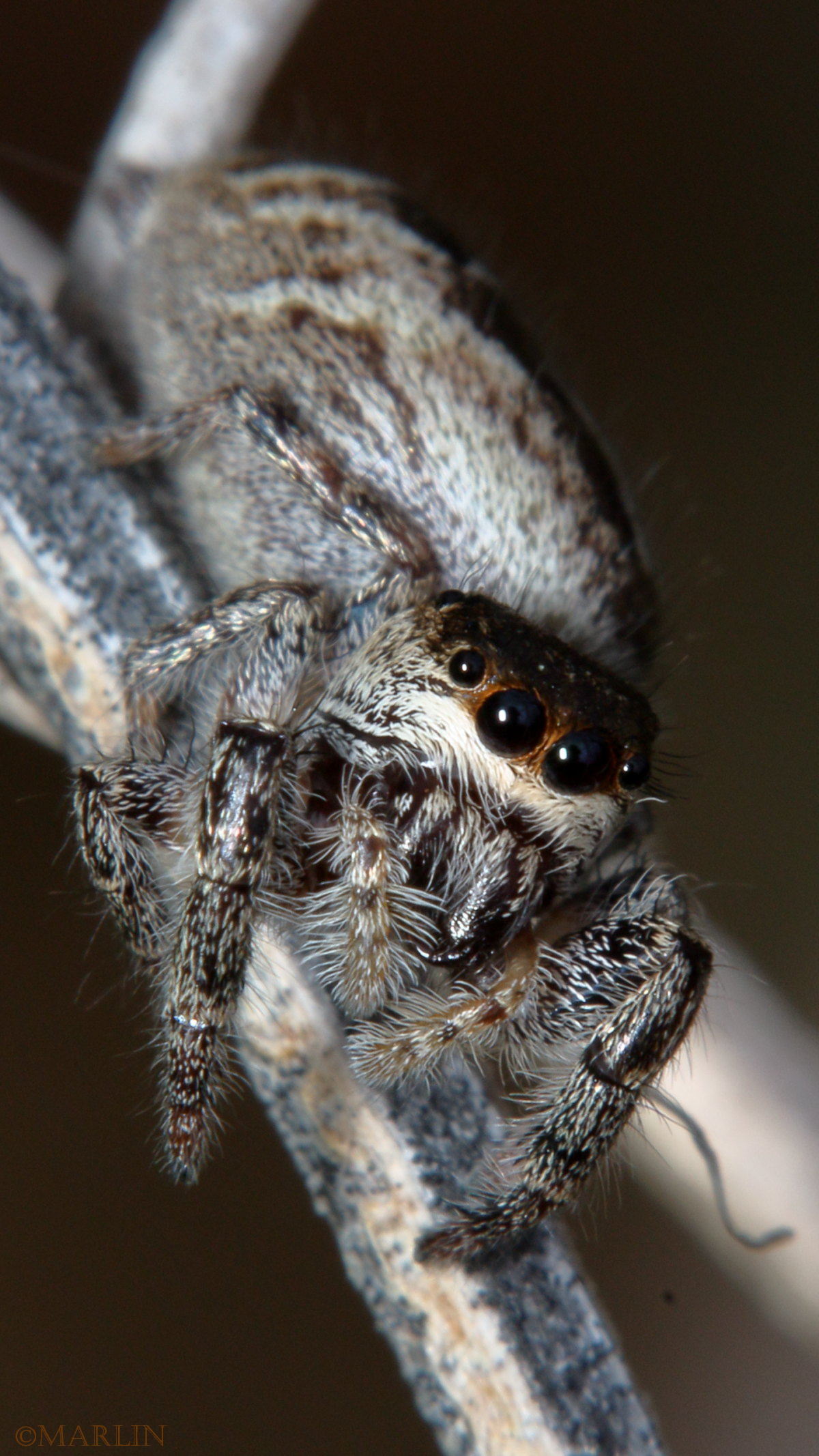
Jumping spiders are easily distinguished from other spiders by
their four big eyes on the face and four smaller eyes on top of the
head. Around the world there are probably more than 5000 species of
jumping spiders. Jumping spiders are charming lil
buggers that look up and watch you. Although a jumping
spider can jump more than fifty times its body length, none of its
legs has enlarged muscles. The power for jumping comes from a quick
contraction of muscles in the front part of the body increasing the
blood pressure, which causes the legs to extend rapidly much as
the hydraulics in a low-rider car.
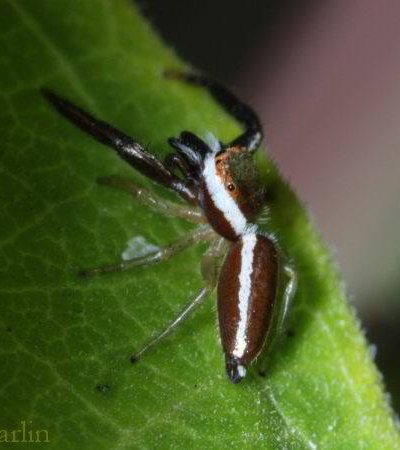
Their vision also allows communications by visual means, such as the
elaborate courtship dances that males perform. Salticids are perhaps
as old and diverse as mammals, though not many humans know their
world. Many salticids are colorful, they take on a variety of body
forms, and some have disguises, looking like ants and other
organisms. The bright colors and elaborate forms of some jumping
spider species are involved in courtship.
Phidippus audax is one of the
most common jumping spiders in North America. It is commonly called
the "bold" or "daring jumping spider." Most casual photographers
capture only this species.
|
|

Jumping Spider - Phidippus mystaceus
|
Phidippus mystaceus has
my vote as the most colorful of all the jumping spiders. It is this
spider that offers the photographer the best chance of capturing
images of the spider's retina, which is not fixed in place, like our
own. The jumping spider's retina is moveable. Because the retina is
the darkest part of the eye, you can sometimes look into the eye of
a jumping spider and see it changing color as it moves to follow
your actions. When it is darkest, you know the spider is looking
straight at you, because then you are looking down into its retina.
|
|

Swollen palpi indicative of male spider |
This is one of the smallest jumpers I've ever
been able to photograph; it is about 3mm long (about 1/8 inch).
Male spiders have an unusual way to get sperm into the females: they
use their palpi, the little 'feelers' beside the face. In the
females, these palpi are simple and leg-like. Both males and females
use them like little hands, to manipulate food and to clean their
faces. But adult males have the palpi swollen and more complex
(that's one way to tell a male spider: adult and sub adult males
have the palpi swollen like boxing gloves).
When the male is ready to mate, he spins a small web and deposits a
drop of sperm on it from the underside of his abdomen. He then
places the tip of the palp into the sperm, and draws the sperm
through the palp's opening into the sperm duct of the palp. There it
is stored. The male then goes out in search of females. If he finds
one, he performs a courtship dance. If she accepts him, he places
his palp against an opening on the underside of her abdomen (her
epigynum). He locks it in place by putting a thumb-like projection,
the tibial apophysis, into a groove that is usually at the back of
her epigynum. The palpus then expands. This happens because the
various hard bits of the palp are connected to one another by
expandable balloons. When they expand by increasing blood pressure,
the hard bits move into position to inject the sperm into the
female.*
|
|

Eris Species |
|
|
You can see the moveable retinas in this spider's eyes |
|
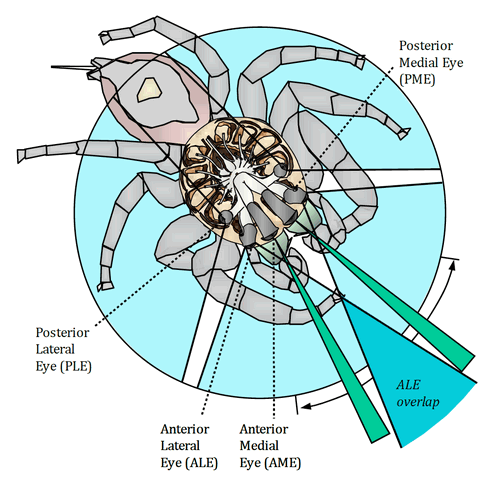
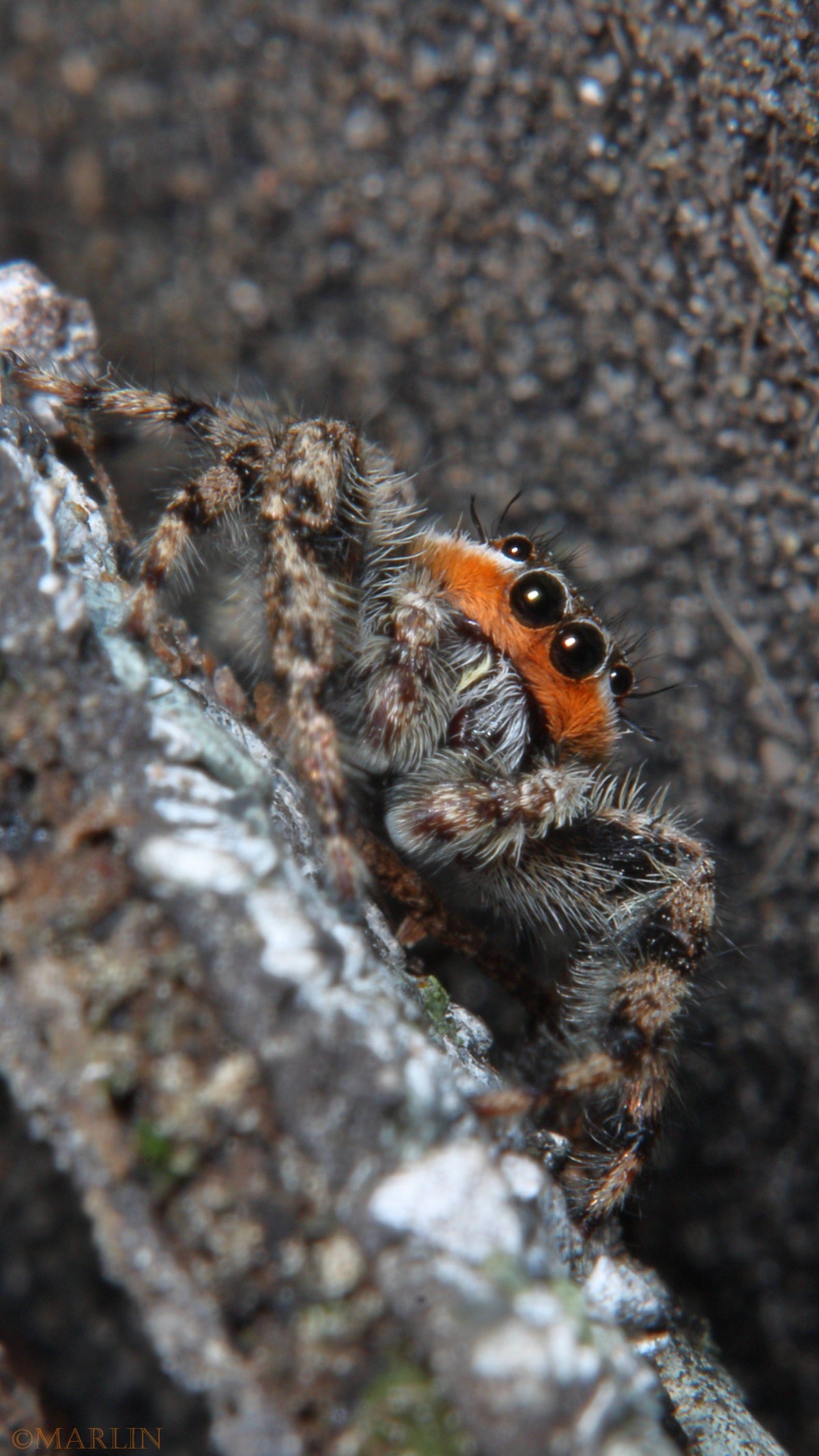
Jumping spiders have excellent vision, with among the highest acuities in
invertebrates. The eight eyes are grouped four on the face (the two big
Anterior Median eyes in the middle, and two smaller Anterior Lateral eyes to
the side), and four on top of the carapace (two medium-sized eyes toward the
back, and two very small eyes in front of them). You can think of the
Anterior Median eyes (AME) as acting like our fovea, with high acuity but
small field of view, and the remaining six eyes acting like our peripheral
vision, with lower resolution but broad field of view.*
|

Two large Anterior Median Eyes provide acute
forward-looking vision |
The AME's are long and tubular, which helps their resolution (longer focal
length, more magnification) but which means they have a narrow field of
view. Since the AME's have a narrow field of view, the spider needs to point
them in different directions to see different things. To some extent this is
done by moving the carapace, but the eyes can move as well. This is not done
by moving the whole 'eyeball', since the lenses of the eyes are actually
built into the carapace. Instead the retina moves around, while the lens
stays fixed. This retinal movement is accomplished by some small muscles. * |
|

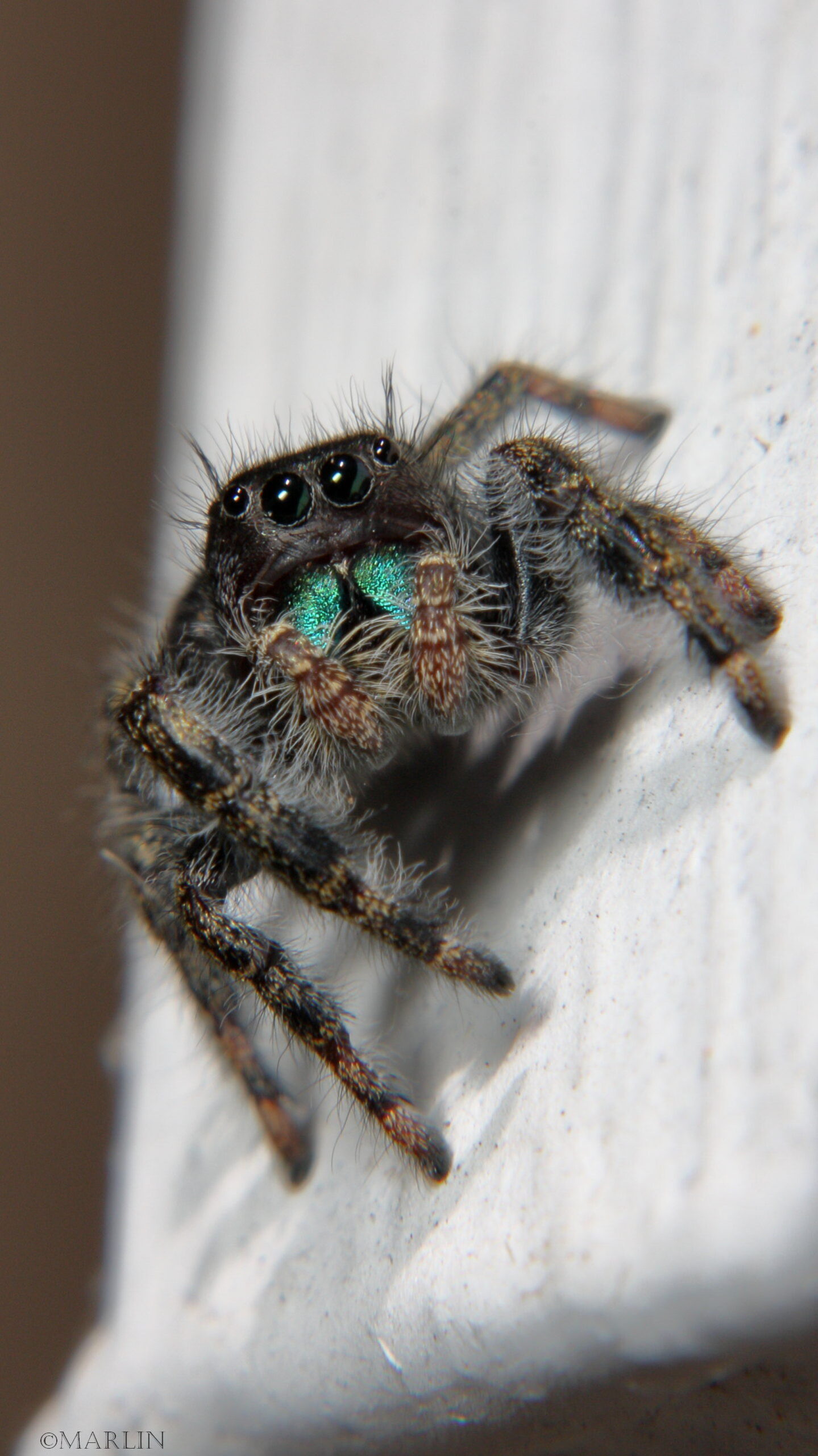
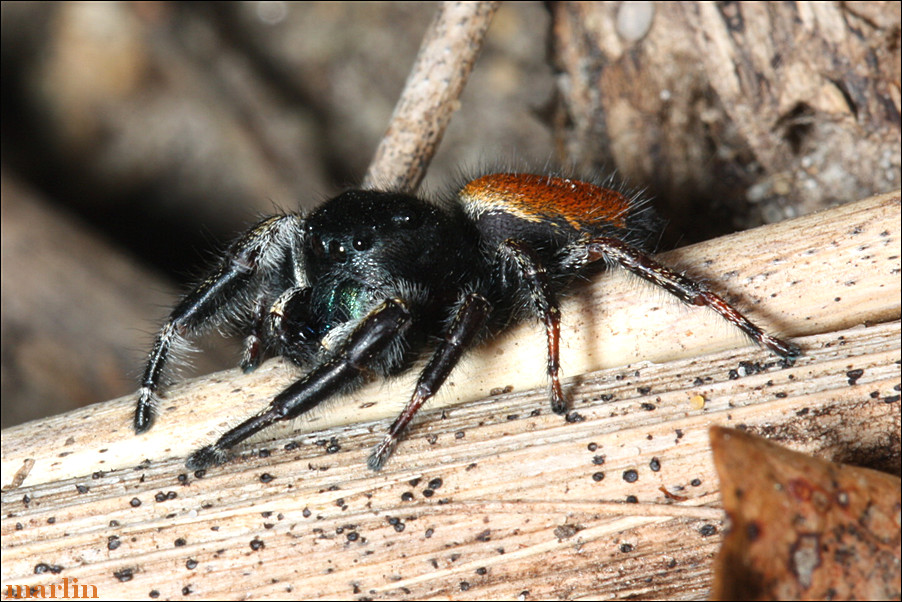
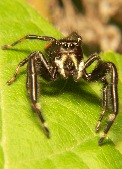
Genus Phidippus: indicative green chelicerae |
Jumping spiders in the genus Phidippus are generally
characterized by their iridescent green chelicerae.

Phidippus princeps
Phidippus otiosus |
 |
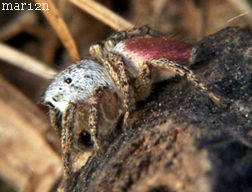
Genus Habronattus is a large diverse genus of medium-sized salticids,
primarily ground-dwellers and with highly ornamented males that perform
complex courtship displays. Approximately 100 species are known, most from
North America, the remainder in the neotropics. Most are ground-dwelling on
open ground with sparse vegetation, especially on rocks, dry leaf litter and
sand. The arid southwest has many species, but Florida also has many
species, and others are known above the Arctic circle and east to maritime
Canada.
For more information and links to the species, go to
Habronattus
.
Identification: The elbowed tegular apophysis ("conductor") of the palp is
distinctive. The third leg is much longer than the fourth, distinguishing
these from other superficially similar genera such as Sitticus. The epigynum
has a triangular or tubular guide. -- From Tree of
Life*
|
|
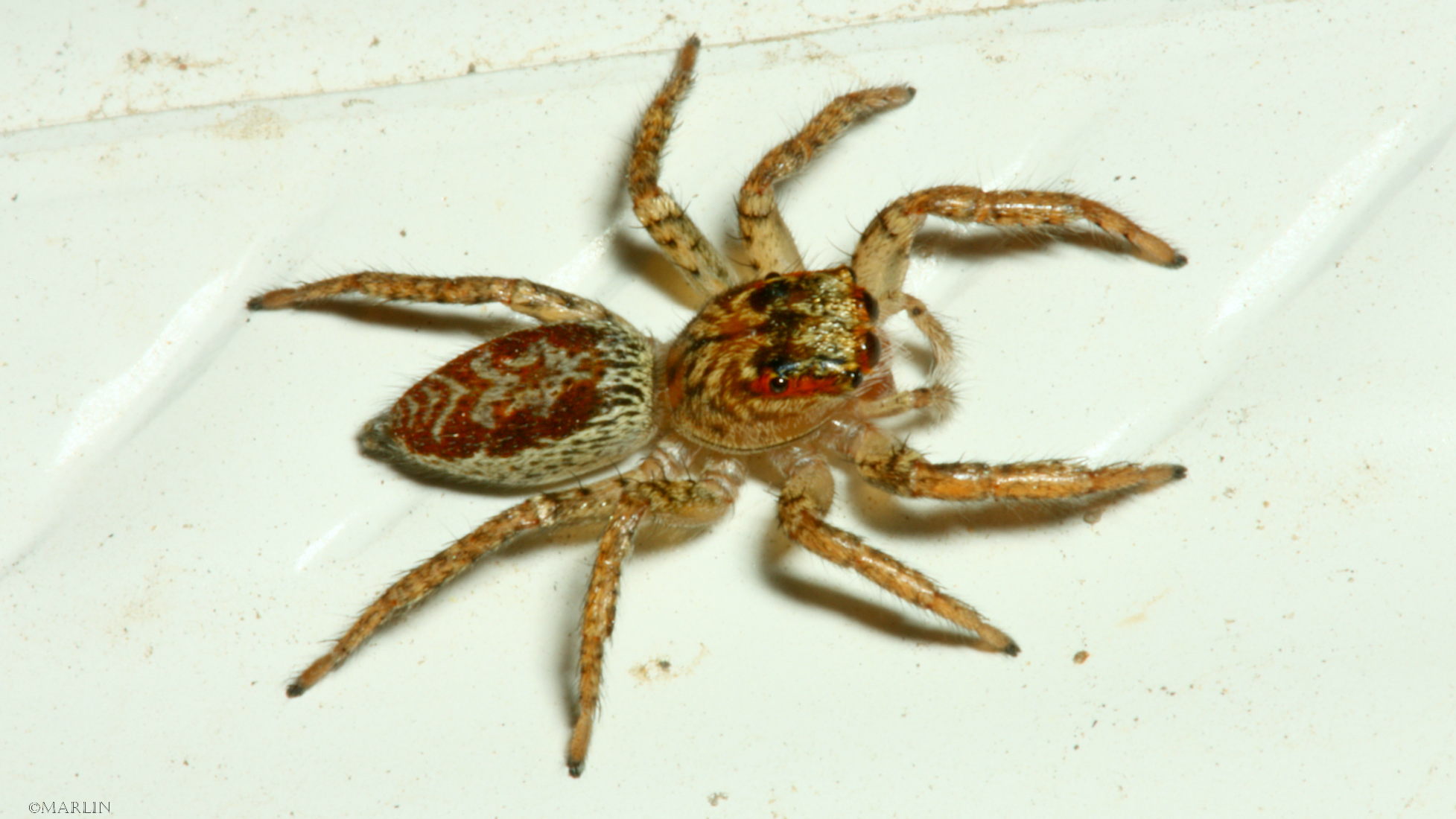
These are live jumping spiders photographed in the wild, unposed. Jumpers do
not build spider webs for trapping prey - they use them for hiding and
laying eggs only. Prey is stalked and killed much like a cat stalks a bird.
A spider silk "lifeline" is always at the ready; if threatened, these guys
rapidly lower themselves into the underbrush. They also use the line to
climb back into position should a jump go awry and they miss their target. |
|
|
 |
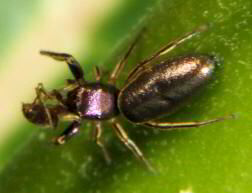
Genus Tutelina - Dendryphantines characterized by unusual
chelicerae. Typically uniform colored, from gray or green to
black, though T. harti is often mottled. Some species have a
prominent V-shaped tuft of black hairs above anterior eye row.
Some species, esp. T. formicaria, are reasonably antlike.
Probably all specialize on eating ants. A closely related genus
is Poultonella. The two share the unusual chelicerae. Somewhat
similar in including mild ant-mimics that are sometimes metallic
is Paradamoetas.
For more information and larger images go
to the species
Tutelina
.
Identification: Chelicerae with a very
stout fang and a keel along the medial margin. |
|

Phidippus princeps - female |
|
|

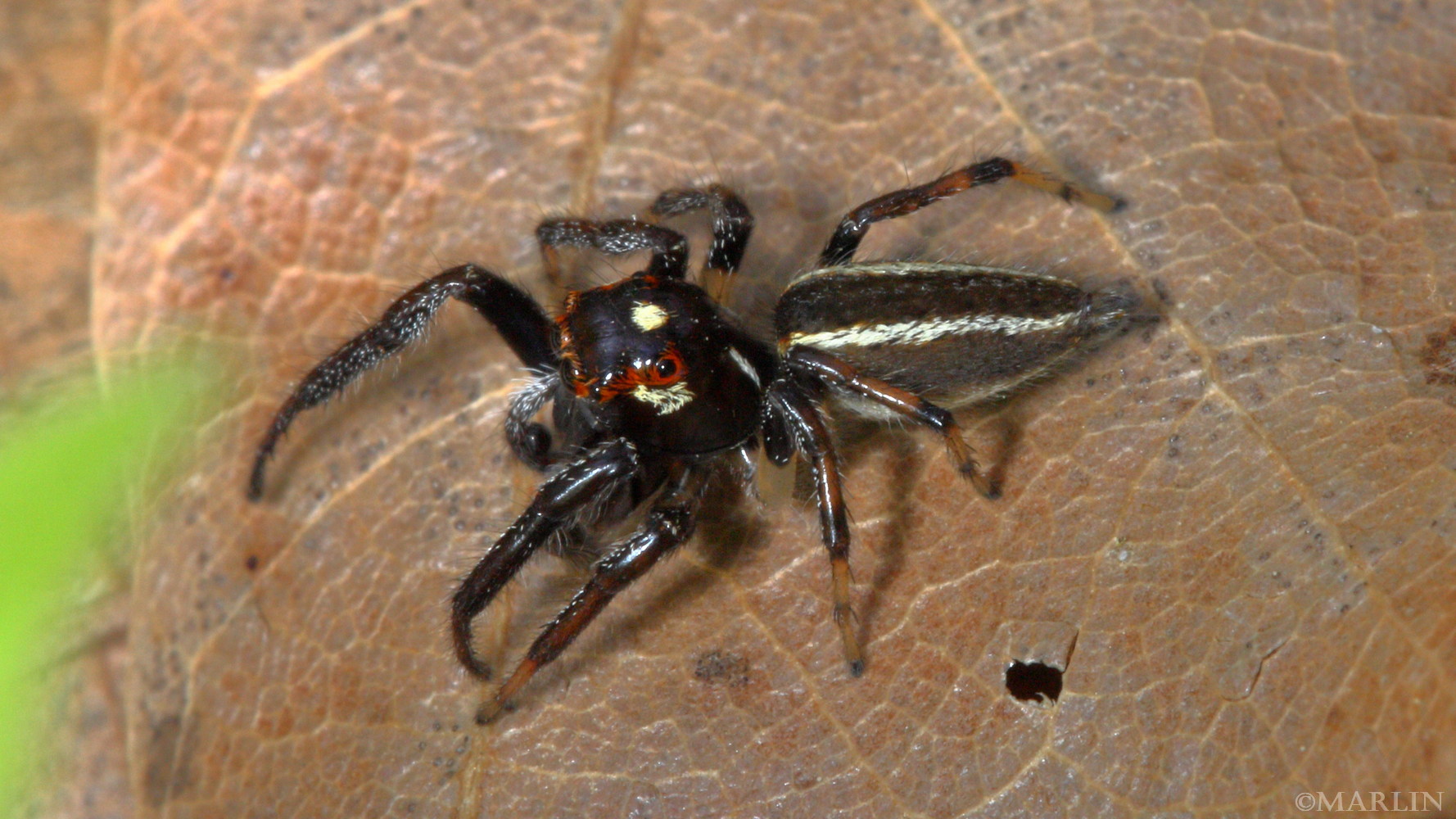
Phidippus clarus - male |
|
|
 |
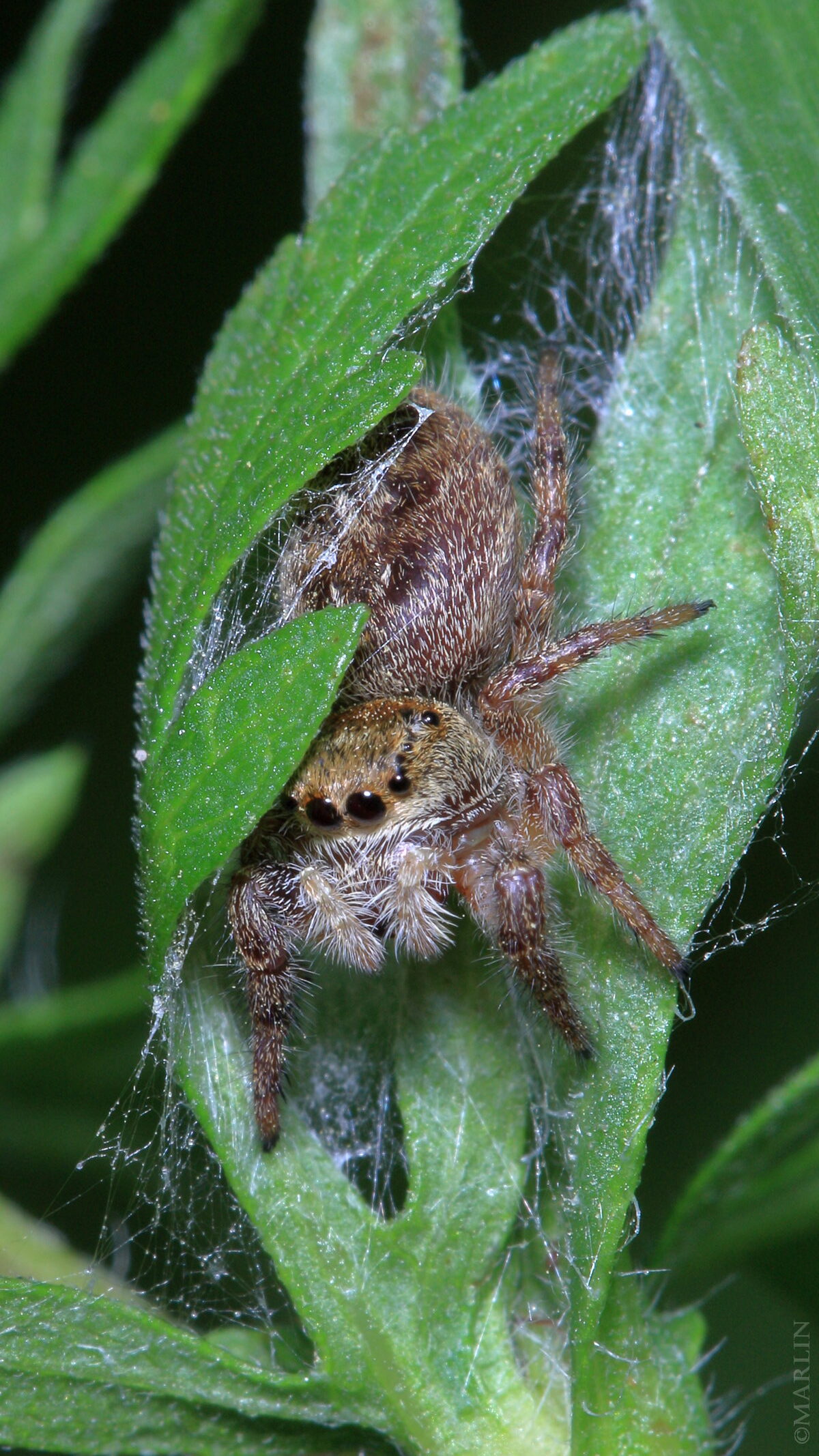
Phidippus species |
The more I see and study jumping spiders, the more captivating
and fascinating they become. It is apparent others feel the same
way; there is no dearth of information on Salticids on the web.
Here are some links explaining astounding features of these
creatures:
The Tree of Life Web Project* has
an excellent jumping off place. There are articles, pictures and
diagrams covering anatomy, physiology, vision, even movies of
them pouncing.
*Excerpts taken from:
Maddison,
Wayne. 1995. Salticidae. Jumping Spiders. Version 01 January
1995
|
|