American Plum - Prunus americana var. lanata [2]
Rose Family: Rosaceae
American plum is a commonly cultivated fruit plant thoughout its range. [4]
[Cirrus Home]   [Trees Graphics]   [Trees Table of Contents]   [Rosaceae Table of Contents]   [Rosaceae Graphics]
  American Plum - Prunus americana

American plum is distributed throughout much of northeastern Canada and a major portion of the United States, although it is less common west of the Great Plains. This native plum occurs from Massachusetts west to Manitoba and western Montana, south through the Rocky Mountains to New Mexico and Arizona, and eastward to northwestern Florida.

American plum is utilized for wildlife habitat and soil stabilization projects in the West. Plummer and others recommend it for use on wet meadow and mountain brush sites in Utah. Although seed dormancy is a problem in almost all species of Prunus, American plum germinates more consistently following cool, moist stratification at 36 to 41 degrees F (2.2-5 deg C) for 90 to 150 days. Vories reported that stratified seed should be planted 1 to 2 inches (2.5-5 cm) deep in the spring or fall; for nursery culture, seeds should be sown at the rate of four seeds per square foot. Seed viability is estimated to be approximately 5 years [10]. This species can also be successfully propagated via stem cuttings.

OTHER USES AND VALUES :
American plum is a commonly cultivated fruit plant thoughout its range. Fruits are used in making pies, jams, jellies, and dessert sauces. A number of horticultural varieties have been derived from this native plum. Rootstocks are utilized for the propagation of plums in northern climates. [4]

American Plum - Prunus americana
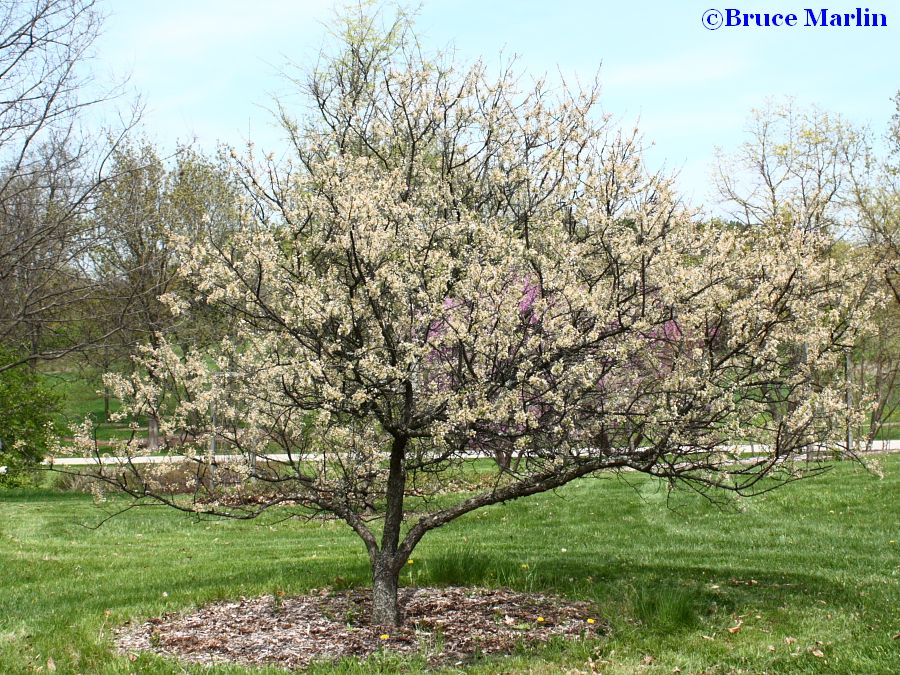
American Plum - Prunus americana var. lanata, Morton Arboretum acc. 439-81*1  May 8th, near Chicago. [2] 
GENERAL BOTANICAL CHARACTERISTICS :
American plum is a native, deciduous, sometimes thicket-forming, erect shrub or small tree. The growth habit of this species can vary considerably; plants range from shrubs approximately 3 feet (1 m) in height to arborescent individuals growing up to 32.8 feet (10 m). On the Great Plains this species typically grows from 9.8 to 26.2 feet (3 to 8 m) tall and is rarely treelike. In Utah, American plum forms thickets reaching heights of up to 16.4 feet (5 m), and treelike individuals are uncommon.
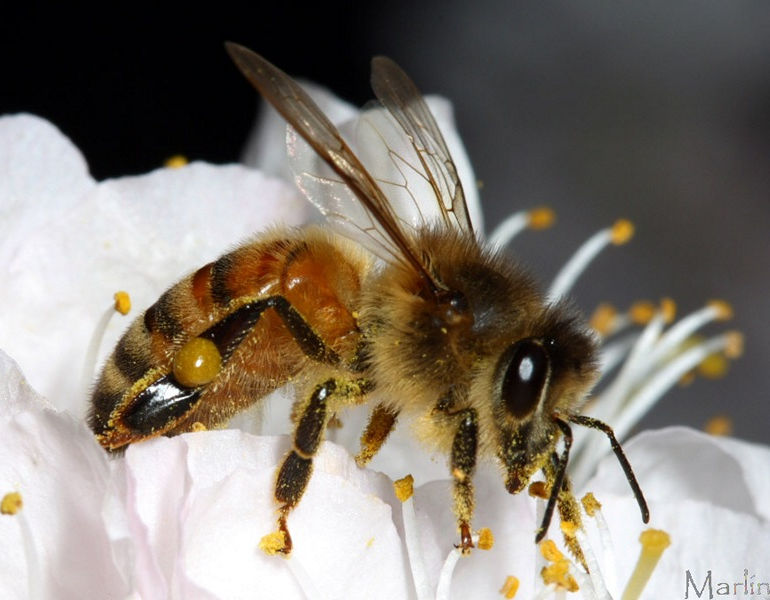
The leaves are somewhat stout with pubescent, usually glandless petioles; twigs often become somewhat spinelike at the tips. White flowers usually appear before the leaves and are borne in fasicles of two to five on the tip of spur branchlets or from axillary buds formed the previous season. Fruits are yellow to red plums (drupes), at least 0.8 inch (2 cm) long with yellow flesh and a compressed stone. Although this species sometimes produces small, hard plums, the fruits are generally fleshy and highly palatable. Occassionally trees cultivated for plums escape and persist. Horticultural varieties can be distinguished from the native species by their larger petals, smaller flower clusters (one to three per node), and sometimes by the gland-tipped teeth of the leaves. [4]
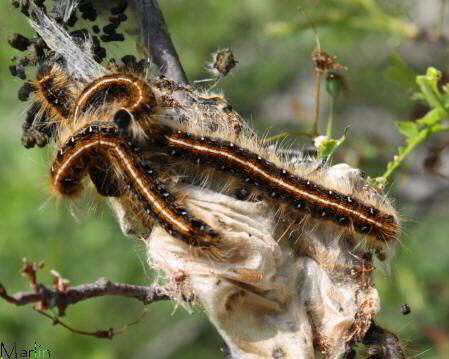
Tent caterpillars
Cherry is often infested with tent caterpillars in springtime.
These pests can strip a tree of foliage in a matter of days.
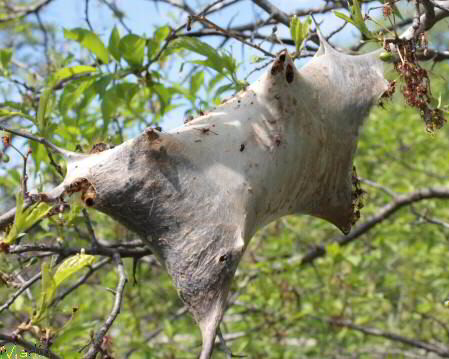
Tent Caterpillar Tent
This tent was found on wild plum.
It contained about 100 caterpillars and 2 lbs. of scat.


American plum typically blooms from April to May in the Pacific Northwest and on the Great Plains. Flowers characteristically appear before the leaves and are borne in fasicles of two to five on the tip of spur branchlets or from axillary buds formed the previous season.

FIRE ECOLOGY OR ADAPTATIONS :
Presumably this native plum is somewhat resistant to fire due to its tendency to spread through underground stems [34]. To a lesser degree, postburn regeneration probably also involves the germination of off-site seed dispersed by mammals. Two other Prunus species indigenous to the western United States, chokecherry (Prunus virginiana) and bittercherry (Prunus emarginata), are well adapted to disturbance by fire. [4]
 

The fruit of American plum is a yellow to red drupe containing a compressed stone. Seeds are approximately 0.6 to 0.7 inch (1.5 to 1.8 cm) long and 0.4 to 0.5 inch (1 to 1.2 cm) wide. As with all species within the Prunus genus, seed dormancy is a problem. In order to overcome dormancy, seeds must be exposed to an afterripening period in the presence of oxygen and moisture.  germination is usually enhanced following cool, moist stratification for 90 to 150 days at 50 degrees F (10 degrees C); germinative capacity is approximately 60 percent following stratification at 50 degrees F (10 degrees C) for 60 days. Germination requirements appear to vary geographically.

American plum seed from northern Minnesota germinated much better at 50 degrees F (10 degrees C) than at higher temperatures; whereas optimal germinating temperatures for seeds from Nebraska are from 70 to 80 degrees F (21.1 to 26.6 degrees C). Seedbed characteristics are virtually unstudied in this species. Although the majority of seeds are presumed to be deposited beneath the parent plant, frugivorous mammals probably function as long-distance dispersal vectors. Rogers and Applegate speculated that black bears are one of only a few disperal agents for large-seeded species such as American plum. [4]

Please visit some of our other tree species and families:


Hickory
 Carya sp.

Umbrella Black Locust
Robinia pseudoacacia
Japanese Horse Chestnut - Aesculus turbinata
Japanese Horse Chestnut
Aesculus turbinata

Tulip-Tree
Liriodendron tulipifera
References
  1. Morton Arboretum, Crabapple: A Tree For All Seasons
  2. American Plum - Prunus americana var. lanata, Morton Arboretum acc. 439-81*1, photographed May 8th, 2009. Photographer: Bruce J. Marlin
  3. Morton Arboretum, Crabapples for the Home Landscape
  4. McMurray, N. 1987. Prunus americana. In: Fire Effects Information System, [Online]. U.S. Department of Agriculture, Forest Service,
    Rocky Mountain Research Station, Fire Sciences Laboratory (Producer). [2009, December 13]

Excerpts from Morton Arboretum articles used with permission.


Dolgo CrabappleSelkirk Crabapple - Malus 'Sekirk'Pink Spires Crabapple - Malus 'Pink Spires'Purple Prince Crabapple - Malus 'Purple Prince'Mary Potter Crabapple - Malus 'Mary Potter'American Masterpiece™ Crabapple - Malus 'Amaszam'Klehm Prairie Crabapple - Malus ioensis 'Klehmii'Christmas Holly Crabapple - Malus 'Chrishozam'Dusky Pear - Pyrus phaeocarpa