Chinese Yew - Taxus chinensis (Pilger) Rehd.
Synonym of Taxus wallichiana Zucc. var. chinensis (Pilg.) Florin (4)
Family Taxaceae -- Yews
Chinese: 红豆杉 hong dou shan (1)


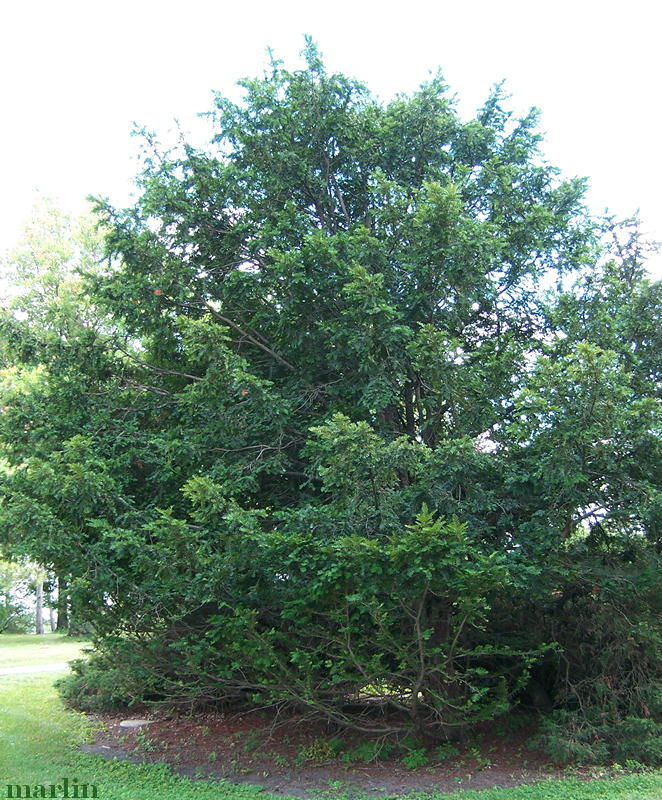
This Chinese Yew is a Morton Arboretum specimen,
started from a seed 52 years ago.
 

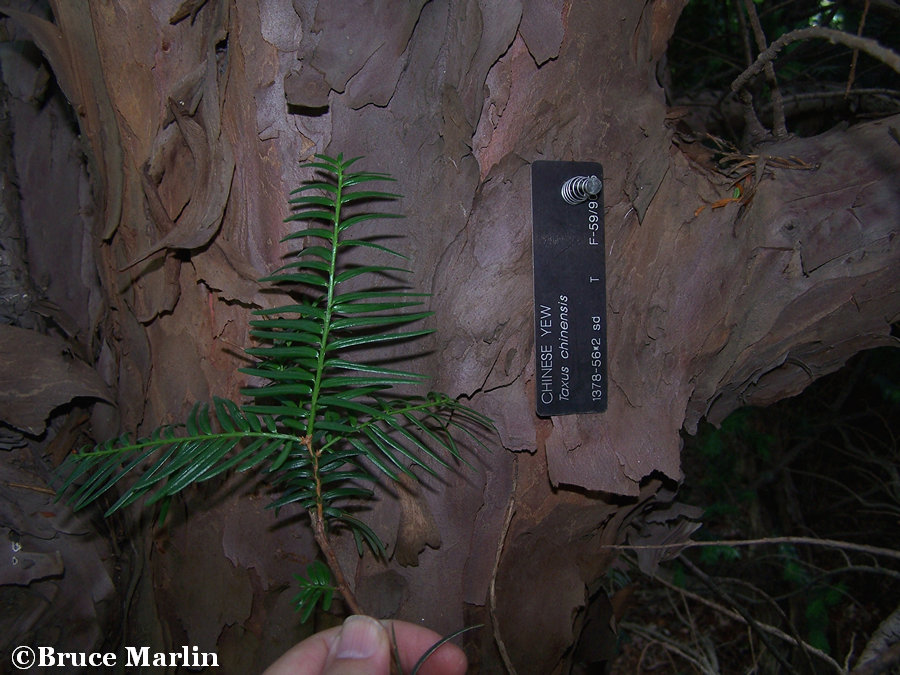
"Leaves linear, straight to distally falcate, usually 1.5-2.2 cm × ca. 3 mm, thick textured, midvein of same color as stomatal band, densely and evenly papillate, margin flat in living state.

Most often found in forests, often among bamboos, frequently by streams; 1100-2500(-2700) m. S Anhui (Huang Shan), Fujian, S Gansu, N Guangxi, SE and W Guizhou, W Hubei, NE Hunan, S Shaanxi, Sichuan, E Yunnan, Zhejiang; cultivated in Jiangxi (Lu Shan) [N Vietnam]." (1)

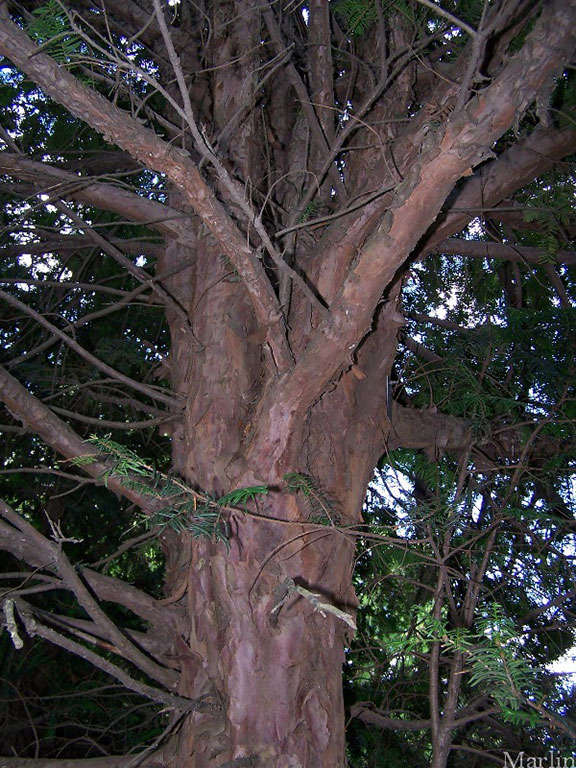
"Evergreen shrub or tree to 14 m tall, wide and bushy when cultivated. "Leaves linear-lanceolate, falcate, spirally arranged, spreading in two ranks, about 1.2-2.7 cm. long, 2-2.5 mm. broad, abruptly pointed at the apex, the base decurrent, yellowish green above, pale green beneath. Seeds drupe-like, the fleshy arillate coat reddish at maturity, ripening in the first season (November). Trunk bark grayish red, with flimsy longitudinal commissure-like chinks, exfoliating in irregular flakes and leaving scars with dachytogram-like streaks on the trunk, flakes about 1.5 mm. thick; lenticels inconspicuous; outer bark about 0.4-1.6 mm., membranous or fibrous, with a reddish brown to orange yellow cross-section; phelloderm more or less conspicuous; inner bark 0.5-0.8 cm. thick, pink finely fibrous; freshly cut cambium and newly formed phloem colorless, transparent, becoming pale orange yellow after cutting. Freshly cut sapwood pale apricot yellow, wood rays inconspicuous" (Liu 1970 [as T. celebica])."
The red spot a Brahmin places in the center of the forehead is made with a paste of powdered yew bark and oil (Liu 1970 [as T. celebica]).

Listed (as T. chinensis and T. wallichiana) as threatened in Viet Nam by the World Conservation Monitoring Centre. - conifers.org 


Taxus wallichiana was found in the late 1960's to yield various compounds useful in treating various forms of cancer in humans, most notably breast cancer. The following is from a World Wildlife Fund treatise:

"Parts used: Leaves and bark. Young branches are used as fodder in Pakistan. The foliage and seeds are toxic. The aril (but not the poisonous seed) is eaten. Uses: Originally, the Pacific yew (Taxus brevifolia) from the north-west US, has entered the Halls of Fame because research into its chemistry resulted in the discovery of the now well-known anticancer drug taxol. The active compound pacilitaxel was first isolated from its bark in 1969. This was followed by development of a drug by the pharmaceutical company Bristol Myers Squibb, subsequently patented under the name taxol. Clinical trials have shown a 56 per cent success rate in treating breast cancer and a 30 per cent success rate in treating ovarian cancer. Taxol taken in combination with other drugs increased the response rate to more than 60 per cent (Phillips et al. 1998).

Approximately 10,000 kg of Pacific yew bark are needed to make 1 kg of taxol. The bark of no fewer than six trees is required for a single dose. High demand, combined with such low yields from such a slow-growing tree, could easily result in the decimation of the species. Clearly, titleernatives had to be found. It was discovered that taxol could be semi-synthesised from chemical precursors found in the twigs and needles (leaves) of the European yew Taxus baccata (Phillips et al. 1998), which is taxonomically very close to the Himalayan yew and possibly the same species. The harvesting of twigs and leaves is much easier to place on a sustainable basis than the harvesting of bark, which in this species is highly destructive. Use of material from the European yew (Taxus baccata) has taken some pressure off the Pacific yew, but it has also led to over-exploitation of Taxus wallichiana along the Himalayas. Taxus wallichiana has other medicinal uses, both in Ayurveda and Tibetan m edicine. In the latter, it is used to treat fever and relieve muscular pain. The timber is excellent and resistant to decay. It is used to cover graves in Pakistan.

Conservation assessment: The collection of material from various types of yew for the preparation of anti-cancer drugs is ever increasing. It is difficult to distinguish between products deriving from the different species. The population of Taxus wallichiana in China considered to be endangered according to World Conservation Union threat categories. In northern India, where it is estimated that there has been a 90 per cent decline in the population over the last few decades, the species has been listed as critically endangered (WCMC 2002).

It has been possible to synthesise taxol since 1994, but the structure of the molecule is so complex that synthetic production is not yet commercially viable. Pharmaceutical companies still rely heavily on wild sources (Schippmann 2001).

Conservation recommendations:
The demand for cancer cures is of course continually increasing. To substitute harvesting from the wild fully for harvesting from cultivated trees might take many years. Thus the development of sustainable harvesting systems, combined with replanting and regeneration, is necessary. Enabling legislation would be desirable. Until recently, there has been very little research into the commercial cultivation of Taxus wallichiana, which is a slow-growing tree. Despite this, cultivation of Taxus wallichiana is now becoming very popular in India and Nepal. One approach, recently highlighted, is to encourage farmers to plant yews along the margins of their fields and to manage them in hedge form by regular clipping; titleernatively, they may incorporate the tree into their cropping systems.

Dabur India Ltd, a large manufacturer of plant-based medicines, is propagating the species through cuttings, then distributing the seedlings to farmers to grow under contract (Outgrower strategy, see Phillips et al. 1998). Other pharmaceutical companies should be encouraged to follow this example, and to support research. It is possible that improved methods of synthesising taxol, or increasing the amounts of yew under cultivation, will eventually take some of the pressure off the wild plants. Increased cultivation is to be encouraged, but cultivation could have its drawbacks. For instance, without further measures such as improved management of wild trees, it might not result in a reduction in unsustainable harvesting. This is because, unless undertaken with care, cultivation is most likely to be adopted by relatively well-off farmers, while those with little or no land might be forced to continue wild harvesting in the absence of titleernative sources of income."


Native:

  • ASIA-TEMPERATE
    China: China - Anhui [s.], Fujian, Gansu [s.], Guangxi [n.], Guizhou [s.e. & w.], Hubei [w.], Hunan [n.e.], Shaanxi [s.], Sichuan, Yunnan [e.], Zhejiang

  • ASIA-TROPICAL
    Indo-China: Vietnam [n.]


This Chinese Yew is a Morton Arboretum specimen, started from a seed 52 years ago.


References:
1. Flora of China
2. USDA NRCS Plant Guide
3. USDA NRCS Threatened and Endangered species
4. USDA, ARS, National Genetic Resources Program.
Germplasm Resources Information Network - (GRIN) [Online Database]

5. University of Michigan Native American Ethnobotany
 

MORE TrEES


       web      www.cirrusimage.com