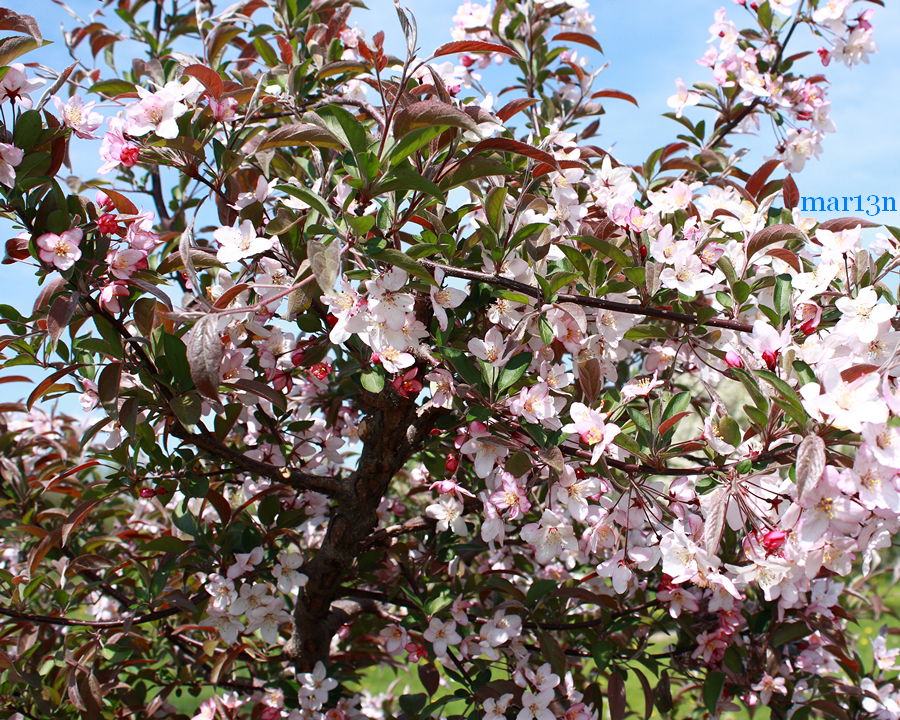
May's Delight Crabapple - Malus 'May's Delight' [2]
Rose Family: Rosaceae
The Royalty Crabapple is an outstanding ornamental with single, dark red blossoms in spring that produce large, dark red fruit.  [Cirrus Home]   [Trees Graphics]   [Trees Table of Contents]   [Rosaceae Table of Contents]   [Rosaceae Graphics]
  May's Delight Crabapple

May's Delight is a slow growing hybrid crab from a seedling block of Malus sargentii and has a distinctive upright habit, bright rose flower buds opening to pink. Crabapples are dark burgundy wine in color, but the tree is not a heavy fruiter. Foliage is reddish purple tinged with a light underside, and excellent disease resistance. A more vigorous grower than M. sargentii.

USDA hardiness zones: 4 through 8A (Fig. 1)
Planting month for zone 7: year round
Planting month for zone 8: year round
Origin: not native to North America
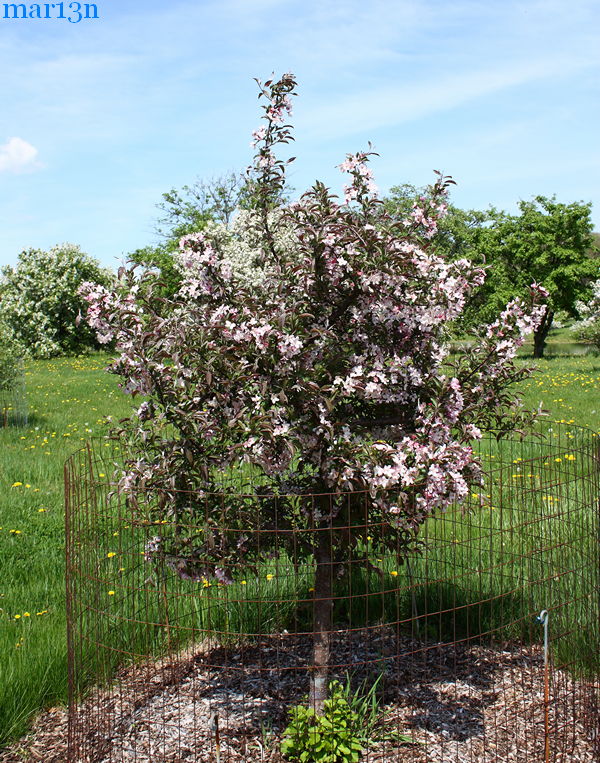
Uses: residential street tree; espalier; small parking lot islands (< 100 square feet in size); medium-sized parking lot islands (100-200 square feet in size); large parking lot islands (> 200 square feet in size); narrow tree lawns (3-4 feet wide); medium-sized tree lawns (4-6 feet wide); wide tree lawns (>6 feet wide); recommended for buffer strips around parking lots or for median strip plantings in the highway; container or aboveground planter; trained as a standard; bonsai Availability: generally available in many areas within its hardiness range.

Description
Height: to 15 feet / Spread: to 15 feet
Plant habit: spreading / Plant density: dense
Growth rate: moderate / Texture: medium

Foliage
Leaf arrangement: alternate, simple, crenate, serrate, elliptic;
Leaf venation: brachidodrome; pinnate / Leaf type and persistence: deciduous
Leaf blade length: 2 to 4 inches
Leaf color: green
Fall color: yellow
Fall characteristic: not showy
Flower color: pink, white
Flower characteristic: very showy; pleasant fragrance 
May's Delight Crabapple
Fruit shape: round / Fruit length: < .5 inch / Fruit covering: fleshy Fruit color: orange; red
Fruit characteristics: attracts birds; no significant litter problem; persistent on the tree; showy

Trunk/bark/branches: droop as the tree grows, and will require pruning for vehicular or pedestrian clearance beneath the canopy; routinely grown with, or trainable to be grown with, multiple trunks; not particularly showy; tree wants to grow with several trunks but can be trained to grow with a single trunk; no thorns.

Requires pruning to develop strong structure. Resistant to breakage and windthrow.
 Tree Hardiness Zone Map

Fig. 1
Hardiness zone map courtesy the Arbor Day Foundation*


Diseases
Many flowering crabapples are made unsightly or are severely injured by one or more of four common diseases—apple scab, fire blight, cedar-apple rust, and powdery mildew. Unless resistant crabapples are selected and grown, fungicide sprays used as disease preventatives must be included in the maintenance program.

Apple Scab
This common fungal disease is a serious problem in Kentucky on many flowering crabapple varieties, causing spotting of the leaves, premature defoliation, and unsightly corky spots on the fruit. Spots on the new leaves appear olive-colored and velvety. Later, the infections appear as olive-green or brown circular spots, with raised or puckered leaf tissue underneath. Scab spots may appear on leaves anywhere on the tree.

When severe infections take place, the leaves yellow and the tree may lose almost all its leaves by midsummer. Typical fruit lesions are distinct, almost circular, rough-surfaced, olive-green spots, which later turn brown to black.

The apple scab fungus, Venturia inaequalis, overwinters in old, infected, fallen leaves. In spring, the fungus produces spores which land on crabapple foliage or fruit and infect the plant if the tissue surface is wet for several hours. The fungal infection results in leaf lesions, where more spores are produced to begin additional cycles of infection throughout the growing season. Secondary infection may also occur from spores produced on scab lesions found on the twig growth of extremely susceptible crabapples such as Malus ‘Almey,’ M. ‘Hopa,’ and M. x purpurea ‘Eleyi.’

Control: Use scab-resistant varieties in new plantings. Scab infection on established trees may be prevented by three to five applications of fungicides at 10 to 14 day intervals starting as soon as bud growth appears and continuing until mid June. Scab is most severe during wet growing seasons. [4]

May's Delight Crabapple
May's Delight Crabapple - Malus 'May's Delight', Morton Arboretum acc. 420-2004*1  May 8th, near Chicago. [2] 

Please visit some of our other tree species and families:


Hickory
 Carya sp.

Umbrella Black Locust
Robinia pseudoacacia
Japanese Horse Chestnut - Aesculus turbinata
Japanese Horse Chestnut
Aesculus turbinata

Tulip-Tree
Liriodendron tulipifera
References
  1. Morton Arboretum, Crabapple: A Tree For All Seasons
  2. May's Delight Crabapple - Malus 'May's Delight', Morton Arboretum acc. 420-2004*1, photographed May 8th, 2009. Photographer: Bruce J. Marlin
  3. Morton Arboretum, Crabapples for the Home Landscape
  4. R.E. Durham, R.E. McNiel, J.R. Hartman, D.A. Potter, and W.M. Fountain, University of Kentucky College of Agriculture, The Flowering Crabapple

Excerpts from Morton Arboretum articles used with permission.


Dolgo CrabappleSelkirk Crabapple - Malus 'Sekirk'Pink Spires Crabapple - Malus 'Pink Spires'Purple Prince Crabapple - Malus 'Purple Prince'Mary Potter Crabapple - Malus 'Mary Potter'American Masterpiece™ Crabapple - Malus 'Amaszam'Klehm Prairie Crabapple - Malus ioensis 'Klehmii'Christmas Holly Crabapple - Malus 'Chrishozam'Dusky Pear - Pyrus phaeocarpa