 |
Scots Pine or Scotch Pine -
Pinus sylvestris
Waterer Scots Pine - Pinus sylvestris 'watereri'
Family:
Pinaceae.
Scotch pine is an introduced species in North America, brought here from
Europe probably in colonial days. although it is used for both pulpwood
and sawlogs, its principal value in the United States appears to be as a
Christmas tree, as an ornamental, and for erosion control. |
|
|

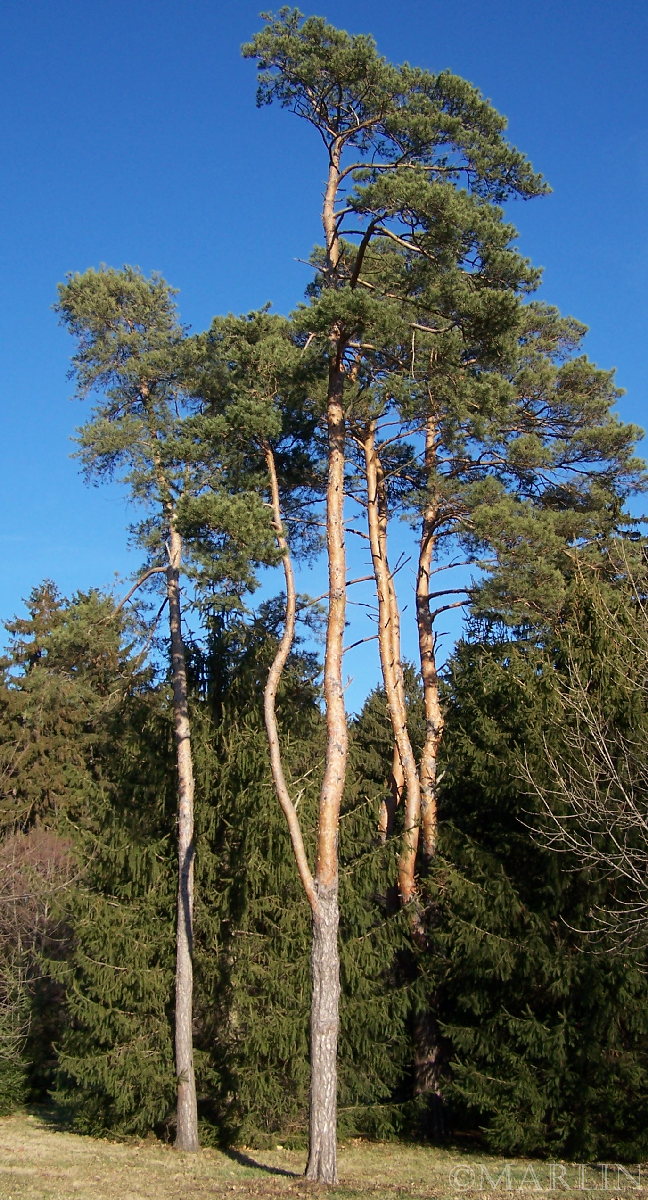
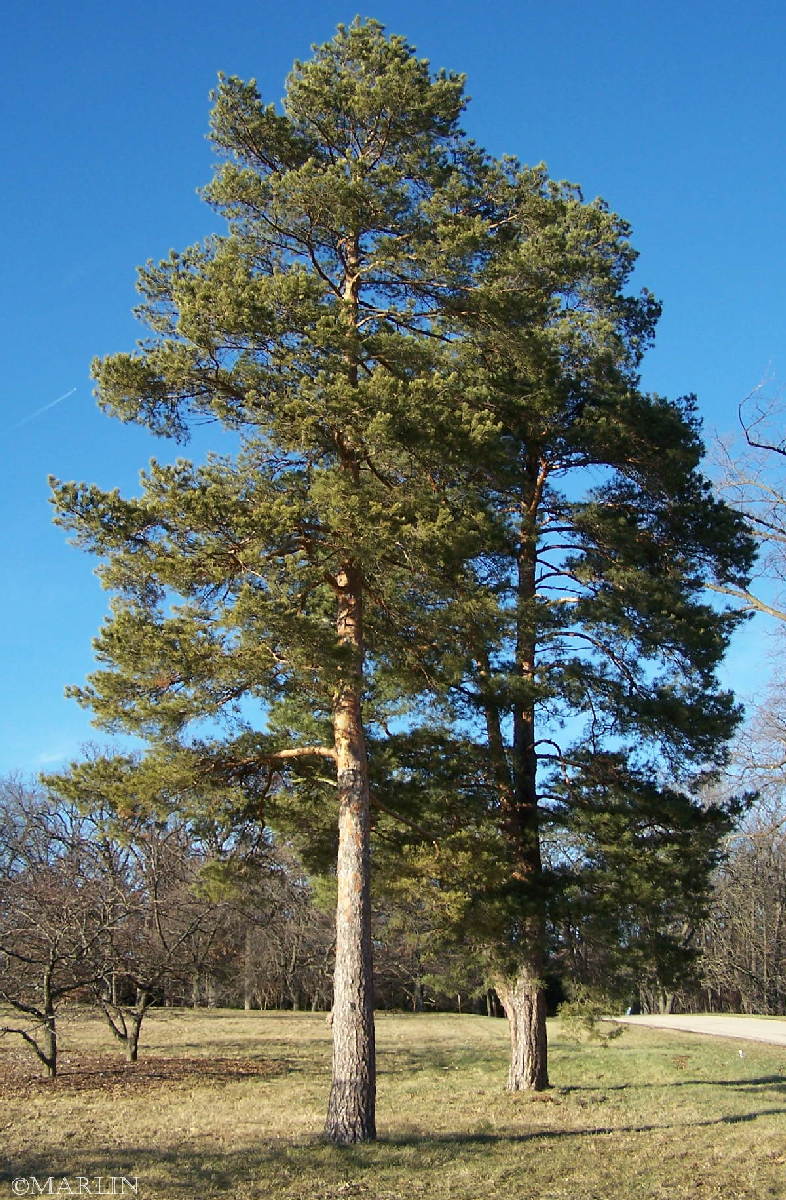
This Morton Arboretum specimen shows the bright orange bark of Scots
Pine. |

These elegant Scots pines are 78 years old, part of the original
Morton Arboretum plantings circa 1924. |
-
|
You can see an
aerial view of these
two trees by
selecting "Live
Maps" from the above
toolbar, then
selecting "birds eye
view."
(You may have to
install Microsoft's
Virtual Earth, a
free program with
amazing bird's eye
views Google Maps
does not have).
|
|
Scotch pine has been
widely planted in
the United States,
especially in the
Northeast, Lake
States, Central
States, and Pacific
Northwest. It is now
considered
naturalized in parts
of New England and
the Lake States. The
species has also
been planted across
southern Canada.
Scotch pine is the
most widely
distributed pine in
the world. It grows
naturally from
Scotland almost to
the Pacific Ocean
and from above the
Arctic Circle in
Scandinavia to the
Mediterranean. Its
titleitudinal range is
from sea level to
about 2440 m (8,000
ft). Scotch pine is
adapted to a wide
variety of climates
as indicated by its
extremely large
natural range. It
grows in areas with
an annual
precipitation
exceeding 1780 mm
(70 in) and in areas
with an annual
precipitation as
little as 200 mm (8
in). Scotch pine
survives in the
Verkhoyansk
Mountains of eastern
Siberia where winter
temperatures have
been recorded as low
as -83° F. In some
areas it grows where
the subsoil is
permanently frozen.
Scotch pine can also
survive high
temperatures, and it
is found at middle
titleitudes in the
Mediterranean
region. The primary
distribution of
Scotch pine,
however, indicates
that it is a tree of
the continental
climates.
Scotch pine, like
many of the hard
pines, is intolerant
of shade. Seedlings
germinating under a
dense forest canopy
do not survive for
long. although the
seedlings will grow
very well on fertile
soil, they are
usually found on the
more sandy dry soils
because of the lack
of competition from
other trees and
plants.
During the last
century, Scottish
foresters have had
serious difficulties
establishing Scotch
pine regeneration
under mature pine
stands. This
difficulty appears
to be partly due to
grazing by deer and
domestic animals.
Successful
regeneration has
been achieved,
however, with the
uniform or
shelterwood
compartment system,
which also appears
to be successful in
the Scandinavian
countries.
The best
regeneration is
found in stands with
the following
characteristics:
large seed supply,
open or light tree
canopy, light
understory ground
cover, and exposed
mineral soil or no
continuous layer of
raw humus.
In the United States
in the Northeastern
and Lake States,
Scotch pine
reproduction is
extremely abundant
on the more sandy
sites. As soon as
the parent stand
reaches seed bearing
age, it begins to
spread outward into
firebreaks and along
open roadsides. In
many areas
reproduction is so
plentiful as to
present a mat of
seedlings, and this
aggressive
reproductive habit
has concerned
foresters who
preferred to grow
other conifer
species on these
sites. A recent
event in New York
may change this
reproductive
potential of Scotch
pine. When
scleroderris canker
(Gremmeniella
abietina) is
present in the
Scotch pine
overstory, the
advance reproduction
can be completely
eliminated. As this
disease has advanced
across northern New
York, the "mats" of
Scotch pine
reproduction have
become seas of dead
seedlings. New
seedlings continue
to germinate under
the parent stand but
become infected and
die within 1 or 2
years. Scleroderris
canker is present in
Scotland but it is
not known whether
this disease is
related to the
reproduction
problems there. (1)
|
-

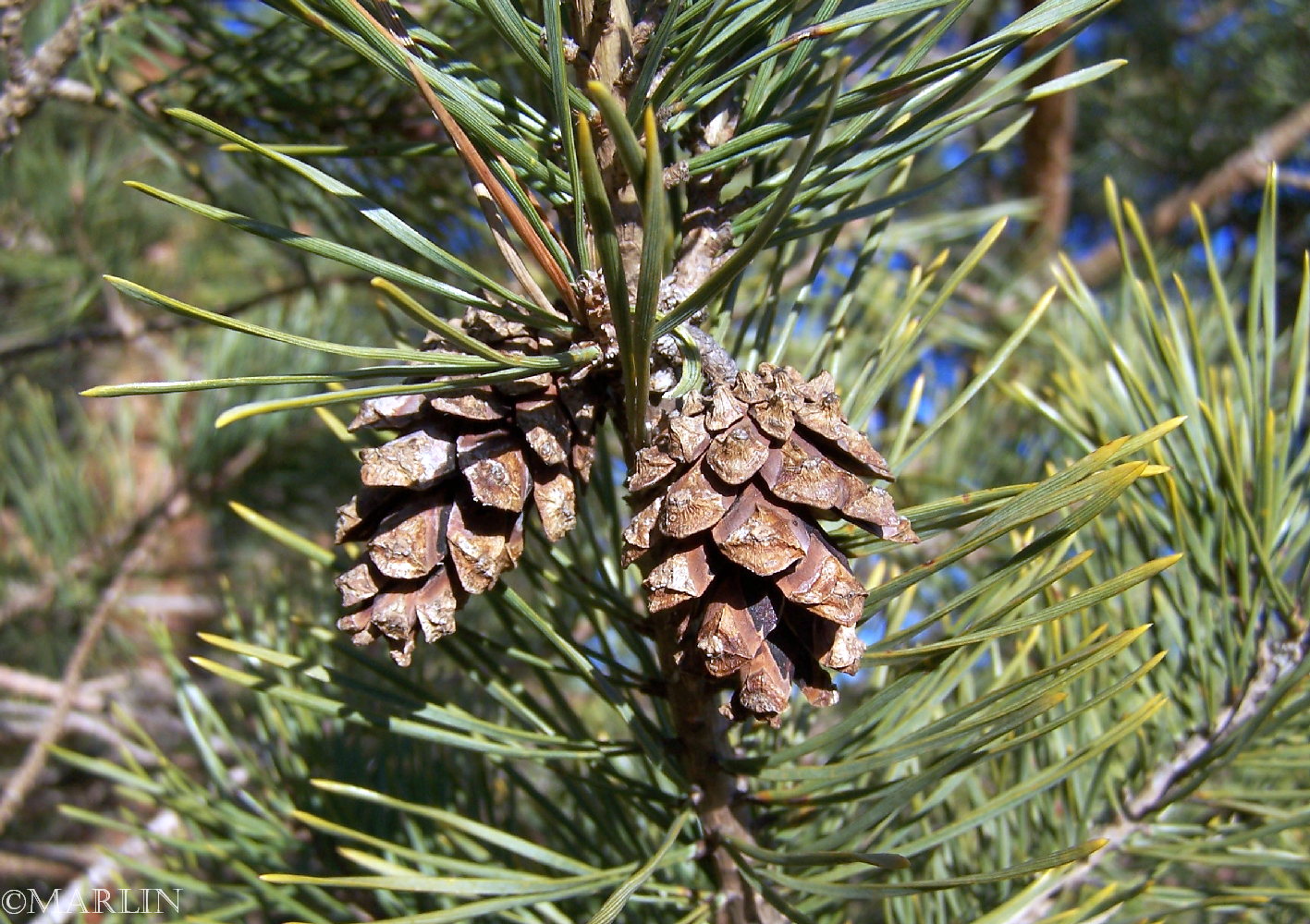
Scots Pine Cones and Foliage
|
Flowering and
Fruiting-
although Scotch
pine is
primarily a
monoecious
species, some
shoots,
branches, and
even entire
trees are
predominantly of
one sex. Male
flower primordia
are formed in
late summer at
the base of the
bud that will
make the next
year's growth.
During the
winter their
presence can be
noted as a
slight swelling,
and the
preferred male
catkins are
easily visible
if a bud is
dissected. About
2 weeks after
growth begins in
the spring, the
male catkins
enlarge to 0.6
to 0.7 cm. (0.2
to 0.3 in) long
and shed pollen.
At this time
they are yellow.
The male catkins
are borne at the
base of the
twigs, replacing
leaf clusters.
They are most
common in the
lower part of
the crown and on
short lateral
twigs. Because
they replace
leaves, an
excess of pollen
production can
lead to sparse
foliage. A
Pennsylvania
breeder who
selected for
early flower
production for
two generations
obtained a
variety that
produced
plentiful pollen
but few needles
and it was
worthless as a
Christmas tree.
Female flower
primordia are
also formed in
late summer but
are microscopic.
They are borne
at the tips of
buds for the
next year's
growth. There
may be one, two,
or three on a
single bud. They
first become
visible after
the buds expand
in the spring.
The primordia
enlarge into
female flowers
or strobili
about 2 weeks
after growth
begins in the
spring, at a
time when the
new growth has
completed 75
percent of its
elongation for
the season.
Because of this,
shearing of the
outside branches
such as is
practiced by
Christmas tree
growers removes
all female
flowers. Indeed,
trees sheared in
June will not
produce seed for
the next 3.5
years.
Flowering occurs
in late May or
early June. On
any one tree
nearly all
pollen is shed
and nearly all
the female
flowers are
receptive during
the same 2- or
3-day period. In
any one stand
most trees
flower within a
day or two of
each other.
Trees of
different
provenances may
differ in
blooming time by
several days,
however; trees
of northern
provenances
bloom the
earliest.
Pollen
production tends
to be
concentrated on
short lateral
twigs in the
lower half of a
tree crown.
Female flowers
are borne on the
most vigorous
shoots. They
tend to be
concentrated on
upper branches
but may occur in
any part of the
crown receiving
full sunlight.
Pollination
occurs in early
summer, at a
time when the
female strobili
are from 0.6 to
0.7 cm (0.2 to
0.3 in) long.
Shortly after
pollination, the
scales of the
female strobili
thicken, and the
pollen grains
germinate and
send out a short
pollen tube. At
this time the
female strobili
become reflexed
instead of
pointing
forward. For the
next 12 months
the germinated
pollen remains
dormant and the
female strobili
grow little. A
little more than
a year after
pollination, the
germinated
pollen grains
renew growth and
fertilize the
ovules. In June,
soon after
fertilization,
the conelets
rapidly elongate
and reach full
size by early
summer. Seeds
mature and cones
ripen in early
October. The
cones require
titleernating
periods of dry
and wet weather
to open and shed
few seed until
early winter.
Indeed, many
seeds are
retained on the
tree until early
spring.
Seeds from any
one tree can be
sorted visually
by color into
those that are
full and those
that are
empty-empty
seeds are much
lighter in color
(often nearly
white) than full
ones. On any one
tree the full
seeds are fairly
uniform in color
and size, but
both traits vary
considerably
from tree to
tree. Trees from
the same stand
may produce
seeds ranging
from tan to
almost black and
from all one
color to
speckled. Seed
size varies in a
geographic
pattern-seeds
from the extreme
northern
latitudes are
half the size of
those from the
southern part of
the range. (1) |
|
|

Scots Pine Bark (lower trunk)
|
Damaging Agents- Scotch pine in
North America is subject to a number of
agents that can severely damage or kill
the trees. Some of these agents are not
present in Europe and Asia and, as a
result, the species has not yet had an
opportunity to develop genetic
resistance. Fire and wind can damage
the trees. Young stands have thin bark
and are heavily damaged by fire. Older
trees with thicker bark are moderately
resistant. Scotch pine has more branches
per whorl than red or white pine and
this large number of branches makes the
tree weak at the nodes. During severe
wind storms, trees may snap off at the
nodes 3 to 6 m (10 to 20 ft) above the
ground. Wildlife and insects are also
damaging. The pine grosbeak feeds on the
terminal and lateral buds of Scotch pine
causing numerous small crooks. Trees of
Scandinavian provenances are heavily
attacked. In Christmas tree plantations,
this feeding can cause major economic
losses; a single year's feeding can
reduce the tree harvest by 50 percent.
This is a minor problem to timber
growers, however. On occasion, porcupine
seriously damage Scotch pine plantations
by girdling young trees, causing dead
tops.
The pine root collar weevil
(Hylobius radicis) is a major cause
of tree death in young plantations in
the Lake States. The weevil girdles the
tree at the base, killing it within 3 to
4 years. The damage is especially severe
on dry sandy soils. The fast-growing
central European trees are particularly
susceptible (26). In Michigan, on low
quality sites, mortality frequently
reaches 70 to 80 percent. The pine root
tip weevil (Hylobius rhizophagus)
causes serious damage in Michigan on
Scotch pine Christmas trees grown from
stump culture. These trees result from
leaving the lower limbs on cut trees to
grow into a second tree crop. The pine
root tip weevil larvae feed on the roots
and root tips, resulting in reduced
height growth and flagged shoots, and
eventual death. In some cases the pine
root tip weevil and the pine root collar
weevil attack some Scotch pine stands
simultaneously, causing more mortality
than expected from either insect alone.
The European pine sawfly
(Neodiprion sertifer) causes
moderate damage in Christmas trees and
ornamental plantings. Heavy defoliation
reduces growth from 10 to 20 percent.
The fast-growing Scotch pine variety
uralensis shows some resistance to
this insect while the slow-growing
variety iberica is most
susceptible.
Scotch pine is also a host for brown
spot needle disease of southern pines
(Scirrhia acicola). This disease,
like Lophodermium, causes
premature defoliation and is primarily
limited to Christmas tree plantations.
The long needle provenances are also
more resistant to this disease.
Western gall rust (Endocronartium
harknessii) is common on Scotch pine
in the Lake States and the Northeast.
Individual trees may have several
hundred galls. In most cases damage is
limited to branch mortality and growth
loss. As described earlier, Scotch pine
is susceptible to scleroderris canker.
This disease is present in many areas in
Europe, and as a result, certain Scotch
pine provenances show some resistance.
Scotch pine is more resistant to
scleroderris canker than red pine, and
in some areas, red pines have been
eliminated from the stand while Scotch
pines are still alive. Scleroderris
canker can be spread on cut Scotch pine
Christmas trees. Therefore, State
quarantines have been established to
prevent the movement of this disease
into noninfected areas.
When southern seed sources of Scotch
pine are planted too far north of their
normal range, severe foliage winter
injury develops. This winter injury
causes both branch and tree mortality.
In the Lake States, a large number of
Christmas tree plantations have been
destroyed by this problem. Many of these
problems in Scotch pine plantations are
the result of planting this species on
very poor sites or planting the wrong
seed source. Scotch pine has the
inherent ability to produce excellent,
straight-boled stands under the proper
conditions. Hundreds of Scotch pine
plantations throughout the Lake States
and the Northeast are equal to or better
than the best red pine stands. When
Scotch pine is planted on very poor
sites, however, or when improper seed
sources are used, damage by insects is
so severe as to make the final stand
useless for timber production. (1) |
|
|
|

26-year-old
Scotch Pine
More:
(2)
|
Scots Pine shoot, in
spring, with two-year old
seed cone
(open, brown), one-year old
seed cone (green), and
new seed cones (red) and
pollen cones (yellow).
Photo via
Wikimedia Commons
published under
GFDL |
|
| Scotch pine is the most widely
planted pine introduced in North
America. It is also the preferred
large-volume Christmas tree in the
United States- approximately 30 percent
of the 35 million Christmas trees
harvested annually are Scotch pine (20).
Because it survives on poor droughty
sites, Scotch pine has been used to
control erosion in many areas. However,
the poor vigor of many of these stands
on dry, infertile sites has made them
susceptible to serious insect attack and
many of them have little potential to
produce timber (28).
Scotch pine has also been used to a
large extent in ornamental plantings. It
grows better than red pine on compacted
clay soils frequently found around
home sites. Because Christmas tree
plantations are a ready source of trees,
many trees are removed from these
plantations as ornamental stock. Many
Scotch pine have also been planted along
roadsides throughout the Lake States.
Scotch pine is similar in fiber and wood
characteristics to red pine and is
usable for both pulpwood and saw logs.
(1) |
|

Morton Arboretum accession 661-65*2
Waterer Scots Pine - Pinus sylvestris
'watereri' |
References:
1.
USDA
Forest Service Pinus sylvestris - Scotch Pine
2.
USDA, ARS, National Genetic Resources Program.
Germplasm Resources Information Network - (GRIN)
[Online Database]
MORE TrEES |
|
|
|