Siberian Elm - Ulmus pumila
Elm Family: Ulmaceae.
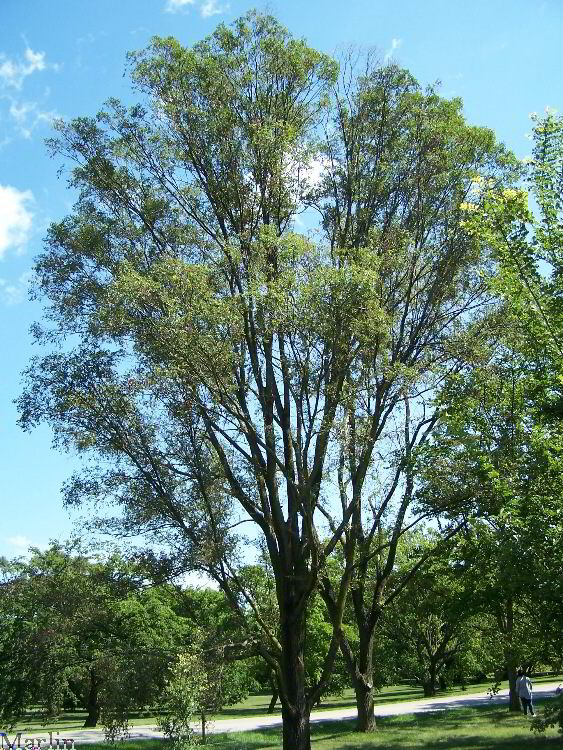
Classified as an invasive in North America, the Siberian elm is a medium sized tree reaching up to 70 feet tall; typically a shabby looking tree due to considerable limb breakage and sprouting along the trunk. This specimen was photographed at The Morton Arboretum at Lisle, Illinois, USA.


37-year-old Siberian Elm
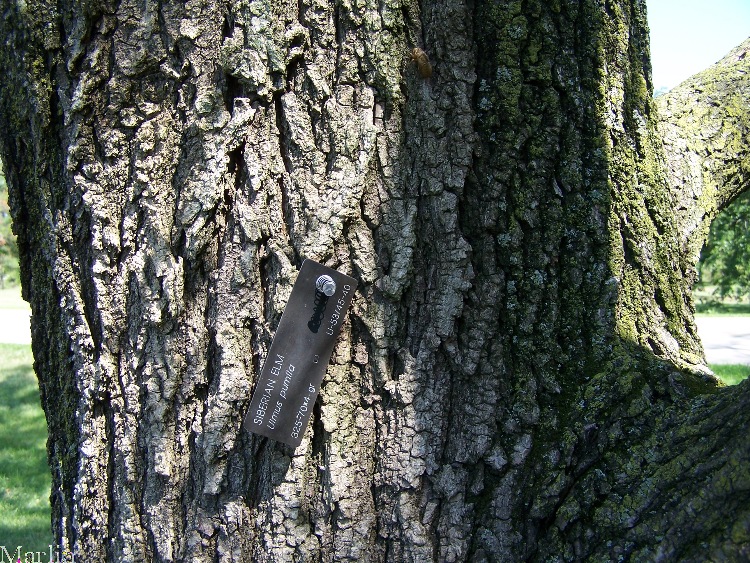
The crown is open and rounded with slender, spreading branches. The leaves are small (< 2 in.) alternate, simple, singly-serrate, and dark-green in color. The bark is light-gray with irregular furrows. Siberian elm invades pastures, roadsides, and prairies throughout the Midwest and Great Plains regions of the United States. The trees are very drought and cold resistant allowing it to grow in areas where other trees cannot. The abundant, wind-dispersed seeds allow this plant to spread rapidly, forming dense thickets that close open areas displacing native vegetation and reducing forage for wild animals and livestock. Siberian elm is native to northern Asia and was first introduced into America in the 1860s. It has been planted throughout the Midwest and Great Plains for windbreaks and lumber.
In North America, Ulmus pumila is an invasive species, spreading from Utah east to Kansas and north to Ontario. It is found in abundance along railroads and in abandoned lots and on disturbed ground. The gravel along railroad beds provides ideal conditions for its growth: well-drained, nutrient poor soil, and high light conditions, and these beds provide corridors which facilitate its spread. Owing to its high sunlight requirements, it seldom invades mature forests, and is primarily a problem in cities and open areas.


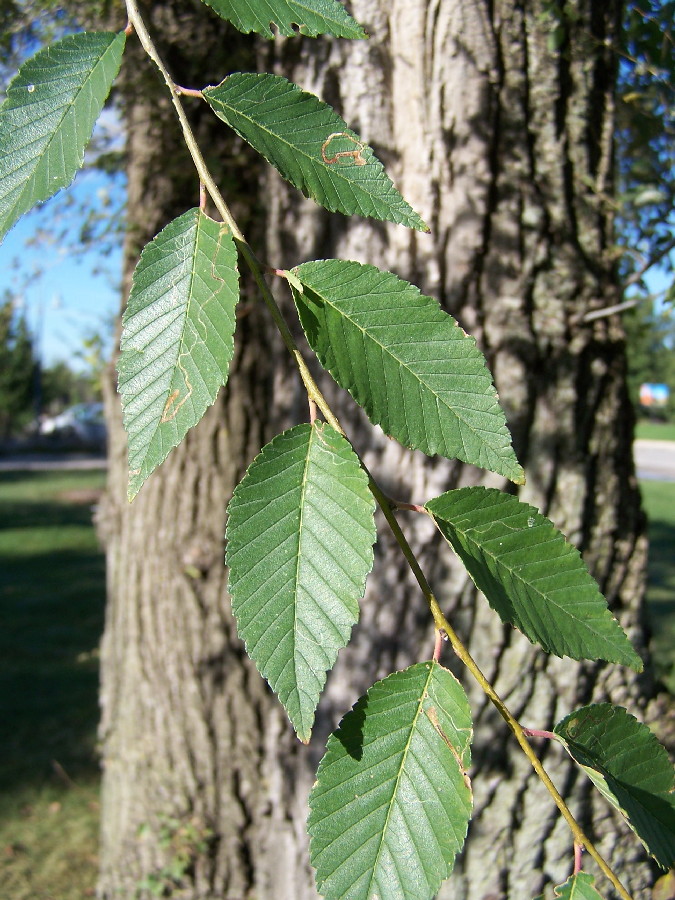
These are the leaves of the Siberian Elm - Ulmus pumila

I have no idea why these leave look so.. diseased. Almost all the elms looked terrible this July day in 2007. This was at the height of the 17-year cicada emergence, but I doubt that had anything to do with it.

Leaf: alternate, simple, elliptical to ovate, 1 to 2 1/2 inches long, singly serrated margin, nearly an equilateral base, dark green and smooth above, paler and smooth below. Flower: Monoecious; small, pale green clusters occurring in early spring before leaves.
Fruit: Thin, wafer-like samara, nearly round, notched at top, 1/2 inch in diameter, initially pale green, later turning light brown when ripe in spring.
Twig: Slender, slightly zigzag, grayish tinged with green; buds are quite small (1/8 inch), dark reddish-gray, round, flower buds are considerably larger.


Bark

More TREES


       web       www.cirrusimage.com


[Cirrus Home]    [Butterflies]    [Bugs]    [Beetles]    [Mantids]    [Spiders]    [Bees & Wasps]    [Dragon & Damselflies]    [Moths]   [Wildflowers]
[Fungi & Mushrooms]    [Flies]   [Butterflies of the World]  [Trees]  [Cicadas & Grasshoppers]   [Ticks & Mites]


Tree Encyclopedia by Bruce Marlin is licensed under a Creative Commons Attribution-Noncommercial-No Derivative Works 3.0 Unported License.
Based on a work at www.cirrusimage.com.
Attribution and permissions guidelines at http://www.cirrusimage.com/copyright.htm.