![]() | American Basswood or Linden - Tilia americana L. Tiliaceae -- Basswood family. Trees in this family are commonly known as limes in the UK. [Trees Index] [Trees Main Page Graphics] |
![]() |
| American basswood or Linden is a native deciduous tree. The northernmost Tilia species, it is a large, rapid-growing tree of eastern and central hardwood woodlands. Best growth is in the central part of the range on deep, moist soils; development is vigorous from sprouts as well as seed. American basswood is an important timber tree, especially in the Great Lakes States. The soft, light wood has many uses in wood products. The tree is also well known as a honey-tree, and the seeds and twigs are eaten by wildlife. It is commonly planted as a shade tree in urban areas of the eastern states where it is called American linden. Mature heights range from 75 to 130 feet (23-40 m) with diameter ranges from 36 to 48 inches (91-122 cm). The bark of mature trees is up to 1 inch (2.54 cm) thick at the base of the trunk. The bark is furrowed into narrow, flat-topped, firm ridges with characteristic horizontal cracks; young trees have smooth, thin bark. The inflorescence is a drooping axillary cyme. The fruit is dry, hard, indehiscent, subglobose to short-oblong, and is usually 0.2 to 0.28 inch (5-7 mm) in diameter, and bears one or two seeds. |
Climatic conditions associated with the species range are generally continental-cold winters, warm summers, and a humid to subhumid moisture regime. Mean annual precipitation within the species range is 530 min (21 in) at the western limit and 1140 min (45 in) in the northeast. The northern limit of basswood approximates the - 18° to -17° C (0° to 2° F) isotherm for mean daily minimum January temperature. Basswood reaches its maximum development in areas averaging 18° to 27° C (65° to 80° F) in July and receiving 250 to 380 mm (10 to 15 in) of precipitation during the growing season. The frost-free growing period varies from 80 to 180 days within its range.
Soils and Topography The species grows on soils ranging in pH from 4.5 to 7.5 but occurs more often in the less acidic to slightly basic part of this range. In fact, calcareous soils have been associated with the presence of basswood. The importance of aspect and edaphic factors to local distribution is reflected by the restriction of basswood throughout much of its range to moist sites on north- and east-facing slopes. Maple-basswood forests in southern Wisconsin are largely restricted to northerly exposures. Basswood is restricted to more mesic sites in southern Illinois and in northern Kentucky. At the western limit of its range, basswood frequently grows on the eastern side of lakes and along major drainages. This localized growth is often ascribed to fire protection. although lack of fire may be a reason for the persistence of a fire-sensitive species such as basswood, presence and distribution are controlled more by soil moisture and the ameliorating effects of water on the local climate. Basswood is classified as a nitrogen-demanding species because it grows poorly on sites deficient in nitrogen. With increasing nitrogen supplies, basswood growth increases markedly, approaching a maximum radial increment when 560 to 670 kg/ha (500 to 600 lb/acre) of nitrogen are added. Basswood leaves have high contents of nitrogen, calcium, magnesium, and potassium at the time of leaf fall and they contribute most of these nutrients to the forest floor. Associated Forest Cover American basswood grows in mixture with other species and only rarely forms pure stands. It is dominant in a single forest type, Sugar Maple-Basswood (Society of American Foresters Type 26). This cover type is most common in central Minnesota and western Wisconsin but is represented elsewhere from central Illinois, northward to southern Ontario and Quebec, eastward to northwestern Ohio, and westward along valley slopes of the prairie forest transition (15). Sugar maple (Acer saccharum) dominates both overstory and understory layers, with basswood achieving the position of second dominant in the tree layer. Common associates are white ash (Fraxinus americana), northern red oak (Quercus rubra), eastern hophornbeam (Ostrya virginiana), red maple (Acer rubrum), and American elm. |

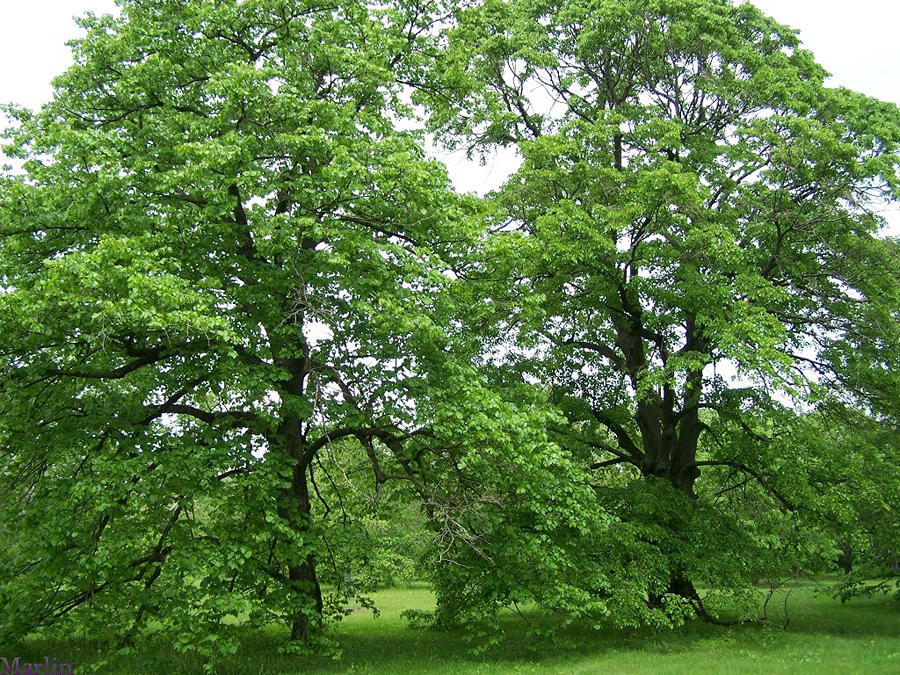
These lovely basswoods are two of the original Morton Arboretum collection, growing from seeds planted in 1923. Acc. 2122-23*1 & 2
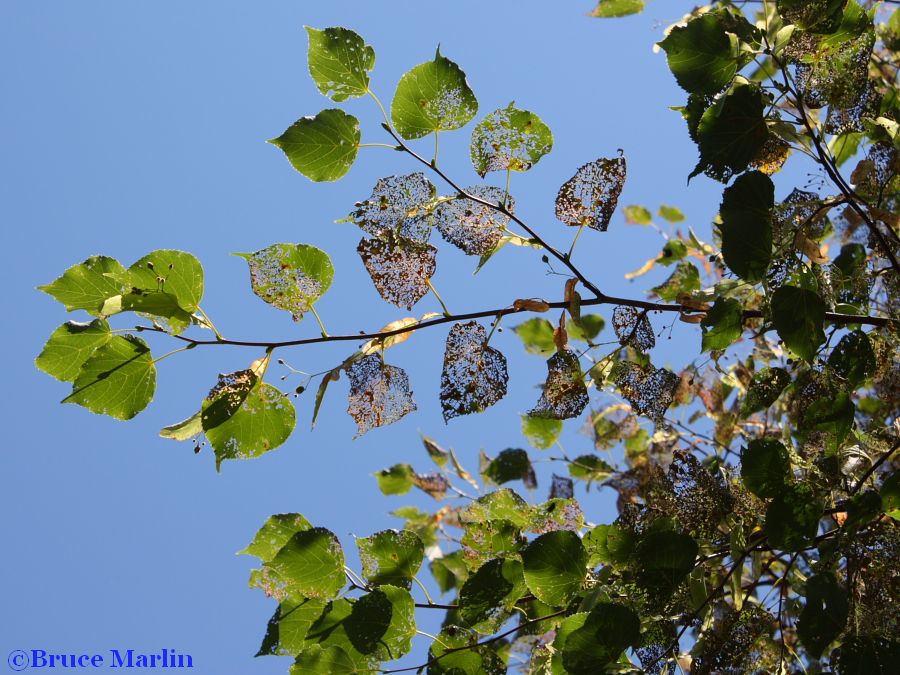
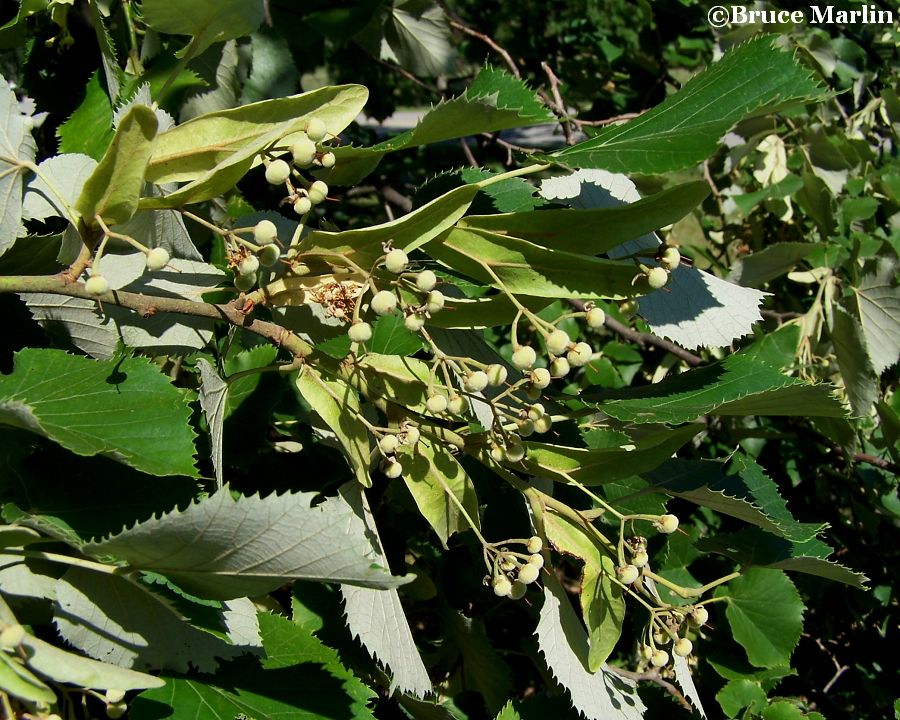
Flowering and Fruiting- The fragrant, yellow-white, flowers are borne on loose cymes on long stalks attached to leafy bracts. Flowering generally occurs in June but can begin in late May or early July, depending on latitude and annual variations in temperature. Flowering follows initial leaf-out and lasts approximately 2 weeks. During this period, all stages of floral development are present on a single tree or even in a single inflorescence (4 to 40 flowers per inflorescence). The flowers attract a number of insect pollinators. In a study of the pollination biology, 66 species of insects from 29 families were identified as pollinators of the flowers. Bees and flies were the most common diurnal pollinators; moths were the primary nocturnal visitors. The fruit, a nutlike drupe 5 to 10 mm (0.2 to 0.4 in) in diameter, usually contains one seed but in collections from both open- and forest-grown trees, 12 percent of the fruit contained two seeds and less than 1 percent contained three seeds. The seeds have a crustaceous seed coat (testa), a fleshy yellowish endosperm, and a well-developed embryo. A variety of forms of fruit and seed have been noted, including egg-shaped, round, onion-shaped, conical, and pentagonal. Individual trees tend to consistently produce fruit of a particular form and size. Seed Production and Dissemination- Fruits ripen in September and October and are soon dispersed by such mechanisms as wind, gravity, and animals. although the flower bracts are reported to aid in wind dispersal, fruits rarely are carried more than one or two tree lengths from the parent. In addition to their limited role in seed dispersal, bracts may act as "flags" to attract pollinators (especially nocturnal ones) to the inflorescences. Animals probably increase the seed dispersal significantly. Damaging Agents- Basswood plantations established on weed infested old-field sites are susceptible to girdling by mice and voles, and completely girdled trees die. In a southern Ontario plantation, 44 percent of the basswood stems were completely girdled and 39 percent were partially girdled. The species responsible for the girdling, the meadow vole, does most of this damage feeding beneath the snow. Rabbits also feed heavily on seedlings and small saplings in both plantations and natural stands. The foliage is host to various diseases-anthracnose (Gnomonia tiliae), black mold (Fumago vagans), and leaf spot (Cercospora microsora)-but none seem to do serious damage. The wood of basswood decays easily and once exposed can be host to many of the common hardwood decay organisms such as the yellow cap fungi (Pholiota limonella) and Collybia velutipes. Phellinus igniarius, Ustulina deusta, and nectria canker (Nectria galligena) also are found on basswood. Little defect is encountered in basswood when harvested before it reaches 120 years of age. Beyond this age, the chances of losses due to decay are greatly increased. Cull studies in the forests of Ontario indicate that yellow-brown stringy rot was the most common bole defect encountered; brown stain, some incipient yellow rot, and green stain were also found. The thin bark of this species is easily damaged by fire. Basswood is one of the hardwoods least susceptible to late spring frosts. [Cirrus Home] [Tree Encyclopedia] [Trees Alphabetic Table of Contents] |
|