|
 |
Populus balsamifera -
Balsam Poplar
Willow Family: Salicaceae.
Height: to 100' Spread: 40-50' Habit / Form: Upright /
Hardy to USDA Zone 3
Other common names include Balm Of Gilead, Balm Poplar,
Black Poplar, Black Cottonwood, Hackmatack, Tacamahac
|
|
|

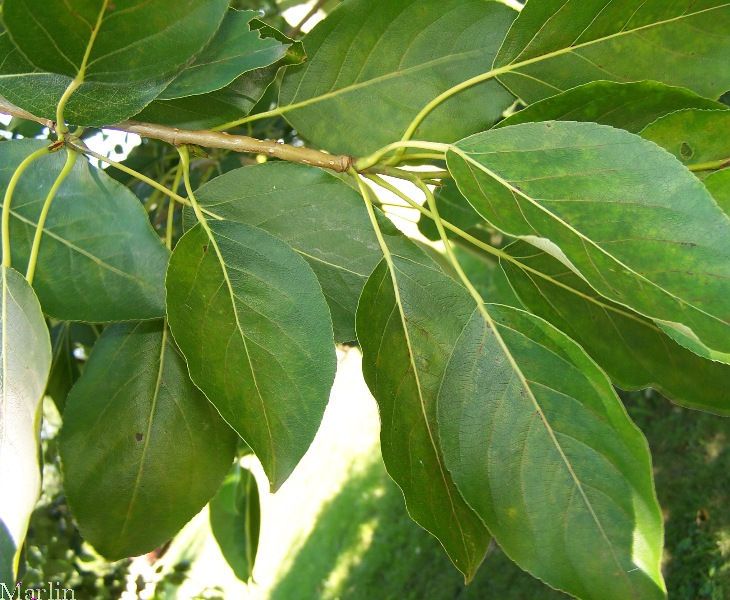
Balsam Poplar Foliage. |
|
The Willow family of trees (Salicaceae) has 350
or so species of willows and poplars, which are
mainly natives of the Northern Hemisphere. The
one uniting feature of all Salicaceaes is their
flowers; they have neither petals nor sepals but
are borne in catkins that usually appear with or
before the tree's new leaves. Both willows and
poplars prefer moist sites and hybridize so
easily identification is sometimes difficult.
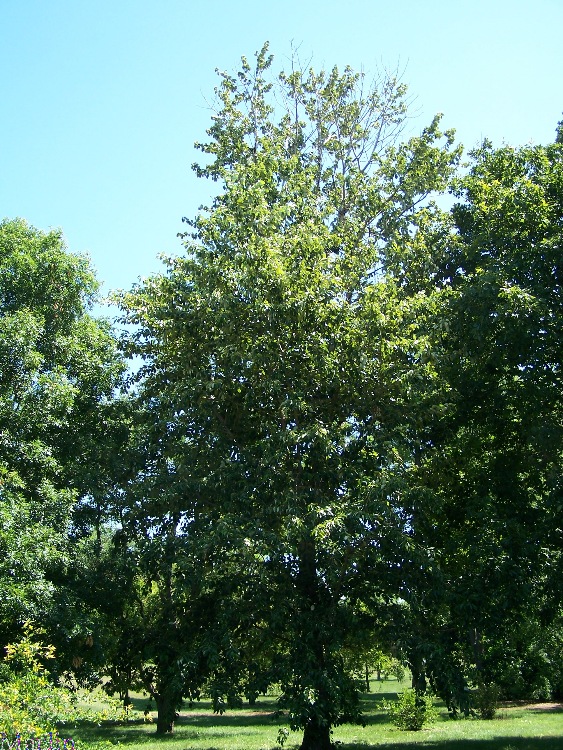
These trees were growing along the banks of a
small creek, along with various willows.
Poplar hybrids (Populus spp.) are
the result of natural and manmade crosses among
poplar species. The genus is further divided into
five sections of which four are represented in North
America: Leuce (aspen type), to which P.
grandidentata and P. tremuloides (bigtooth aspen and
quaking aspen) belong; Aigeiros (cottonwood or
poplar type), to which P. deltoides, P. sargentii,
P. fremontii, and P. wislizeni (eastern, plains,
Fremont, and Rio Grande cottonwood) belong;
Tacamahaca (balsam poplar type), to which P.
balsamifera, R trichocarpa, and P. angustifolia
(balsam poplar, black, and narrowleaf cottonwood)
belong, and Leucoides (swamp poplar type), to which
P. heterophylla belongs. P. balsamifera subsp.
trichocarpa has been reported as the correct status
of P. trichocarpa. |
|

Balsam Poplars are shade intolerant.
|
Flowering and Fruiting-
Poplar hybrids are dioecious and first
flower at about 8 years of age. The flowers
are borne in catkins (or aments) in the
spring before leafing. Male and female
catkins, when fully developed, are 10 to 15
cm (3.9 to 5.9 in) long. In the female
flower, the number of stigmas varies from
two to four and are either cap- or y-shaped.
In the male flower, the number of stamens
varies from 30 to 80. The bract has 20 to 30
digits, depending on the cultivar. The
central areas of the bracts are light in
color and the digits are dark brown,
sometimes tinged with black. Many poplar
hybrids have never produced flowers and thus
are thought to be sterile. Poplars flower
between February and May and disperse seed
between April and June of the same year.
Intersection Leuce hybrids disperse seed a
few weeks before intersection Aigeiros and
Tacamahaca or intersection Aigeiros-
Tacamahaca hybrids. Fruits are one-celled
capsules borne in long pendulous clusters
(catkins), and each capsule is surrounded by
tufts of long, white, silky hairs attached
to the short stalks of the seeds, promoting
wind dispersion over great distances.
Hybrid poplars were initially developed for
conventional pulpwood. In recent years, more
interest has been placed on evaluation of
hybrid poplar for short-rotation chip
production for pulp and energy uses.
However, at this time, investment rates of
return are not attractive for large scale
conversions to short rotation intensive
culture systems. |
|
|
|

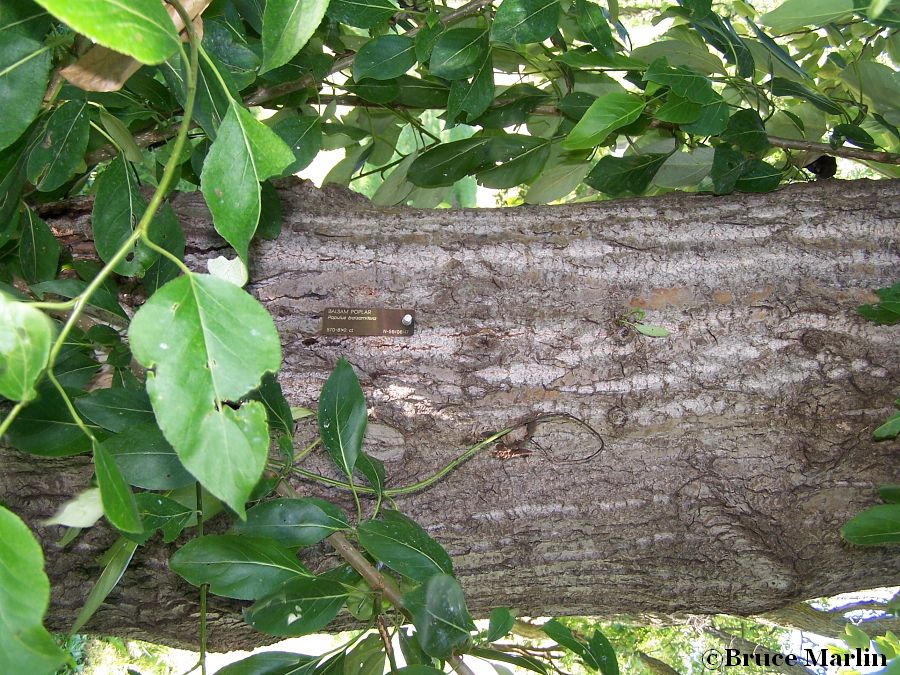
Balsam poplar's bark is heavily mottled with black
patches. |
|
In the northeastern
United States, moose and deer often browse
on poplar hybrids in recently planted
plantations. Poplar buds are a choice food
supply for ruffed grouse and several kinds
of songbirds. Grouse and pheasant also eat
the catkins. In urban areas, poplar hybrids
are useful where fast-growing trees are
needed for shade, landscaping, and screening
around industrial buildings, apartment
complexes, recreational playing areas,
parking lots, and landfills. These trees
live less than 100 years so more tolerant
species should be interplanted with them.
Poplar hybrids are used to stabilize soils
on hillsides, along streams and rivers,
landfills, and borrow pits. They are also
planted as fence rows to reduce air speed in
agricultural areas where soil is transported
by the wind.
Excerpts from:
--USDA
http://na.fs.fed.us Maurice E.
Demeritt, Jr. Poplar Hybrids
http://www.na.fs.fed.us/spfo/pubs/silvics_manual/volume_2/populus/populus.htm
|
|