Hickory – Carya species
Family Juglandaceae – Nut Trees
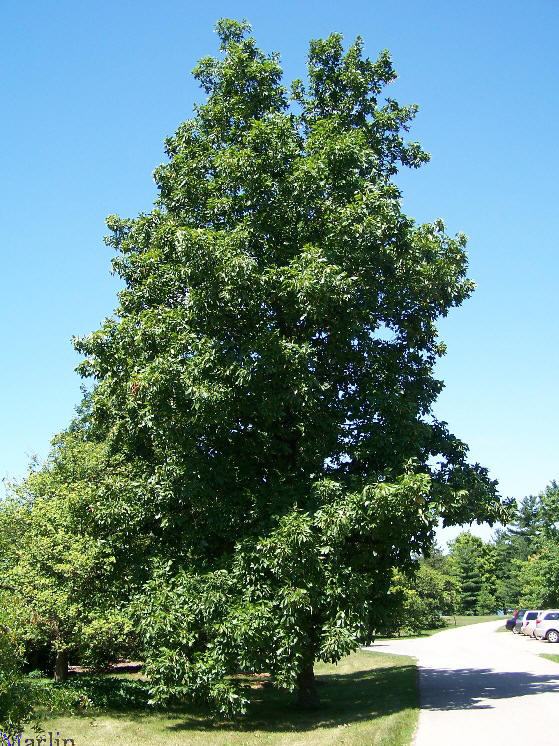
Height: to 100′ Spread: 40-50′ / Habit / Form: Upright Hardy to USDA Zone 3
Hickory grows well in both dry and wet soil condition, but prefers well-drained soils such as those found here, on a bluff overlooking the West Branch of the DuPage River in Northern Illinois. This bluff is the site of a Late Woodland period aboriginal settlement responsible for the effigy burial mounds found nearby. Shagbarks are commonly found in association with oak trees.
The wood is hard, strong, tough and elastic, and is used in handles for tools and in athletic equipment. The wood also makes excellent firewood, and often is used in smoking meat. Squirrels are extremely fond of the fruit of the hickory, and some humans also use the nuts in baked goods, cookies, cakes, salads and game dishes.
Flowering and Fruiting- Hickory is monoecious-male and female flowers are produced on the same tree. Mockernut male flowers are catkins about 10 to 13 cm (4 to 5 in) long and may be produced on branches from axils of leaves of the previous season or from the inner scales of the terminal buds at the base of the current growth (4). The female flowers appear in short spikes on peduncles terminating in shoots of the current year. Flowers bloom in the spring from April to May, depending on latitude and weather. Usually the male flowers emerge before the female flowers. Hickories produce very large amounts of pollen that is dispersed by the wind.
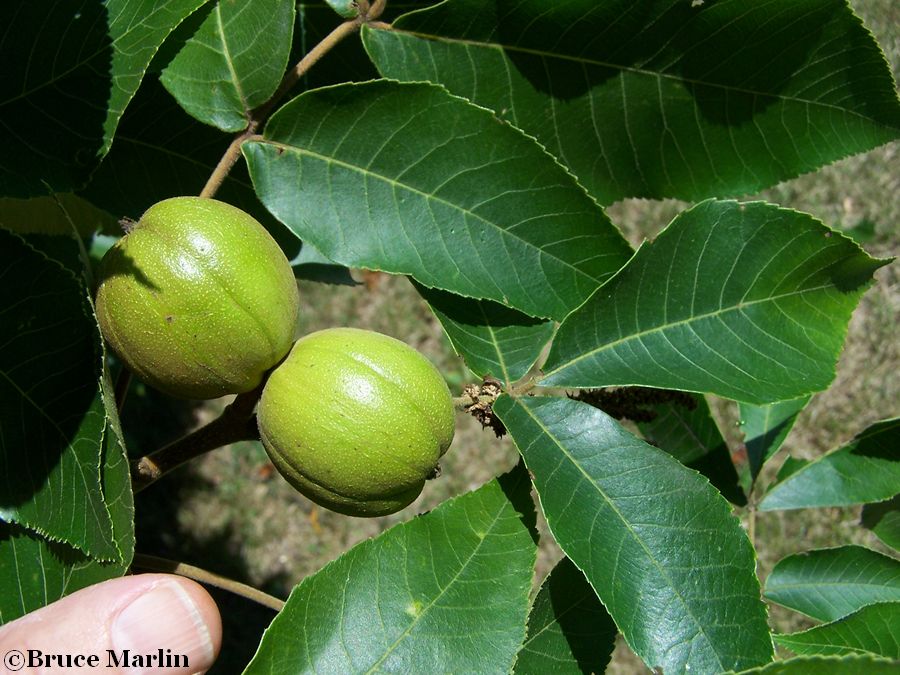
Fruits are solitary or paired and globose, ripening in September and October, and are about 2.5 to 9.0 cm (1.0 to 3.5 in) long with a short necklike base. The fruit has a thick, four-ribbed husk 3 to 4 mm (0.11 to 0.16 in) thick that usually splits from the middle to the base. The nut is distinctly four-angled with a reddish-brown, very hard shell 5 to 6 mm (0.20 to 0.23 in) thick containing a small edible kernel (4,10,19,22). Seed Production and Dissemination- The seed is dispersed from September through December.
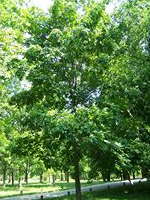 Shellbark Hickory Carya laciniosa |
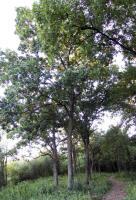 Shagbark Hickory Carya ovata |
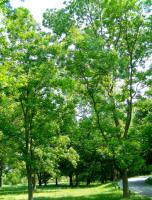 Pecan Carya illionensis |
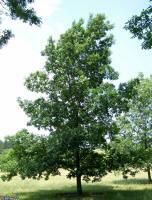 Bitternut Hickory Carya cordiformis |
Hickory requires a minimum of 25 years to reach commercial seed-bearing age. Optimum seed production occurs from 40 to 125 years, and the maximum age listed for commercial seed production is 200 years. Good seed crops occur every 2 to 3 years with light seed crops in intervening years. Approximately 50 to 75 percent of fresh seed will germinate. Fourteen mockernut hickory trees in southeastern Ohio produced an average annual crop of 6,285 nuts for 6 years; about 39 percent were sound, 48 percent aborted, and 13 percent had insect damage.
Hickory shuckworm (Laspeyresia caryana) is probably a major factor in reducing germination. Seed is disseminated mainly by gravity and wildlife, particularly squirrels. Birds also help disperse seed. Wildlife such as squirrels and chipmunks often bury the seed at some distance from the seed-bearing tree. —USDA Forest Service Fact Sheet
Family Juglandaceae – Nut Trees – Walnut, Hickory, Butternut, Pecan
The Walnut family is a large group of deciduous, aromatic trees including the commercially important nut-producing trees. The Persian walnut (Juglans regia) is one of the major nut crops of the world. Tree Encyclopedia | Tree Index | Juglandaceae Index