
Himalayan White Pine – Pinus wallichiana
Family Pinaceae: Pine, Cedar, Spruce, Fir
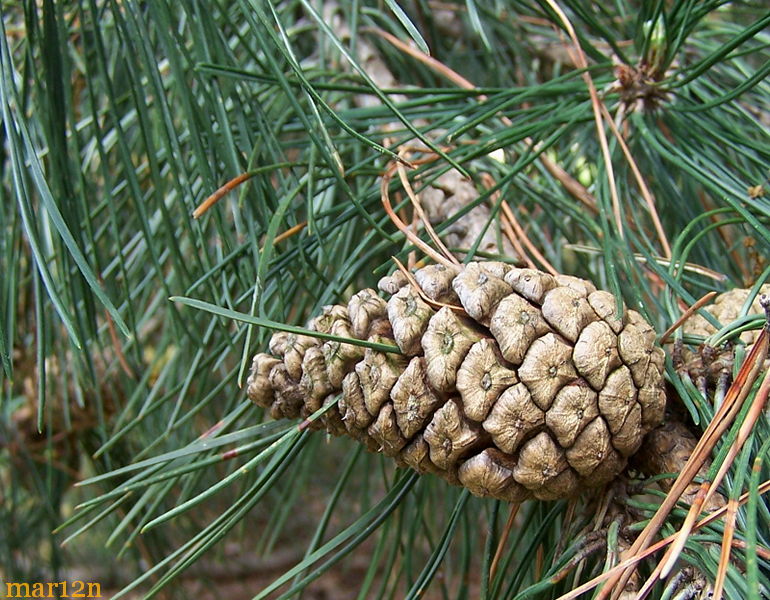
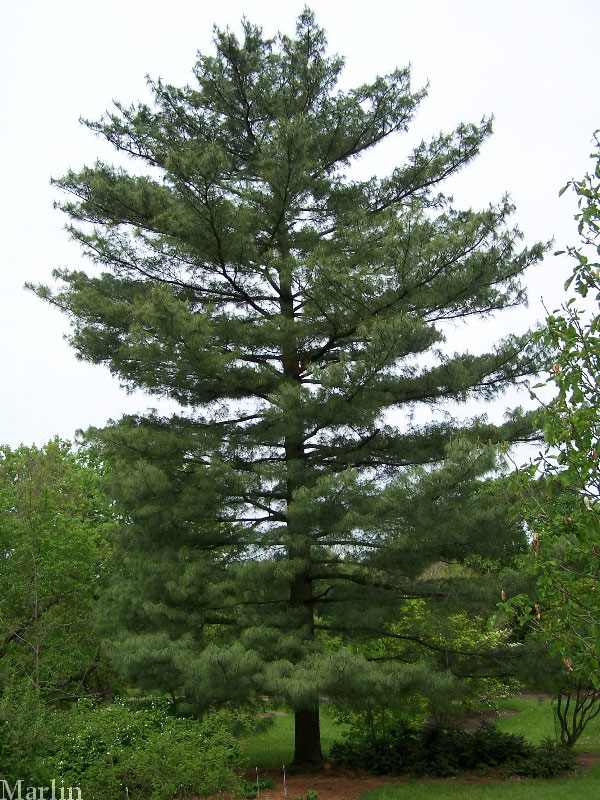
This variety is known for its drooping branches, soft feathery foliage, and long resinous cones.
White Pine bark darkens and thickens as the tree ages, is smooth and gray on young growth. It becomes gray-brown, deeply furrowed with broad ridges of irregularly rectangular, purple-tinged scaly plates. Branches are whorled, few and spreading, with slightly upturned tips.
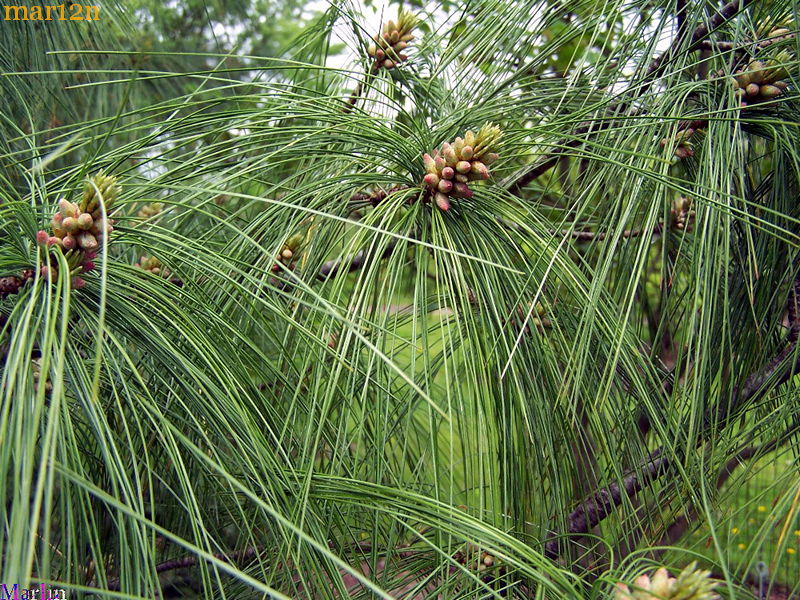
Needles soft, flexible, blue-green; 2″-4″ long, 3-sided, in bundles of five. Evergreen. Buds are heavily resinous and sticky, aromatic. Cones are slender and thornless, 3″-10″ long and tapering; each scale usually bears two winged seeds as do all native pines. Roots are widespreading and deep, without a distinct taproot.
Diseases: White Pine Blister Rust (Cronartium ribicola), an introduced fungal disease, has decimated formerly extensive stands. Occurs on a variety of sites from wet bogs and moist streambottoms to dry sand plains and rocky ridges; common on the east shore of lakes where blowdowns create openings for regeneration. Soils: grows on nearly all soil types within its range. Most competitive on fairly infertile sandy soils. On clay or poorly drained soils, occurs only as individuals or in small groups. Grows on fine sandy loams and silty loams on disturbed sites with little hardwood competition.
Sometimes a component of climax forests on sites such as steep slopes and ridge tops where windfall provides regeneration opportunities. Frequently dominates or codominates dryer northern pine forests. In mixed hardwood forests, it often occurs as a scattered superdominant tree towering above the surrounding hardwoods. Lower soil pH limit of 4.0. Seedlings tolerate limited shade from herbaceous ground cover better than other pines. Germination and emergence not greatly affected by soil acidity caused by acid rain.
Squirrels, chipmunks and mice feed on the seeds and soft needles. Inner bark is a preferred winter food of porcupine and deer browse the twigs. Rabbits may eat the bark of young trees. The seeds are eaten by red squirrels and such birds as crossbills and pine siskins. Pocket gophers graze the roots of seedlings and young trees. Snowshoe hares, white-tailed deer, and cottontails browse the foliage; the bark is eaten by various mammals. Young black bear cubs use large White Pine to climb to safety. Songbirds eat seeds. Bald eagles build nests in living White Pine, usually at a main branch located below the crown top. White Pine, especially those with broken tops, provide valuable habitat for cavity-nesting wildlife.
Tree Encyclopedia | Tree Index
Trees live longer than any other organism on earth. Trees commonly live more than 1,000 years, and many grow considerably older. Trees have been living on Earth for more than 370 million years, and today can be found almost everywhere from the Arctic Circle to the Sahara Desert. Explore over 2,000 large format pictures of trees in more than 400 species. Family Pinaceae: Pine, Cedar, Spruce, and Fir