Mugo Pine – Pinus mugo
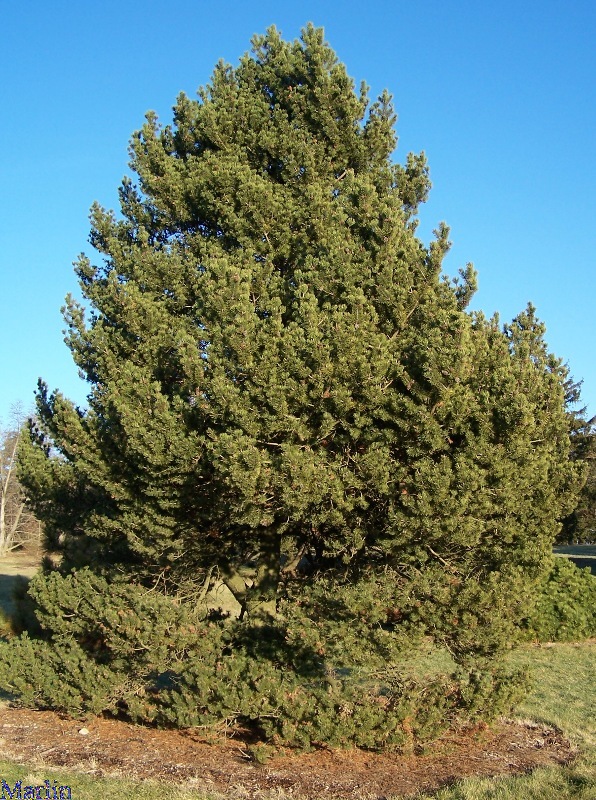 Mugo Pine – This specimen is 34 years old and perhaps 15 feet tall
Family Pinaceae: Pine, Cedar, Spruce, Fir
Common names: Mugo Pine, Swiss Mountain Pine, Mountain Pine. USDA hardiness zones: 2 through 7
Mugo Pine is a shrub 4 to 20 feet tall which grows best in sun in moist loam. Needles of this two-needle pine are held on the tree for more than four years making this one of the more dense pines suitable for a screen planting. Most other pines are not suited for screens since they lose their inner needles and lower branches as they grow older. Since there seems to be great variability in height among individual trees, select nursery plants which have the form which you desire. When selecting a Mugo Pine to grow into a tree, choose one with a central leader; if looking for a more dwarf type Mugo Pine choose among the many compact selections.
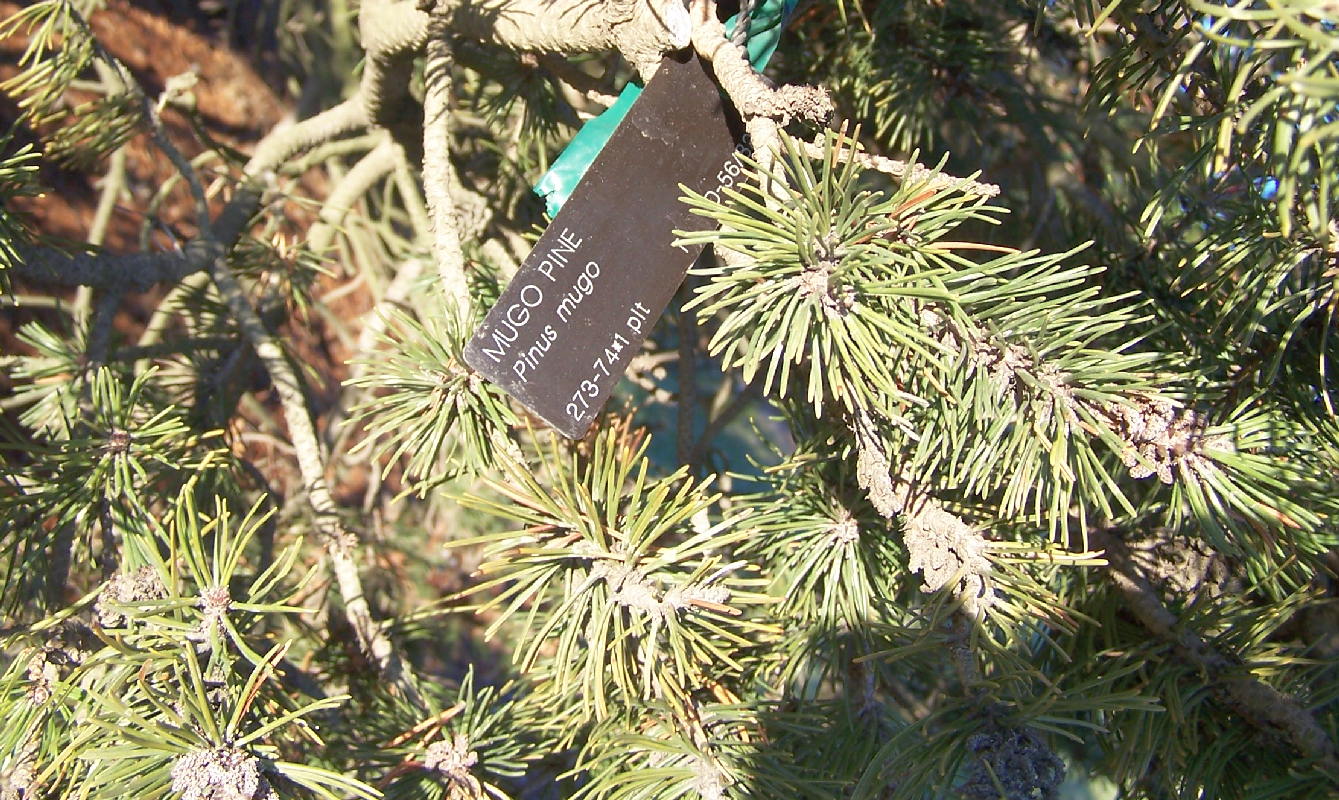
Origin: Europe; Pyrenees, Alps, Erzgebirge, Carpathians, northern Apennines and Balkan Peninsula mountains. Uses: Bonsai; container or above-ground planter; recommended for buffer strips around parking lots or for median strip plantings in the highway; screen; Christmas tree; no proven urban tolerance.
DESCRIPTION: Height: 15 to 25 feet / Spread: 15 to 25 feet. Crown uniformity: symmetrical canopy with a regular (or smooth) outline, and individuals have more or less identical crown forms. Crown shape: round; pyramidal. / Crown density: dense. / Growth rate: slow. /
Leaf arrangement: alternate; spiral, simple. / Leaf margin: entire. / Leaf shape: needle-like (filiform). / Leaf venation: parallel
Leaf type and persistence: evergreen; fragrant; needle leaf evergreen. / Leaf blade length: less than 2 inches. / Leaf color: green.
Cones are persistent, brown, dry and hard, oval, 1 to 3 inches long. They do not attract wildlife. Trunk/bark/branches: routinely grown with, or trainable to be grown with, multiple trunks; grow mostly upright and will not droop; not particularly showy; tree wants to grow with several trunks but can be trained to grow with a single trunk; no thorns.
Mugo Pine is a favored host for Pine sawfly and Pine needle scale. Some adelgids will appear as white cottony growths on the bark. All types produce honeydew which may support sooty mold. European Pine shoot moth causes young shoots to fall over. Infested shoots may exude resin. The insects can be found in the shoots during May. Pesticides are only effective when caterpillars are moving from overwintering sites to new shoots. This occurs in mid to late April or when needle growth is about half developed.
Bark beetles bore into trunks making small holes scattered up and down the trunk. Stressed trees are more susceptible to attack. The holes look like shotholes. Keep trees healthy. Sawfly larvae caterpillars are variously colored but generally feed in groups on the needles. Some sawfly larvae will flex or rear back in unison when disturbed. Sawflies can cause rapid defoliation of branches if left unchecked.
Trees Index | Pine Family | Beech, Oak | Nut Trees | Birch Family | Magnolias
Tree Encyclopedia / North American Insects & Spiders is dedicated to providing family-friendly educational
resources for our friends around the world through large images and macro photographs of flora and fauna.
Online since 2002