Needle Juniper – Juniperus rigida
Family Cupressaceae
Also commonly called Cedar Tree, Juniper, savin, cedar apple, pencil cedar, or Virginia red cedar.
Often grown as an ornamental or bonsai, the tree species Juniperus rigida is commonly known as “needle” or “temple” juniper. It is native to northern China, Korea, Japan, and the far southeast of Russia, occurring between of 10-2,200m elevation. It is closely related to Juniperus communis (Common Juniper) and Juniperus conferta (Shore Juniper) [1].
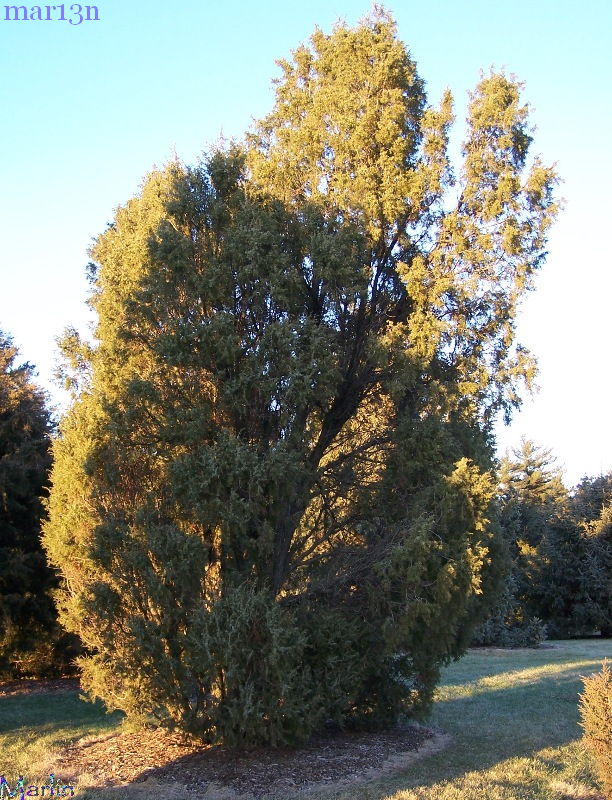 This Morton Arboretum specimen was started from a cutting 55 years ago [2]
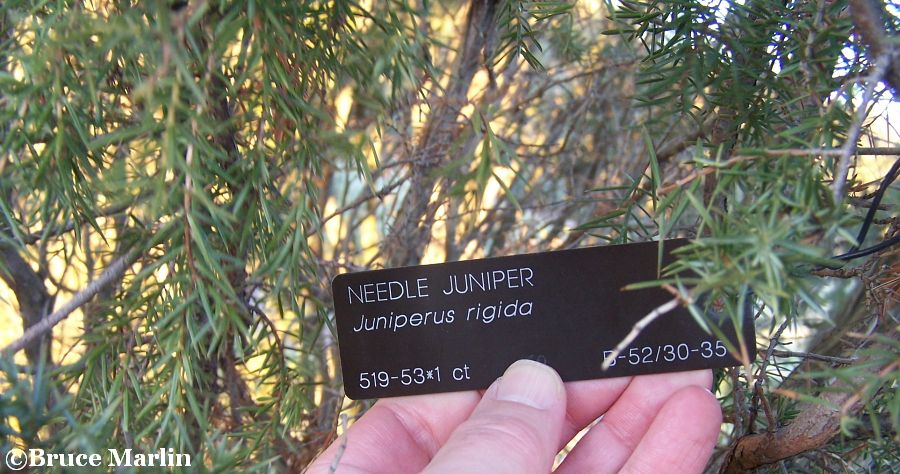
A shrub or small tree growing to a height of 10 m and a trunk diameter up to 50 cm. The leaves are evergreen, needle-like, in whorls of three, bright green to yellowish-green, 10-23 mm long and 1-1.3 mm broad, with a single white stomatal band on the inner surface. It is dioecious. The seed cones are berry-like, ripening in 18 months to dark purple or brownish with a variable whitish waxy coating; spherical, 5-9 mm diameter, and have three fused scales in one whorls of three, each with a single seed. Seeds are usually dispersed by birds. The pollen cones are yellow, 3-5 mm long, and shed their pollen in spring [1].
References:
1. Colin Tudge, The Tree: A Natural History of What Trees Are, How They Live, and Why They Matter
2. Needle Juniper, Morton Arboretum acc. 519-53-1, photos © Bruce Marlin
There are thirty (many monotypic) genera and 142 species in the family Cupressaceae, now widely regarded as including the Taxodiaceae, previously treated as a family. The Cupressaceae are found in the fossil record as far back as the Jurassic Period, about 210 million years ago.
Family Cupressaceae – Arborvitae, Cedar, Cypress, Juniper, Redwood
Trees Index | Pine Family | Beech, Oak | Nut Trees | Birch Family | Magnolias
Tree Encyclopedia / North American Insects & Spiders is dedicated to providing family-friendly educational
resources for our friends around the world through large images and macro photographs of flora and fauna.
Online since 2002