|
 |
Chinquapin Oak - Quercus muhlenbergii
Also commonly spelled "Chinkapin"
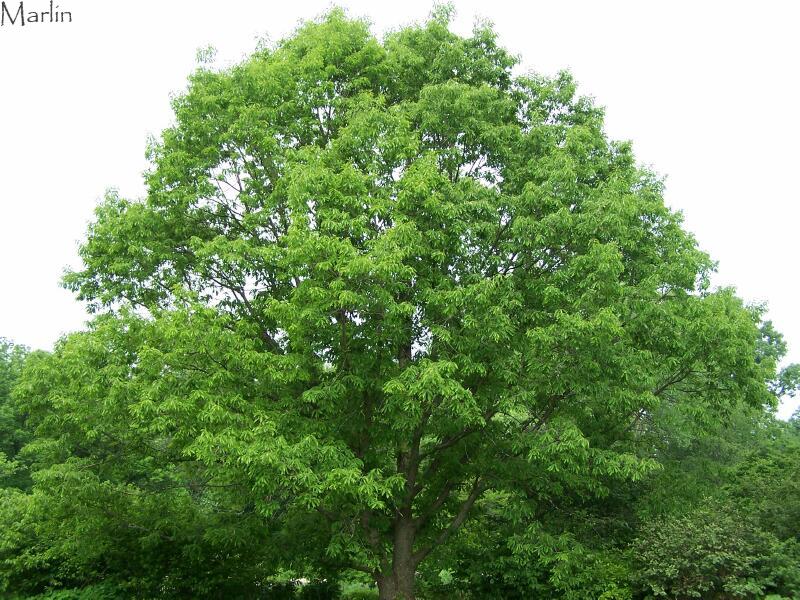
Height: 40-50' Spread: 40-50' Habit/Form: Rounded Growth Rate: Slow Zone:
5-7
|
|
|
|

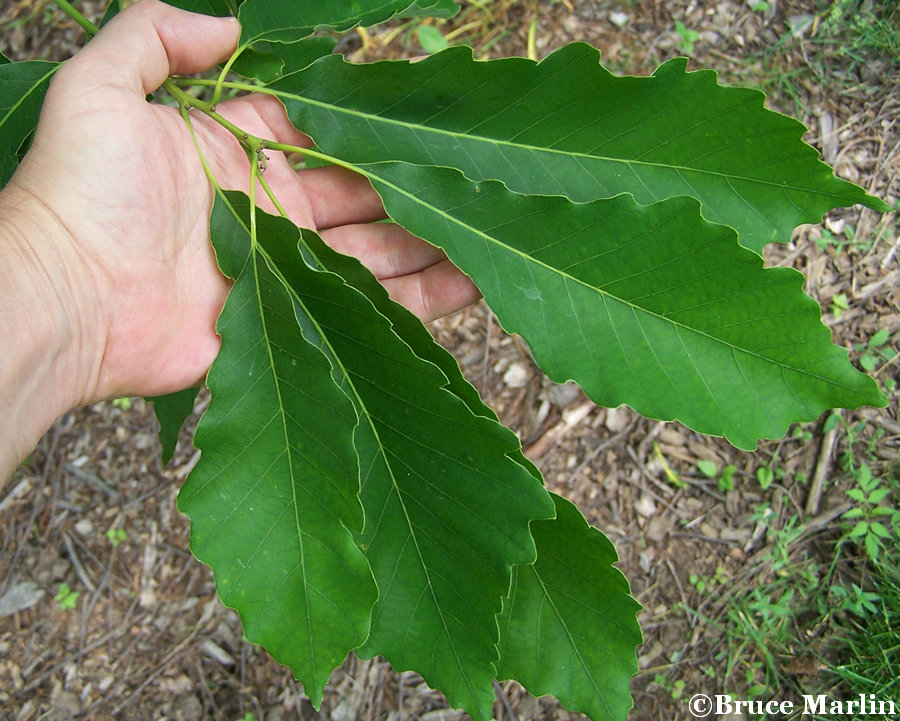
Chinquapin Oak Leaves
|
Chinquapin oak is easily grown
in rich, loamy, well-drained soils in full sun.
It's one of the few oaks that tolerates alkaline
soil and urban pollution, although young trees
may be difficult to transplant and establish.
Ornamental Characteristics: Long, toothed
leaves have a beautiful wavy margin and a
whitish underside; showy, yellow fall color;
branches grow mostly upright or horizontal and
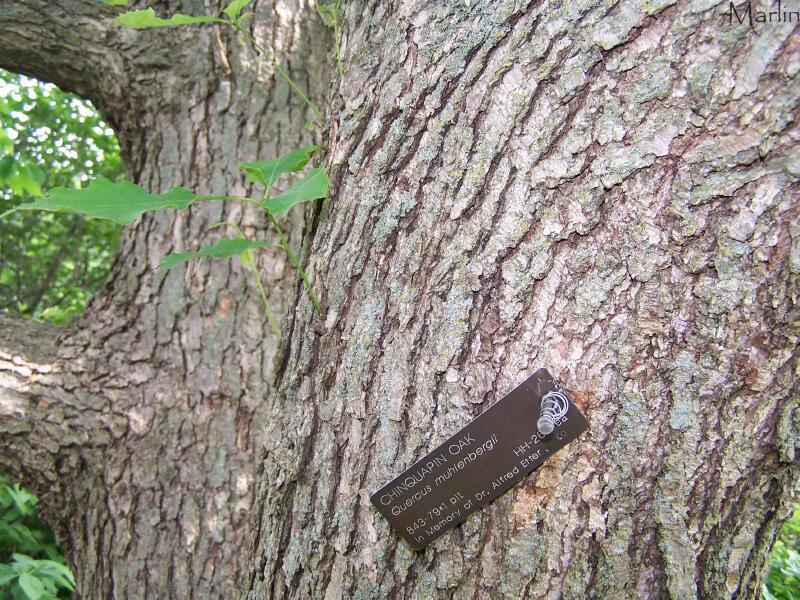
will not droop; bark is a bold, scaly gray.
Acorns are one-half inches in length with a
scaly cap. It may take 20 years to bear the
first crop. Landscape uses: Shade tree,
street and parking islands, large landscapes.
|
|
|

|
Chinkapin oak is sometimes called yellow
chestnut oak, rock oak, or yellow oak. Its
heavy wood makes excellent fuel. The acorns
are sweet and are eaten by several kinds of
animals and birds. Chinkapin oak is rarely a
predominant tree, but it grows in
association with many other species,
including white oak (Quercus alba), black
oak (Q. uelutina), northern red oak (Q.
rubra), scarlet oak (Q. coccinea),
sugar
maple (Acer saccharum),
red maple (A.
rubrum),
hickories (Carya spp.), black
cherry (Prunus serotina), cucumbertree
(Magnolia acuminata), white ash (Fraxinus
americana),
American basswood (Tilia
americana),
black walnut (Juglans nigra),
butternut
(J. cinerea), and yellow-poplar
(Liriodendron tulipifera).
American beech (Fagus grandifolia),
shortleaf pine (Pinus echinata), pitch pine
(P. rigida), Virginia pine (P. uirginiana),
Ozark chinkapin (Castanea ozarkensis),
eastern redcedar (Juniperus virginiana),
bluejack oak (Quercus incana), southern red
oak (Q. falcata), blackgum (Nyssa
sylvatica), and winged elm (Ulmus alata)
also grow in association with chinkapin oak.
Here is an interesting
excerpt from a scientific
paper regarding the
decomposition rate of
different tree leaves in an
aquifer:
Abstract
Dry Chinquapin oak ( Quercus
macrocarpa) and American
elm ( Ulmus americana)
leaves were placed in four
microcosms fed by groundwater
springs to monitor changes in
dry mass, ash-free dry mass, and
microbial activity over a 35-day
period. Oxygen microelectrodes
were used to measure microbial
activity and to estimate
millimeter-scale heterogeneity
in that activity. Oak leaves
lost mass more slowly than elm
leaves. Generally, there was a
decrease in total dry weight
over the first 14 days, after
which total dry weight began to
increase. However, there were
consistent decreases in ash-free
dry mass over the entire
incubation period, suggesting
that the material remaining
after initial leaf decomposition
trapped inorganic particles.
Microbial activity was higher on
elm leaves than on oak leaves,
with peak activity occurring at
6 and 27 days, respectively. The
level of oxygen saturation on
the bottom surface of an elm
leaf ranged between 0 and 75%
within a 30-mm 2 area.
This spatial heterogeneity in O 2
saturation disappeared when the
water velocity increased from 0
to 6 cm s -1. Our
results suggest that as leaves
enter the groundwater, they
decompose and provide substrate
for microorganisms. The rate of
decomposition depends on leaf
type, small-scale variations in
microbial activity, water
velocity, and the length of
submersion time. During the
initial stages of decomposition,
anoxic microzones are formed
that could potentially be
important to the biogeochemistry
of the otherwise oxic aquifer.
(4)
|
|
|
|

Chinkapin Oak Bark
|
|
|
|

Acorn Weevil, Curculio sp. |
|
Defoliating insects that
attack chinkapin oak are the gypsy moth (Lymantria
dispar), the orangestriped oakworm (Anisota
senatoria), and the variable oakleaf
caterpillar (Heterocampa manteo).
Insects that bore into the bole include the
carpenterworm. (Prionoyxstus robiniae),
little carpenterworm (P. macmurtrei),
white oak borer (Goes tigrinus),
Columbian timber beetle (Corthylus
columbianus), oak timberworm (Arrhenodes
minutus), and twolined chestnut borer (Agrilus
bilineatus). The
acorn
weevils (Curculio spp.), larvae of
moths (Valentinia
glandulella and Melissopus
latiferreanus), and gallforming cynipids
(Callirhytis spp.) attack and destroy
the acorns.
Acorn weevils have snouts with small, saw-like teeth at the very end.
There are two types, or genera: the long-snouted acorn weevils (genus
Curculio) and the short-snouted ones (genus Conotrachelus). The
longsnouted acorn weevil's snout may be equal to or greater than the
length of its body. The specimen pictured above is the long-snouted
variety.
Adults of both genera feed on acorns, but only the long
snouted weevils can drill into the shells to feed and lay eggs inside
the nutmeat. The tip of the snouth is actually a miniature saw, and the
weevil places the tip against the shell, circling endlessly around the
pivot point until the shell is pierced. Females place eggs inside the
nut using a long ovipositor that descends from the abdomen.
Grub-like acorn weevil larvae hatch from eggs a few days
after they are laid. There may be one to several acorn weevil larvae in
each acorn. Larvae typically go through five growth stages, or instars.
Each instar ends with the molt or shedding of the old skin, providing
the larva with more room to grow. After a few weeks, larvae chew their
way out of the acorn, burrow into the soil to pupate, and eventually
emerge as adults the next year. Short-snouted larvae usually exit from a
single hole that already exists in the acorn, but long-snouted larvae
may chew their own exit hole through the acorn shell. Like larvae of the
short-snouted acorn weevil, acorn moth larvae can feed only on damaged
or sprouting acorns. The grayish female acorn moths lay eggs in damaged
acorns, sometimes in the emergence holes of acorn weevil larvae. It's
easy to distinguish the acorn moth larva, a caterpillar, from acorn
weevil larvae. The acorn moth larva has three pairs of legs near the
head and is generally longer than the legless, fat larvae of acorn
weevils. Larvae of the acorn moth feed on acorns and probably on the
fungi that often grow in damaged acorns. They usually pupate inside the
acorns.
|
|
|