
Prickly Pear Cactus – Opuntia humifusa
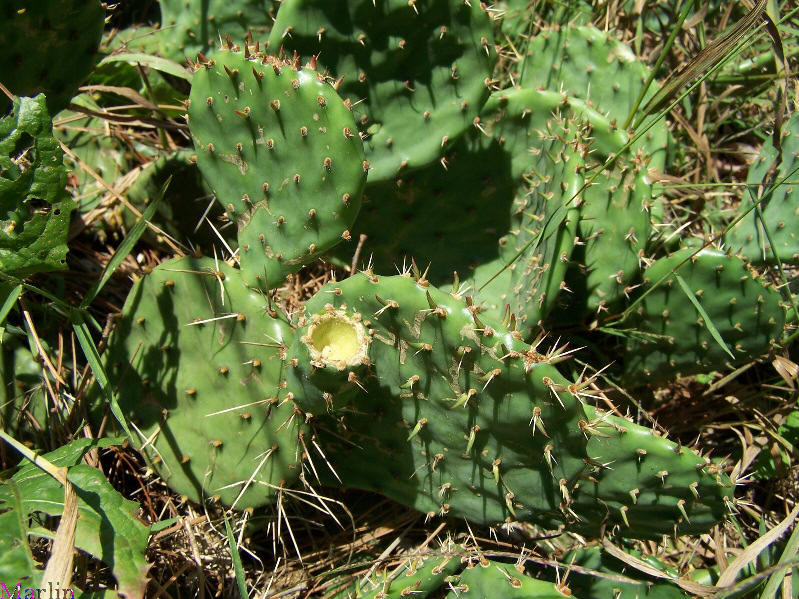
Opuntia humifusa
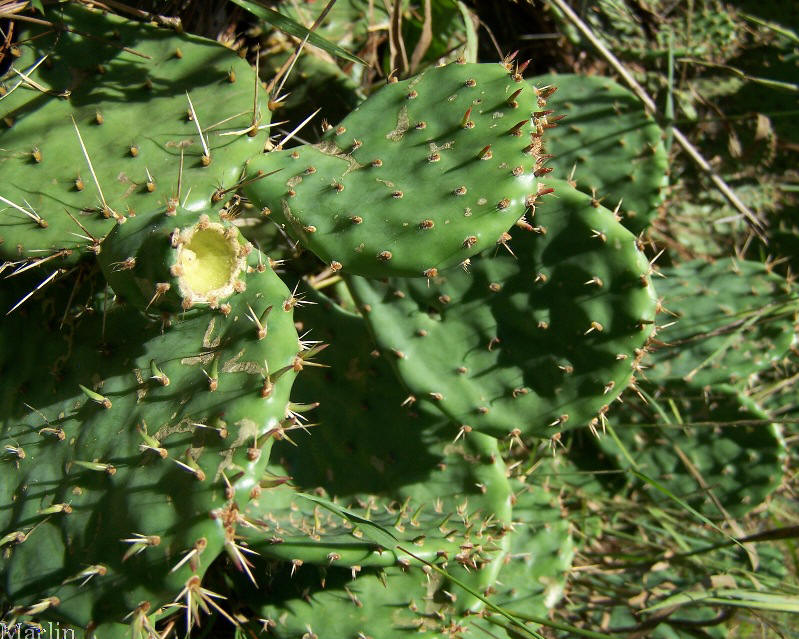
Eastern prickly pear is a prostrate or spreading cactus with oblong, flattened pads 2-6 inches long, with sharp spines. The showy flowers appear in late spring and early summer. They are bright yellow and 3-4 inches across. The edible egg shaped fruits are called “tunas” and are red or green, 2-3 inches long.
Prickly pear cacti typically grow with flat, rounded platyclades that are armed with two kinds of spines; large, smooth, fixed spines and small, hairlike spines called glochids that easily penetrate skin and detach from the plant. Many types of prickly pears grow into dense, tangled structures.
Like all true cactus species, prickly pears are native only to the Western hemisphere; however, they have been introduced to other parts of the globe. Prickly pear species are found in abundance in Mexico, especially in the central and western regions. They are also found in the West of the United States, from arid regions in the Northwest, throughout the mid and lower elevations of the Rocky Mountains, and especially in the Southwest. Prickly pears are also the only types of cactus natively found to grow far east of the Great Plains states, as far north-east as Long Island, where it can be found in Northport.
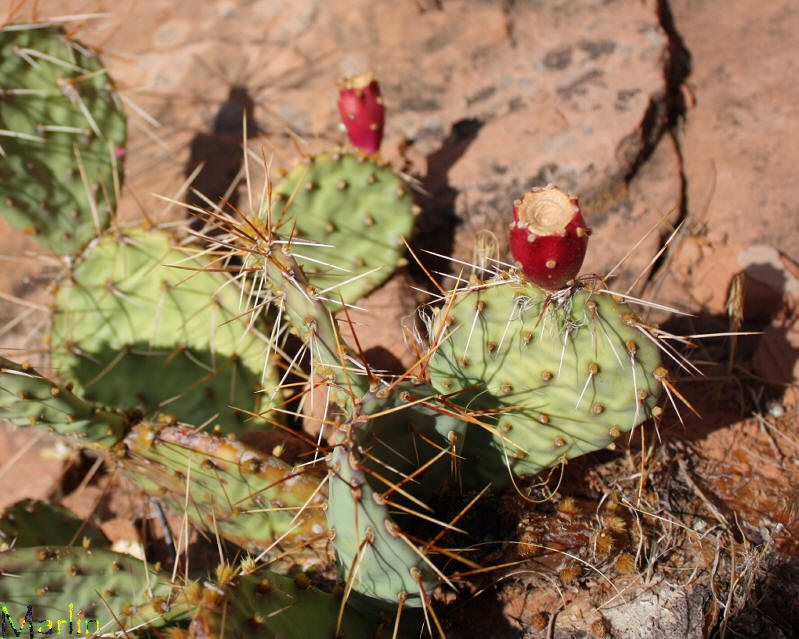 Prickly Pear along the Colorado River near Moab, Utah. These fruits are ripe.
 |
Family: Cactaceae Tree Encyclopedia | Maple Trees | Elms & Zelkovas | Trees Index | Rose Family Genus Opuntia contains about a dozen species. |
|
Prickly pear species were introduced into Australia in the late 1800s, causing major ecological damage in the eastern states (see www.northwestweeds.nsw.gov.au). They are also found in the Mediterranean region of southern Europe, especially on the island nation of Malta where they grow on cactus found all over the island, and can be found in enormous numbers in parts of South Africa, where it was introduced from South America. Opuntia are the most cold-tolerant of the lowland cacti, extending into western and southern Canada; one subspecies, Opuntia fragilis var. fragilis, has been found growing along the Beatton River in central British Columbia, southwest of Cecil Lake at 56° 17’ N latitude and 120° 39’ W longitude. Charles Darwin was the first to note that these cacti have thigmotactic anthers: when the anthers are touched, they curl over, depositing their pollen. This movement can be seen by gently poking the anthers of an open Opuntia flower. [1] |
|
There are over 200 species of prickly pear cacti. Most are found in southwestern North America, Mexico, Central America and South America. Opuntia humifusa is native to the United States east of the Rockies, where it grows in dry, sandy soils in open pine woods, prairies and scrub. Prickly pear is easy to grow, rooting readily from pads stuck in the ground, or even just lying on the surface. Grows best in full sun, in dry, sandy soil.
|
|
The sweet juicy fruits of the prickly pear, called tunas, are very popular everywhere except the United States. In fact, annual worldwide commercial production of prickly pear tunas is more than twice that of strawberries, avocados, or apricots! The pads, called nopales, are a popular vegetable in Mexico and Central America. They are usually cooked but can be eaten raw. They taste a little like green beans. Prickly pear spines are easy enough to avoid, but watch out for the glochids, tiny hairlike bristles that occur in little tufts. They are barbed and can cause skin irritation for hours after contact. |
|
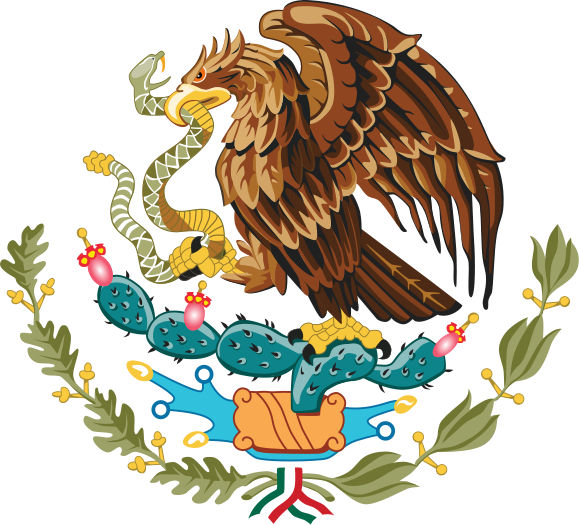
The coat of arms of Mexico depicts a Mexican golden eagle, perched upon an Opuntia cactus, devouring a snake. According to the official story of México, the coat of arms of Mexico was inspired by an Aztec legend regarding the founding of Tenochtitlan. The Aztecs, then a nomadic tribe, were wandering throughout Mexico in search of a divine sign that would indicate the precise spot upon which they were to build their capital. Their god Huitzilopochtli had commanded them to find an eagle devouring a snake, perched atop a cactus that grew on a rock submerged in a lake. After two hundred years of wandering, they found the promised sign on a small island in the swampy Lake Texcoco. It was there they founded their new capital, Tenochtitlan. The cactus (Opuntia ficus-indica), full of its fruits, called “tenochtli” in Nahuatl, represent the island of Tenochtitlan. The stems of Opuntia, called nopales, are commonly used in Mexican cuisine in dishes such as huevos con nopales (eggs with nopal), or “tacos de nopales”. Nopales are also an important ingredient in New Mexican cuisine. In Israel, the prickly pear is called tzabar and it is the origin of the slang term Sabra, meaning a native-born Israeli Jew. [1] |
| Tree Encyclopedia / North American Insects & Spiders is dedicated to providing scientific and educational resources for our users through use of large images and macro photographs of flora and fauna. |
|
Tree Encyclopedia |
