Red Oak - Quercus rubra [1]
Family: Fagaceae - Beeches, Chinkapins and Oaks
Northern red oak has been extensively planted as an ornamental because of its symmetrical shape and brilliant fall foliage.
The acorns are an important food for squirrels deer, turkey, mice, voles, and other mammals and birds. [2]
[Cirrus Home]    [Tree Encyclopedia Main Page]   [Family Fagaceae]    [Trees Table of Contents]

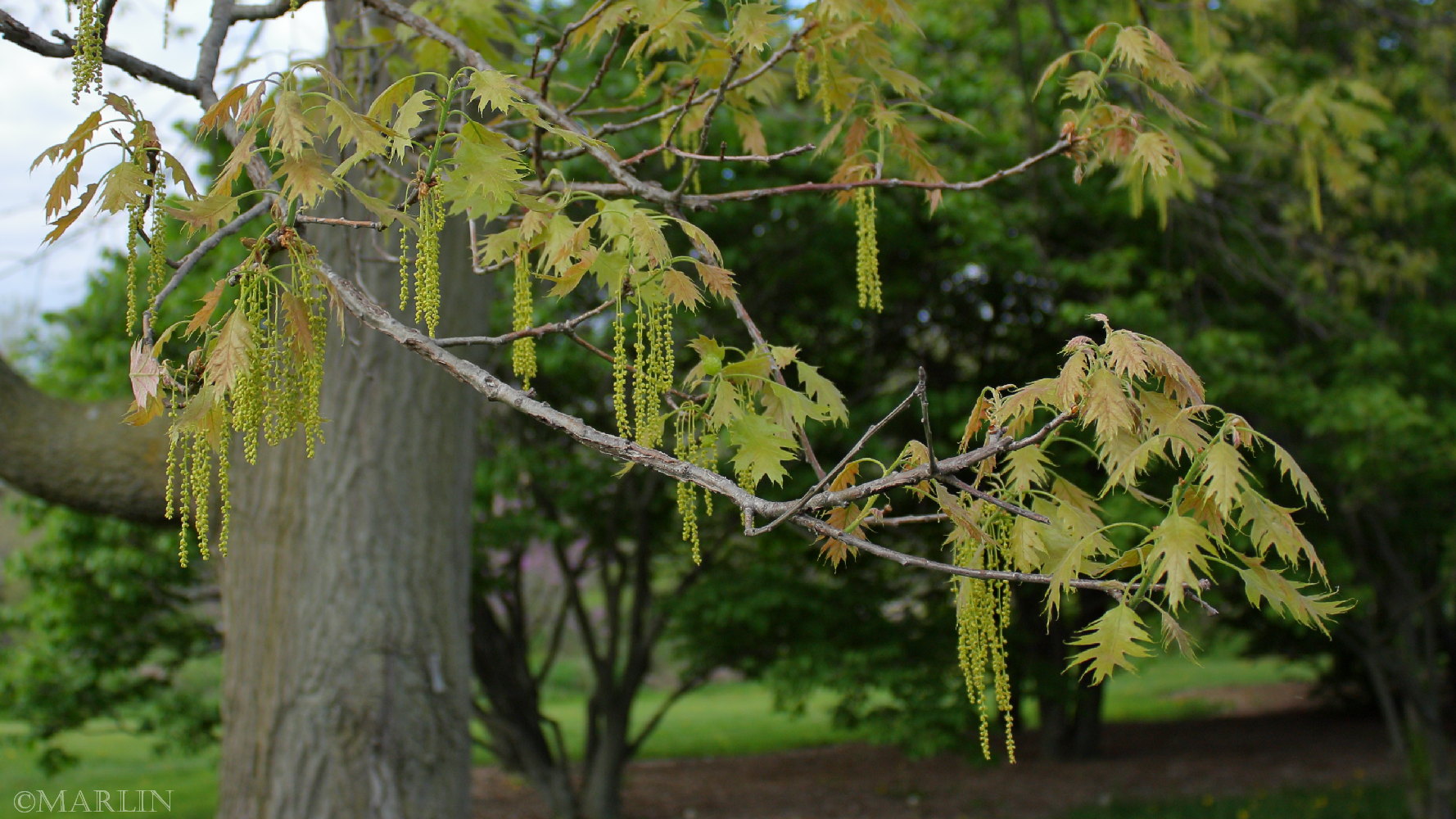
  Red Oak spring foliage and catkins
Red Oak spring foliage and catkins
There are about four hundred species in the oak genus (Quercus) worldwide. Oak trees are majestic beauties and symbols of strength in many cultures. The oak is the national tree of not only the United States, but of England and Germany as well.

Northern red oak (Quercus rubra), also known as common red oak, eastern red oak, mountain red oak, and gray oak, is widespread in the East and grows on a variety of soils and topography, often forming pure stands. Moderate to fast growing, this tree is one of the more important lumber species of red oak and is an easily transplanted, popular shade tree with good form and dense foliage.
Northern red oak is the only native oak extending northeast to Nova Scotia. It grows from Cape Breton Island, Nova Scotia, Prince Edward Island, New Brunswick, and the Gaspé Peninsula of Quebec, to Ontario, in Canada; from Minnesota South to eastern Nebraska and Oklahoma; east to Arkansas, southern Alabama, Georgia, and North Carolina. Outliers are found in Louisiana and Mississippi. [2]

Red Oak Habit
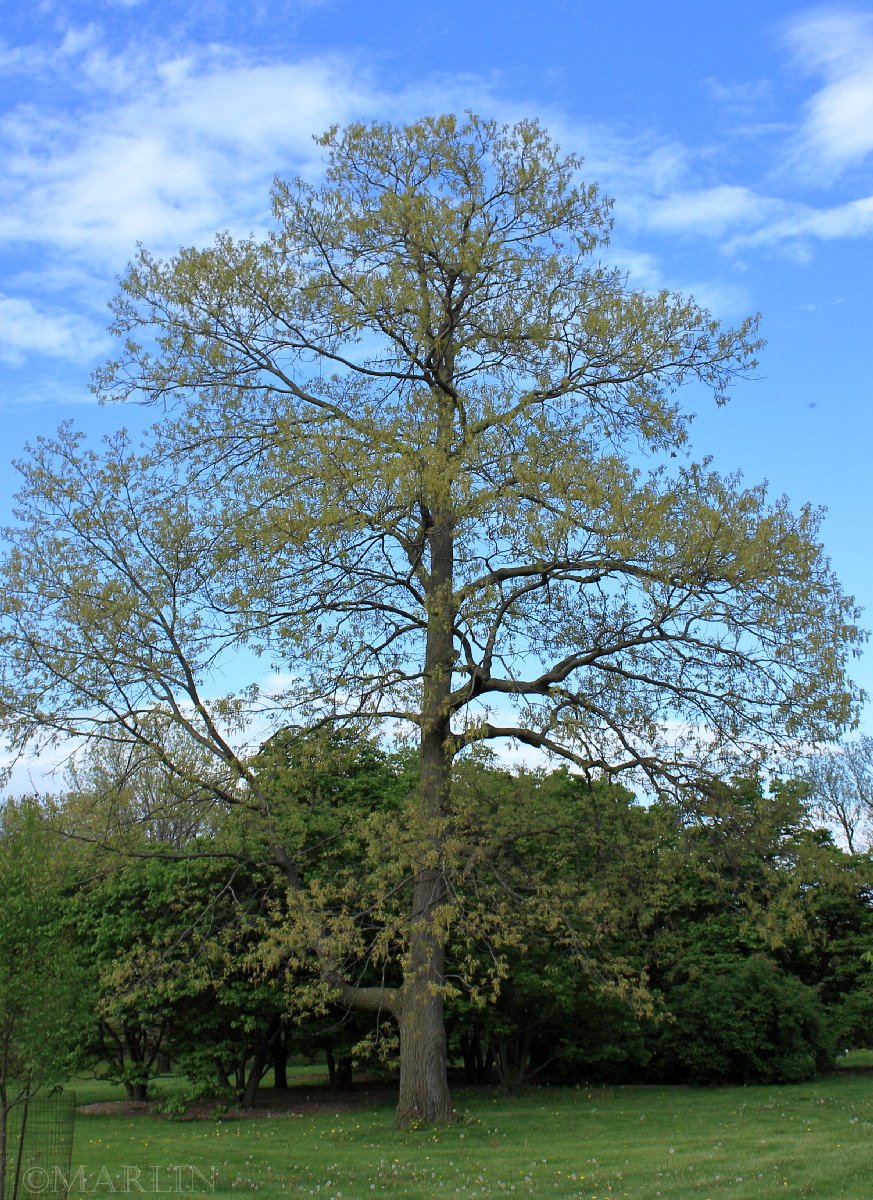
Red Oak at the Morton Arboretum is 69 years old and about 80 feet tall.

Numerous other tree species are associated with northern red oak include white ash (Fraxinus americana) and green ash (F. pennsylvanica); bigtooth aspen (Populus grandidentata) and quaking aspen (P. tremuloides); American elm (Ulmus americana) and slippery elm (U. rubra); pignut hickory (Carya glabra), bitternut hickory (C. cordiformis), mockernut hickory (C. tomentosa), and shagbark hickory (C. ovata); scarlet oak (Quercus coccinea), southern red oak (Q. falcata), post oak (Q. stellata), and chinkapin oak (Q. muehlenbergii); northern white-cedar (Thuja occidentalis); yellow buckeye (Aesculus octandra); cucumber magnolia (Magnolia acuminata); hackberry (Celtis occidentalis); butternut (Juglans cinerea); black walnut (J. nigra); blackgum (Nyssa sylvatica); and sweetgum (Liquidambar styraciflua). [2]

Red Oak Bark

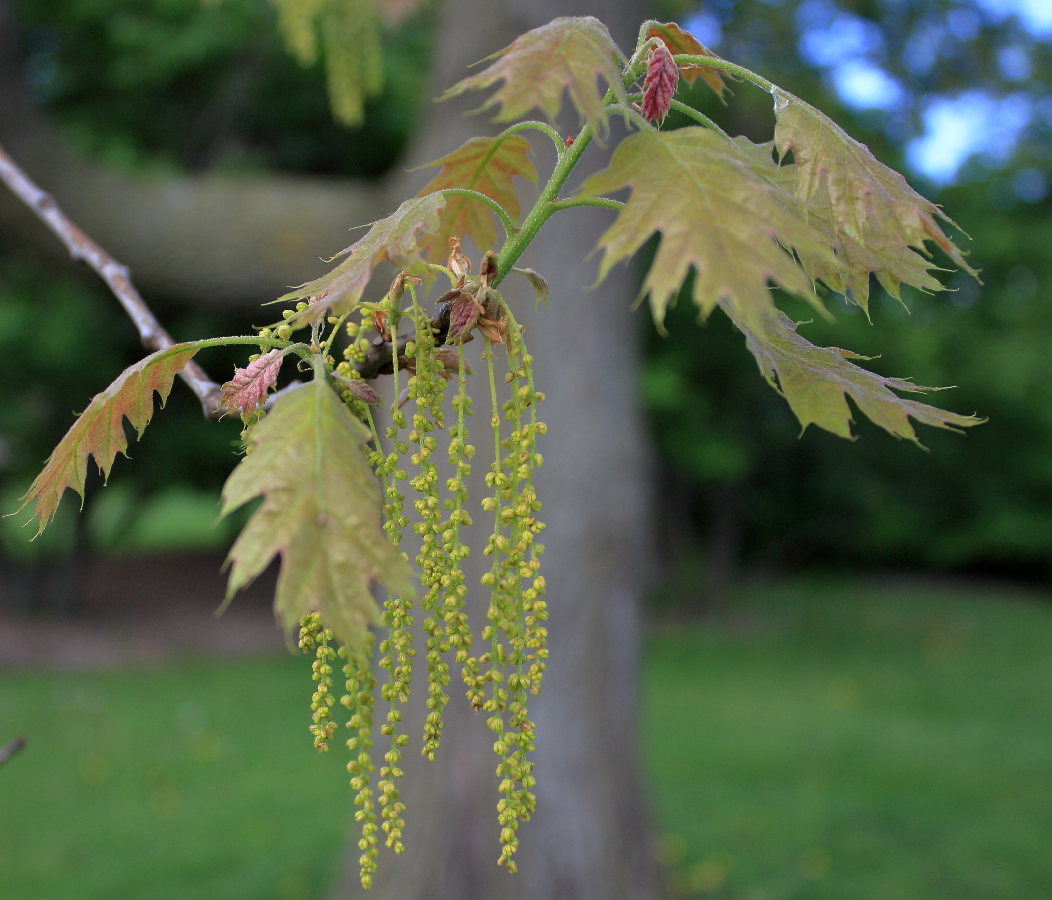
Flowering and Fruiting- Northern red oak is monoecious. The staminate flowers are borne in catkins that develop from leaf axils of the previous year and emerge before or at the same time as the current leaves in April or May. The pistillate flowers are solitary or occur in two- to many-flowered spikes that develop in the axils of the current year's leaves. The fruit is an acorn or nut that occurs singly or in clusters of from two to five, is partially enclosed by a scaly cup, and matures in 2 years. Northern red oak acorns are brown when mature and ripen from late August to late October, depending on geographic location.

Seed Production and Dissemination- In forest stands northern red oak begins to bear fruit at about age 25 but usually does not produce seeds abundantly until about age 50. Good to excellent seed crops are produced at irregular intervals, usually every 2 to 5 years.

Acorn production is highly variable among trees even in good seed years. Some trees are always poor producers while others are always good producers. Crown size seems to be the most important tree characteristic affecting acorn production. Dominant or codominant trees with large, uncrowded crowns produce more acorns than trees with small, restricted crowns.

Even in good years only about I percent of the acorns become available for regenerating northern red oak, and as many as 500 or more acorns may be required to produce one 1-year-old seedling. Many acorns are consumed by insects, squirrels, small rodents, deer, and turkey and other birds. They can eat or damage more than 80 percent of the acorn crop in most years and virtually 100 percent of the crop in very poor seed years (19,24,28). The large acorns are generally dispersed over only short distances. Gravity and the caching activities of squirrels and mice are the primary means of dispersal. [2]


An oak "hedgehog" gall on a white oak leaf. This growth is induced by a small cynipid gall wasp whose larva develops inside.

Damaging Agents- Wildfires seriously damage northern red oak by killing the cambial tissue at the base of trees, thus creating an entry point for decay-causing fungi. Wildfires can be severe enough to top kill even pole- and sawtimber-size trees. Many of the top-killed trees sprout and thus create new evenaged stands, but the economic loss of the old stand may be great. Small northern red oak seedlings may be killed by prescribed fires, but larger stems will sprout and survive, even if their tops are killed.

Oak wilt (Ceratocystis fagacearum) is a potentially serious vascular disease of northern red oak and kills trees the same year they are infected. It usually kills individuals or small groups of trees in scattered locations throughout a stand but may affect areas up to several hectares in size. Oak wilt is spread from tree to tree through root grafts and over longer distances by sap-feeding beetles (Nitidulidae) and the small oak bark beetles (Pseudopityophthorus spp.).

Shoestring root rot (Armillaria mellea) attacks and may kill northern red oaks that have been injured or weakened by fire, lightning, drought, insects, or other diseases. Cankers caused by Strumella and Nectria species damage the bole of northern red oak and although trees are seldom killed, the infected trees are generally culls for lumber. Foliage diseases that attack northern red oak but seldom do serious damage are anthracnose (Gnomonia quercina), leaf blister (Taphrina spp.), powdery mildews (Phyllactinia corylea and Microsphaera alni), and eastern gall rust (Cronartium quercuum).

The carpenterworm (Prionoxystus robiniae), Columbian timber beetle (Corythylus columbianus), oak timberworm (Arrhenodes minutus), red oak borer (Enaphalodes rufulus), and the twolined chestnut borer (Agrilus bilineatus) are important insects that attack the bole of northern red oak. These insects tunnel into the wood, seriously degrading products cut from infested trees.

The most destructive defoliating insect attacking northern red oak is the imported gypsy moth (Lymantria dispar). This insect repeatedly defoliates trees and has killed oaks including northern red oak in a wide area in the northeastern United States. Northern red oak can recover from a single defoliation but may be weakened enough for some disease or other insects to attack and kill them. Other defoliators, that attack northern red oak are the variable oakleaf caterpillar (Heterocampa manteo), the orangestriped oakworm (Anisota senatoria), and the browntail moth (Nygmia phaeorrhoea). The Asiatic oak weevil (Cyrtepistomus castaneus) attacks northern red oak seedlings and has the potential to seriously affect seedling growth because the larvae feed on the fine roots while the adults feed on the foliage.

Much damage is done to northern red oak acorns by the nut weevils (Curculio spp.), gall-forming cynipids (Callirhytis spp.), the filbertworm (Melissopus latiferreanus), and the acorn moth (Valentinia glandulella). In years of poor acorn production, these insects can destroy the entire crop. [2]


References
  1. Red Oak, Morton Arboretum accession 656-40*1, photographed May 8, 2009. Photgrapher: Bruce Marlin
  2. Ivan L. Sander, USDA Forest Service Silvics Manual, Northern Red Oak