Pinus resinosa - Red Pine
Pinaceae --
Pine family
Height: to 140' Spread: 40-50' Habit / Form: Upright /  Hardy to USDA Zone 3


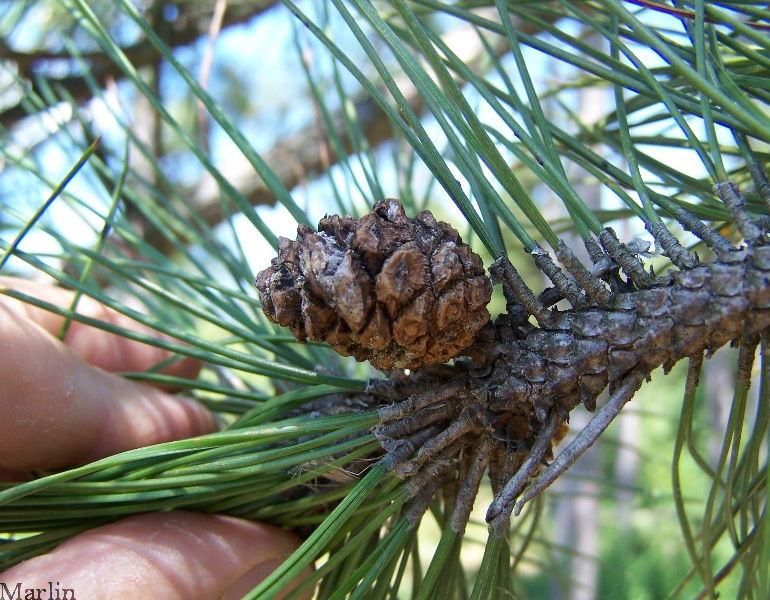
Red Pine Needles and Cone

Red pine, also called Norway pine, is one of the most extensively planted species in the northern United States and Canada. It is a medium-size tree with lightweight, close-grained, pale reddish wood used primarily for timber and pulpwood. Trees 97 cm (38 in) in d.b.h. and 43 m (141 ft) tall in Michigan are among the largest living specimens.
Native Range - Red pine is confined to the Northern Forest region and the southern fringe of the Boreal Forest region. It grows in a narrow zone about 2400 km (1,500 mi) long and 800 km (500 mi) wide around the Great Lakes and the St. Lawrence River, most of it within or closely adjacent to the area glaciated during the late Pleistocene (76). Its range extends from Cape Breton Island, Nova Scotia, Prince Edward Island, New Brunswick, southern Quebec, and Maine, westward to central Ontario and southeastern Manitoba, southward to southeastern Minnesota and eastward to Wisconsin, Michigan, southern Ontario, northern Pennsylvania, northern New Jersey, Connecticut, and Massachusetts. It also grows locally in northern Illinois, eastern West Virginia, and Newfoundland.

Natural stands of red pine are confined largely to sandy soils. They are most common on Entisols followed in order by Spodosols, Alfisols, and Inceptisols. Common materials are glaciofluvial and aeolian in origin, and lacustrine deposits and loamy and finer till soils are less frequently occupied. Red pine commonly grows on dry soils low in fertility, but it is also found on a variety of sites including organic debris over rock outcrops and some structured lacustrine red clays, where it may be somewhat stunted, however. Red pine is rarely found in swamps but is common along swamp borders. It does not grow where the surface soil is alkaline, although it grows on dry, acid soils overlying well drained limestones or calcareous soils. although it can grow well on silt loams, red pine grows only sporadically on heavier soils, probably because of its inability to compete with more aggressive species and because of root injuries known to occur on some such soils. It grows especially well (height growth may be doubled) on naturally sub-irrigated soils with well aerated surface layers and a water table at a depth of 1 to 3 m (4 to 9 ft) in Wisconsin. Best plantation development is made on soils that range from moderately drained to those without substantial moisture stress.


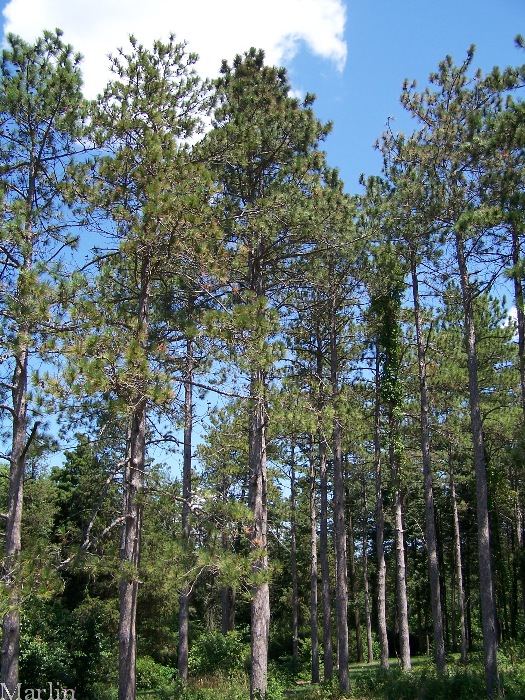
A Stand of Red Pine


Flowering and Fruiting- Red pine is monoecious; the flowers appear between April and June. The female flowers, 2 to 4 mm (0.1 to 0.2 in) long, are borne mostly in the middle third of the crown (in the upper third in older trees), and the purple male flowers, 10 to 20 mm (0.4 to 0.8 in) long, are borne in the lower crown. In Ontario and northern Minnesota, the cone first becomes visible in late May or early June, although the cone primordia are differentiated in June to August of the previous year. Pollination occurs during late May or early June when the cone is about 4 mm. (0.2 in) long. By late summer the cone is 10 to 15 mm (0.4 to 0.6 in) long and stops growing for the season. Insects, weather extremes, and other damaging agents may cause the loss of 60 percent of the cones between the first and second year of their development. The remaining cones begin further growth the next spring, but actual fertilization does not take place until mid-July of the second year (13 months after pollination) when cone growth is completed and the fully developed seed coats have hardened. At that time the cone is 37 to 50 mm (1.5 to 2.0 in) long.

In the absence of fire or other catastrophes, the ecological succession in the Lake States is from jack pine to red pine to white pine and finally to northern hardwoods; the rate of succession is likely to be more rapid on the better sites. On the coarser, more infertile sands, succession apparently stops short of the northern hardwood climax and red pine may be a long persisting subclimax. In much of northern New England and eastern Canada, succession may be to spruce-fir and eastern hemlock. In northeastern Minnesota it may be to spruce-fir alone rather than to northern hardwoods (66,76). Because the crown is not only the source but also the regulating center for all wood growth, silviculturists can manipulate the stand and some features of site to influence both the quantity and quality of wood desired on various parts of the tree bole. They can thin, prune, fertilize, drain excess moisture, and control insects and diseases to this end under specific circumstances (51). Because of its shade intolerance, red pine grows best in even-aged groups or stands and is well adapted to even-aged management. Depending on conditions and management objectives either the shelterwood system or clearcutting followed by planting or seeding may be used. Natural red pine stands in the Lake States commonly are understocked and produce average yields about one-third those produced by well stocked unmanaged stands. Yet even in these understocked stands yields can be increased by about 50 percent with intensive management. For well stocked stands, yields (including intermediate cuts) can be about doubled if managed wisely.

Damaging Agents- although red pine has had fewer serious enemies than most associated species when growing under conditions natural to its native range, nevertheless it is damaged by a number of agents. When grown on less acid, finer textured, and more poorly drained soils and under milder climatic conditions than those to which it is adapted, red pine is subject to damage by additional destructive agents. The following hinder red pine seed germination and early survival: summer drought and high surface soil temperatures; sudden drops in temperature in the early fall, prolonged for about 24 hours, and winter drying of foliage; unidentified insects that consume seedlings shortly after they germinate; competition of subordinate vegetation; post-emergent damping-off (usually caused by fungi of the genera Rhizoctonia, Fusarium, Pythium, and Phytophthora), birds, rodents, flooding, trampling by large animals, and smothering by litter; and large doses of herbicides.

Beyond the early establishment stage red pine may be killed or seriously damaged by many physical and biotic environmental factors. Fire may kill red pines in stands up to 21 m (69 ft) tall. Ice and sleet storms and very strong winds have caused serious breakage and windfall in red pine stands. Spray from de-icing salt (sodium chloride) along well traveled highways has caused red pine mortality and poor growth. Spring flooding for 20 days kills red pine. About 100 insect species are known to feed on red pine, but only a few usually cause mortality or serious injury. Several sawflies (Neodiprion lecontei, N. sertifer, N. abbotii, N. nanalus, N. pratti pratti, N. compar, N. pinetum, Diprion frutetorum, D. similis, Acantholyda erythrocephala, A. pini, and A. zappei) defoliate and often kill seedlings, and some of them damage older trees also. Trees in young stands, especially plantations, may sustain mortality or serious injury from the Saratoga spittlebug (Aphrophora saratogensis), the Zimmerman pine moth (Dioryctria zimmermani), the red pine shoot moth (D. resinosella) or the Allegheny mound ant (Formica exsectoides). The red pine scale (Matsucoccus resinosae), especially in the Northeast, kills or severely injures red pines from seedlings to mature trees. The European pine shoot moth (Rhyaciona buoliana) frequently deforms young red pine. White grubs (such as Phyllophaga rugosa, P. tristis, Diplotaxis sordida, and Serica spp.) cut the roots of the seedlings and often induce mortality in dry years.


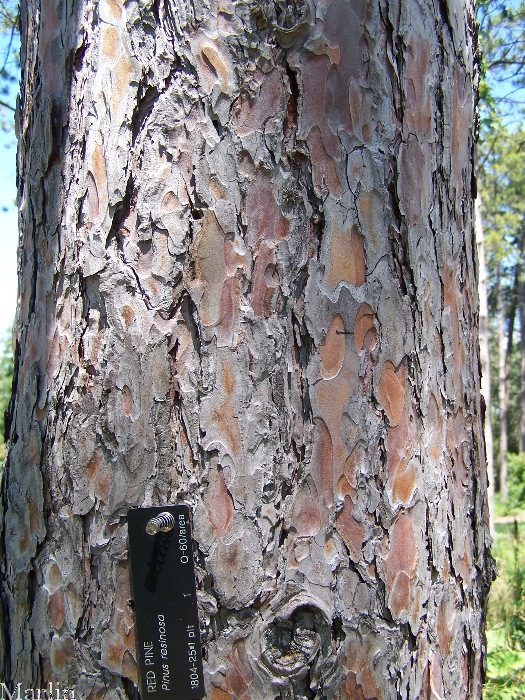
Red Pine Bark

In periods of peak population, the snowshoe hare and the cottontail often kill or reduce height growth of red pine seedlings. When preferred foods are lacking, white-tailed deer browse or destroy red pine seedlings. Porcupines girdle red pines from sapling to mature trees. Red pine has been grown primarily for the production of wood for lumber, piling, poles, cabin logs, railway ties, posts, mine timbers, box boards, pulpwood, and fuel. It has been one of the most extensively planted species in the northern United States and Canada, not only for wood production but also for dune and sandblow control, snowbreaks, windbreaks, and Christmas trees. Even when wood production is the main goal, red pine forests often are managed throughout their rotation for other uses such as recreation, wildlife habitat, and watersheds.

On sandy farmland in the Lake States, narrow strips (usually 3 to 8 rows) of red pine have been planted at intervals to reduce wind caused soil erosion in the fields. Similarly, narrow strips have been planted along roads to control snow drifting and to improve scenic aspects. Red pine has been planted to help control sand dunes near Lake Michigan and also to control "sandblows" that develop when cover is removed from light sandy soils. Such stands should be managed to retain long live crowns and to maintain good vigor without losing essential reduction of wind velocities.

Red pine stands are popular places for hiking, camping, and other recreational activities, especially when the trees are large and located near a lake or stream. Red pine forests used for recreation should be managed to maintain a high proportion of large oldgrowth trees.--USDA Forest Service Fact Sheet


sans