| Juniperus scopulorum is a
perennial, evergreen gymnosperm native to North
America. The species grows as a shrub or tree to
30 feet (10 m) or more and has thin, fibrous
bark that usually shreds with age. In the open,
trees are stubby and broadly pyramidal with
branches to ground level. In shaded areas, the
trunk is less tapered and foliage arranges in
"weeping sprays". Leaves are scalelike and
0.03-0.11 inch (1-3 mm) long or needlelike and
0.11-0.47 inch (3-12 mm) long.

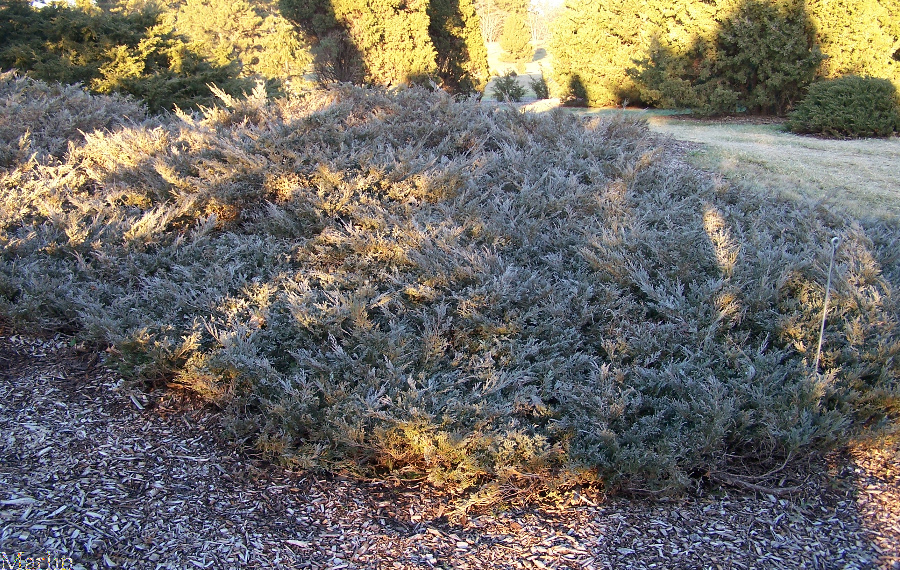
White's Silver King Juniper grows to 50 cm tall and about 2 meters in
diameter, densely spreading filiform
branchlets, in silvery-blue foliage.
(1)
Juniperus scopulorum juniper prefers calcareous and
somewhat alkaline soils and grows best on moist,
deep soils. It survives extremes of temperature
well. Rocky Mountain juniper is considered hardy
except for "burning" of foliage on trees exposed
to northwest winds during winter in the northern
Great Plains. It can tolerate shade when young,
but becomes intolerant later in life. It is more
drought tolerant than eastern redcedar and less
so than other tree junipers in the west. In
fact, during the 1930s drought, Rocky Mountain
juniper woodland maintained and expanded range
in the western Dakotas.
Juniperus scopulorum grows throughout the
drier mountains and foothills of British
Columbia and Alberta; south through the Great
Basin and Rocky Mountains to Arizona, New
Mexico, and western Texas; and north across
eastern Colorado, western Nebraska and North
Dakota, Montana, and into Saskatchewan. It is
also found on Vancouver and other Puget Sound
islands, as well as the surrounding mainland.
Juniperus scopulorum is found over most of the
range of pinyon (Pinus spp.)-juniper (Juniperus
spp.) woodlands. It is a major tree species in
the higher elevations of pinyon-juniper
woodlands in Colorado, northern New Mexico, and
Arizona, and locally in Nevada and Utah. In
pinyon-juniper woodlands, it is found in
association with other juniper species such as
alligator juniper, oneseed juniper, and Utah
juniper, as well as Colorado pinyon (Pinus
edulis), Mexican pinyon (P. cembroides), and
singleleaf pinyon (P. monophylla).
Rocky Mountain juniper communities in the
northern Great Plains are often restricted to
steep, north-facing slopes. Individuals may be
scattered across other areas in mountains and
canyons throughout the Rocky Mountain region,
such as rocky outcrops, butte tops, draws, and
floodplains [19,49,58,109]. Rocky Mountain
juniper forms open woodland with sagebrush and
grasses, and it is often found mixed with
Douglas-fir (Pseudotsuga menziesii), Gambel oak
(Quercus gambelii), or ponderosa pine (Pinus
ponderosa). It is also found along waterways in
pure stands or as understory in the cottonwood
(Populus spp.)-willow (Salix spp.) habitat type.
It forms pure stands at middle and low
elevations in the northern part of its range.
(2)
|