 |
White Fir -
Abies concolor (Gord. & Glend.) Lindl. ex Hildebr.
Family:
Pinaceae.
Also commonly called concolor fir. |
|
|

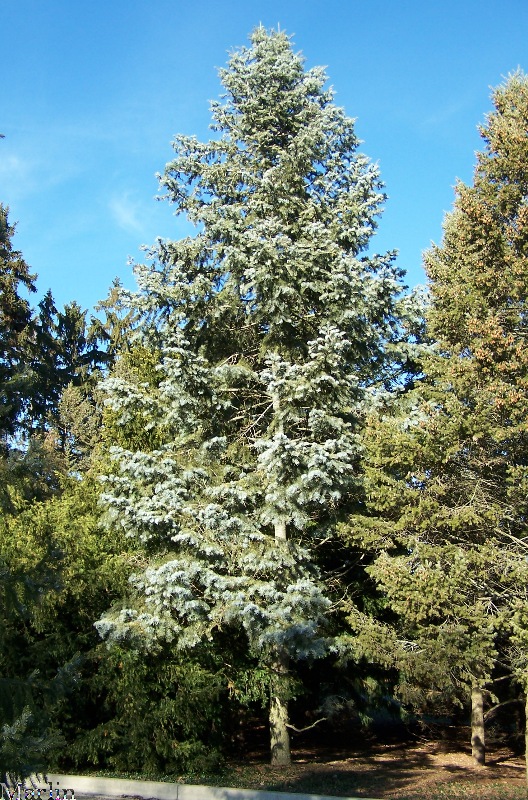
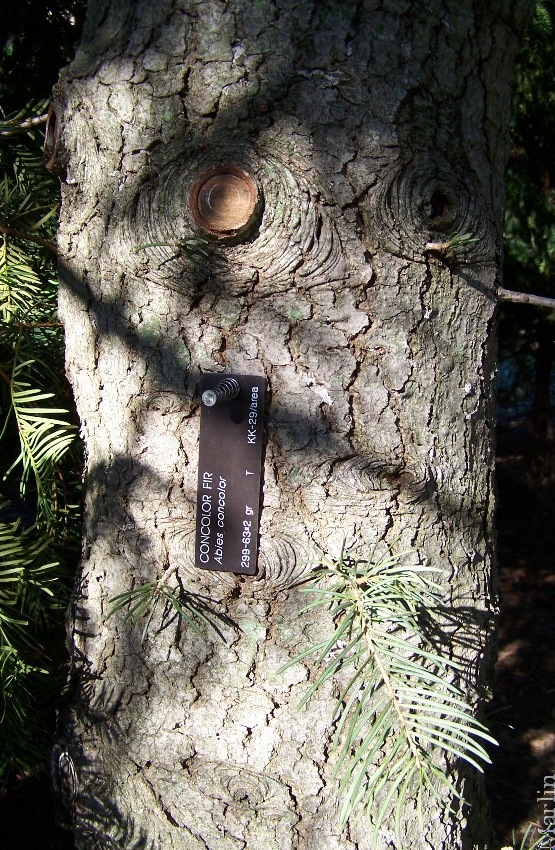
This Concolor fir is a Morton Arboretum specimen. |
|
Long considered undesirable for timber, white
fir (Abies concolor) is finally being recognized as a highly
productive, valuable tree species. White fir reaches its best
development and maximum size in the central Sierra Nevada of
California, where the record specimen is 58.5 m (192 ft) tall
and measures 271 cm (106.6 in) in d.b.h. Large but not
exceptional specimens, on good sites, range from 40 to 55 m (131
to 180 ft) tall and from 99 to 165 cm (39 to 65 in) in d.b.h. in
California and southwestern Oregon and to 41 m (134 ft) tall and
124 cm (49 in) in d.b.h. in Arizona and New Mexico.
Needle form and terpene content vary sufficiently across the
wide range of the species to warrant definition of two
varieties: the typical var. concolor, white fir, often called
Rocky Mountain white fir, occupies the eastern and southwestern
part of the range; var. lowiana (Gord.) Lemm., California white
fir, grows in the western range.
Rocky Mountain white fir grows on high
mountains, typically with long winters, moderate to heavy
snowpacks, and short growing seasons. California white fir grows
in cold, high elevations and in warm-to-hot low elevations.
Throughout its natural range, white fir grows on a variety of
soils developed from almost every kind of parent material. These
materials include recent volcanic and igneous rocks of nearly
all compositions, large areas of intrusives (mostly granites),
and various metamorphics, including serpentine. Sedimentary
materials range from limestone, sandstone, and shale to
unconsolidated Pleistocene lake deposits.
|
- Conifer, evergreen, 30-50 ft (9-15 m), conical and
branched to base, upper branches tend to point upward
whereas lower branches are horizontal or directed
down. Leaves curve outwards and upwards on branches,
3.8-6.5 long and 2 mm wide, flattened, glaucous on both
sides and more or less bluish green (concolor:
uniform color, refers to both needle surfaces) Cones are
stalked and 8-13 cm long, pale green with a purplish bloom,
finally brown.
- Sun. Best in deep, rich, moist, well-drained soil, poor
on heavy clay. Withstands heat, drought, and cold. A good
fir for the east and midwest.
- Hardy to USDA Zone 3 Native to Colorado, southern
Oregon to southern California and Mexico.
White fir is generally tolerant of a wide range of soil
conditions, nutrient availability, and pH values. It seems to be
more dependent on moisture availability and temperature than on
soil series. In at least one area of summer-dry Mediterranean
climate, productive stands of white fir may utilize water
obtained from shattered or otherwise porous bedrock well below
the maximum soil depth. California white fir is moderately
sensitive to excess soil moisture and invades high-elevation
meadows by growing near older lodgepole pine, taking advantage
of relatively dry ground created by the pine roots. A similar
pattern of meadow invasion can develop where radiational heat
loss on clear, cold nights is significant. In these situations,
the frost-sensitive fir is protected by the pine foliage.
At low elevations California white fir is an aggressive,
tolerant species that appears to have been held in check by
frequent natural fires. Extensive fire control efforts, however,
have reduced fire frequency. As a result, white fir is becoming
a major stand component in California at elevations and on sites
where originally it was minor. Dense fir regeneration
beneath older stands of less tolerant trees is common and
threatens a major change in species composition. In many places,
especially with giant sequoia, such changes are undesirable, and
control measures, including reintroduction of fire, are
necessary. |
|

Flowering and
Fruiting- White fir is monoecious
(that is, both male and female cones
are present on each tree).
The reddish male strobili (cones)
are generally less than 1.6 cm (0.6
in) long and are densely grouped on
the underside of 1-year-old twigs
about midcrown. Female cones are
borne erect on 1-year-old branches,
usually in the uppermost crown
although both male and female cones
are occasionally found on the same
branch. California white fir flowers
in May or June and fertilization
occurs shortly thereafter. Flowering
of Rocky Mountain white fir at the
higher elevations may be delayed and
extend into July. Female cones reach
full size, 7.5 to 13 cm (3 to 5 in)
long, in late summer and turn from
greenish or purplish to brown when
mature. Cone specific gravity is
about 0.85 when mature. The seed
matures in September, up to 3 weeks
before seedfall.
Damaging Agents- White fir saplings
and poles are susceptible to fire
damage or kill, but trees become
more resistant to both with age and
size. White fir is considered more
fire resistant than its associated
species at high elevations, but less
resistant than its associates at low
elevations. Fire scars, commonly
found in old-growth stands, provide
an entry court for a variety of
disease and decay organisms.
White fir is sensitive to spring and
fall frosts. Spring frosts can kill
developing buds as well as foliage.
Damage to established trees, other
than Christmas trees, is not usually
significant. On some sites, repeated
damage to new fir growth can give a
competitive advantage to more
resistant species. Cold damage to
mature trees takes the form of frost
cracks and ring shake. Frost cracks
are associated with some rot and
decay loss.
Sudden rises in temperature during
May and early June can cause damage
nearly identical to that of spring
frosts. Sun-scalding following
thinning is rare in mature trees,
although young, thin-barked trees
are susceptible. When white fir
boles are injured, recovery is slow.
Compared to its associated species,
white fir is moderately susceptible
to ozone damage. although fir grows
faster than associated species in
southern California, diameter growth
is affected by oxidant damage as
much as that of Ponderosa pine.
White fir is more resistant to
fluoride damage than Douglas-fir or
ponderosa pine.
As intensive management of this
productive species increases, so
will the importance of mechanical
injury. Studies in Oregon and
California have shown that
conventional logging techniques for
thinning or partial cutting damaged
22 to 50 percent of the residual
stand. Seventy-five percent of these
wounds were at ground level, where
infection by some decay-causing
fungus is almost certain.
Two parasitic plants,
white fir mistletoe (Phoradendron
bolleanum subsp. pauciflorum), a true
mistletoe, and white fir dwarf mistletoe
(Arceuthobium abietinum f. sp.
concoloris), cause major damage to white
fir. In Arizona, Mexico, and the central
to southern Sierra Nevada of California,
white fir mistletoe is a serious problem
on large old trees. Heavy infections
cause spike tops, loss of vigor, and
increased susceptibility to bark beetle
attack. Dwarf mistletoe is a major
problem from the southern Sierra Nevada
north into Oregon. It is found elsewhere
throughout the native range of white fir
in coastal and southern California,
Nevada, and Arizona.
One-third of the white fir stands in
California are severely infested by
dwarf mistletoe and the parasite is
present in other forest types that
contain white fir. Heavily infected
trees suffer significant growth losses
and are prone to attack by Cytospora
abietis, a fungus that kills branches
and further reduces growth. Because of
reduced vigor, infected trees are more
susceptible to bark beetle attack and
various diseases. Heart rots, entering
through open mistletoe stem cankers,
increase mortality of old-growth trees
through stem breakage.
Changes in wood structure in the large
stem bulges caused by dwarf mistletoe
infections reduce the strength of lumber
produced. Current lumber grading
practices, however, are not adequate to
identify the affected wood.
Dwarf mistletoe need not be a problem in
young managed stands because three
factors make damage subject to
silvicultural control. The parasite is
host specific: white fir can be infected
only by A. abietinum f. sp. concoloris,
which in turn can parasitize only one
other fir, grand fir. Small trees (less
than 1 m [3.3 ft] tall) are essentially
free from infection even in infested
stands. Infected young firs free from
new overstory infection outgrow the
spread of mistletoe if height growth is
at least 0.3 m (1 ft) per year. |
|

|
|
Annosus root
rot (Heterobasidion annosum) is
present in all conifer stands
and may become a major disease
problem as management of white
fir increases. Once established,
the disease affects trees within
a slowly expanding, circular
infection center. Spread from
tree to tree is through root
contacts. New infection centers
begin by aerial spread of spores
and infection of basal wounds
and freshly cut stumps. In true
fir, annosus root rot usually
does not kill directly but
produces considerable moisture
stress and loss of vigor that
predispose the tree to attack by
bark beetles, notably Scolytus.
Direct damage resulting from
infection is restricted
primarily to heart rot of butt
and major roots, leading to
windthrow and stem breakage.
Some degree of control is
available through silvicultural
means and use of borax on
freshly cut stumps.
Other rots of major significance
include the yellow cap fungus
(Pholiota limonella), Indian
paint fungus (Echindontium
tinctorium), and white pocket
rot (Phellinus pini). Yellow cap
fungus causes heavy losses from
butt rot and enters through fire
scars and basal wounds. Indian
paint fungus is a major heart
rot organism. This fungus
probably infects fir in the same
manner it does western hemlock.
Entry is through branchlets less
than 2 mm (0.08 in) in diameter.
The fungus can remain dormant
for up to 50 years before being
activated by injury to the tree.
Rot commonly extends 3 m (11 ft)
below and 6 m (20 ft) above each
characteristic fruiting body
(4). No effective control is
known although trees less than
40 years old are relatively free
of rot because they have so
little heartwood. In the white
fir-grand fir complex of Idaho,
the fungus was found in 97
percent of the trees that had
decay. Almost 80 percent of the
decay in old-growth grand
fir-white fir stands of eastern
Oregon and Washington is caused
by Indian paint fungus; in
California, it is much less
common.
Insects from
seven genera attack white fir
cones and seeds. Two cause
damage with considerable loss of
seed. Seed maggots (Earomyia
spp.) are the most abundant and
damaging. The fir cone looper
(Eupithecia spermaphaga) covers
almost the entire range of white
fir and periodically causes
considerable local damage.
although many insects feed on
white fir foliage, few cause
significant damage as
defoliators. The most
destructive of these is the
Douglas-fir tussock moth (Orgyia
pseudotsugata). Over most of its
range the tussock moth shows
equal preference for true fir
and Douglas-fir foliage.
Epidemic outbreaks, although
sporadic, are explosive and
damaging. In California, white
fir is the preferred host, but
outbreaks have not reached the
severe levels sustained
elsewhere. Occasionally,
localized outbreaks result in
increased stand growth as
mortality of subordinate trees
"thin" an overdense stand.
|
|
|
|
The western spruce budworm (Choristoneura
occidentalis) is the most destructive defoliator in
western North America, causing serious damage in
Canada and the Rocky Mountains and Pacific coast
regions of the United States. Some outbreaks are
short lived, but some continue for 20 years or more.
although initial damage is to new foliage and buds,
trees can be completely defoliated in 4 to 5 years.
Ultimate damage ranges from minor growth loss to
major tree mortality over extensive areas, depending
on severity and duration of the outbreak.
A similar species, the Modoc budworm (Choristoneura
retiniana [= viridis]), is endemic to the Warner
Mountains of northeastern California and
southeastern Oregon. Damage to California white fir
in the Warner Range has been sporadic and light.
The New Mexico fir looper (Galenara consimilis) is
restricted to New Mexico and can be a serious
problem locally on white fir. Weevils of the genus
Agronus attack foliage of young trees and may cause
concern with intensive forest management. Sawflies
(Neodiprion spp.) are generally not a problem-but
are potentially damaging in dense stands of young
fir. In California, a species of Neodiprion sawfly
has reached epidemic levels locally on white fir.
White fir needleminer (Epinotia meritana) covers the
full range of white fir and can cause extensive
branch kill predisposing trees to bark beetle
(Scolytus) attack.
Cutworms (Noctuidae) can be a problem in nurseries
and, more especially, in natural regeneration areas.
Cutworms have been responsible for more than 30
percent of the seedling mortality in California.
The most damaging white fir pest is the fir engraver
beetle (Scolytus ventralis). This bark beetle is
found over the entire range of white fir and causes
serious damage nearly everywhere. Mortality
equivalent to an estimated 2.4 million m³ (430
million fbm) of growing stock is caused each year in
California alone. Losses during epidemics are even
larger. The fir engraver can attack any tree, but
those suffering from root rot infections or tussock
moth attack are especially vulnerable. In general,
anything that reduces tree vigor, such as
mistletoes, Cytospora, drought, or fire, increases
susceptibility to attack. Several other bark
beetles-including one species of Pseudohylesinus and
two species of Scolytus, the roundheaded borer
(Tetropium abietis) and the flatheaded fir borer
(Melanophila drummondi)- frequently join the fir
engraver in attacking and killing individual trees.
In epidemic conditions, however, mortality is
primarily caused by the fir engraver. Maintenance of
stand health and vigor is the only known control. |
|
|

|
Selected varieties:
-
'Blue Cloak' is a
weeping form selected for its blue
foliage. Grows to 30 x 15 feet in 30
years.
-
'Candicans' is
one of the bluest forms;
fast-growing, conical. Grows to 40
feet.
-
'Compacta'
irregularly rounded and
slow-growing. To 2 feet, it is great
for a rock garden or as specimen in
larger planting.
-
'Conica': A
compact, conical dwarf with
steel-blue 1" needles. Leader grows
about 1 foot every two years.
-
'Fagerhult': very
blue, slow-growing ground-hugging
variety.
-
'Masonic Broom':
a flat-topped bush form with blue
needles.
-
'Wintergold':
Green needles turn golden in winter;
fast-growing.
White fir is a
general, all-purpose, construction-grade
wood used extensively for solid
construction framing and plywood. A
significant portion of the Christmas
trees used in California are young white
fir. These trees are harvested from
natural stands, from regeneration areas
where the trees are cultured for as long
as 11 years before harvest, and from
areas used specifically for Christmas
tree production.
Detailed and exact wildlife censuses for
large areas do not exist, and any
listing of species numbers associated
with a major forest type is an
approximation. There are, however, about
123 species of birds found in the white
fir type of California, 50 of which are
associated primarily with mature
forests. Perhaps because of the dense
nature of most true fir forests in
California, there are only 33 species of
mammals commonly present and of these
only 7 are generally associated with
mature forests. Reptiles are represented
by 17 species, mostly at lower
elevations. Only eight are regularly
associated with mature forests. |
References:
1.
United States Forest Service
Silvics Manual Abies concolor
MORE TrEES |
|
|
|